Sep 18, 2026
How Is Liposomal Vitamin C Powder Made? A Step-by-Step Manufacturing Overview
Every batch of EmerWell's liposomal vitamin C powder is the output of a defined sequence of unit operations, not one mixing step. For buyers qualifying an ingredient, the useful question is rarely "what is it" but "how is each stage controlled, and what evidence does the supplier retain". This overview walks the process operation by operation, pairing each stage with its process concern, the record entries it should generate, and the deviation that appears when control slips.
The Unit Operations at a Glance
Encapsulation efficiency and particle-size distribution are cumulative outcomes: a broad distribution introduced at hydration cannot be fully corrected downstream, and payload lost during drying cannot be recovered by re-blending.
| Unit operation | Function | Critical control point | Record it generates |
|---|---|---|---|
| Receipt and lipid phase preparation | Confirm identity and a homogeneous lipid phase | COA against the approved specification; dispersion temperature | Lot numbers, COA sign-off, weighing reconciliation |
| Hydration (thin-film or ethanol injection) | Form bilayers around the ascorbate-bearing aqueous phase | Hydration temperature relative to the lipid phase transition | Hydration volume, temperature profile, residual-solvent data |
| Size reduction (homogenization or extrusion) | Narrow the distribution and reduce lamellarity | Pressure and pass count; product temperature rise | Pressure setting, pass count, in-process particle size |
| Loading and encapsulation | Retain the largest possible fraction of ascorbate | Active-to-lipid ratio; hold time before drying | In-process assay and encapsulation-efficiency result |
| Drying (spray or freeze drying) | Convert the dispersion into a shelf-stable powder | Inlet and outlet temperature, or shelf and vacuum profile | Cycle record, residual-moisture result, yield |
| Screening, blending and packaging | Deliver a free-flowing, uniform, protected powder | Screen integrity; moisture and oxygen exposure at packing | Screen check, blend uniformity, nitrogen-flush record |
Step 1 — Raw Material Receipt and Phospholipid Phase Preparation
Batches seldom fail in the reactor; drift more often starts at weighing, where an out-of-specification lot or an overstated lipid content propagates through every later stage.
What to Confirm at Receipt
| Material | Function in the system | Attributes to confirm |
|---|---|---|
| Ascorbic acid | Payload in the aqueous compartment | Assay, appearance, loss on drying, heavy metals |
| Phospholipid (non-GMO lecithin grades) | Builds the bilayer shell | Phosphatidylcholine content, peroxide value, residual solvents |
| Purified water | Hydration and dispersion medium | Conductivity, total organic carbon, microbial limits |
| Carrier or bulking solids | Support the dried matrix and redispersion | Particle size, moisture, compatibility with the active |
Building the Lipid Phase
Phospholipid is dispersed or dissolved above the transition temperature of the chosen lipid, because a partially hydrated lipid phase forms films and lumps that survive homogenization as a second particle population. Lipid left on the vessel wall or in the transfer line is lipid that will not form bilayers, so weighing reconciliation matters here more than in most blending operations.
Step 2 — Hydration: Thin-Film Hydration or Ethanol Injection
Both routes produce the same intermediate — vesicles suspended in an aqueous ascorbate phase — so the choice is normally a plant decision about solvent handling and throughput, not a product decision. How the dry and liquid routes differ at plant level is discussed in how dry and liquid manufacturing routes differ.
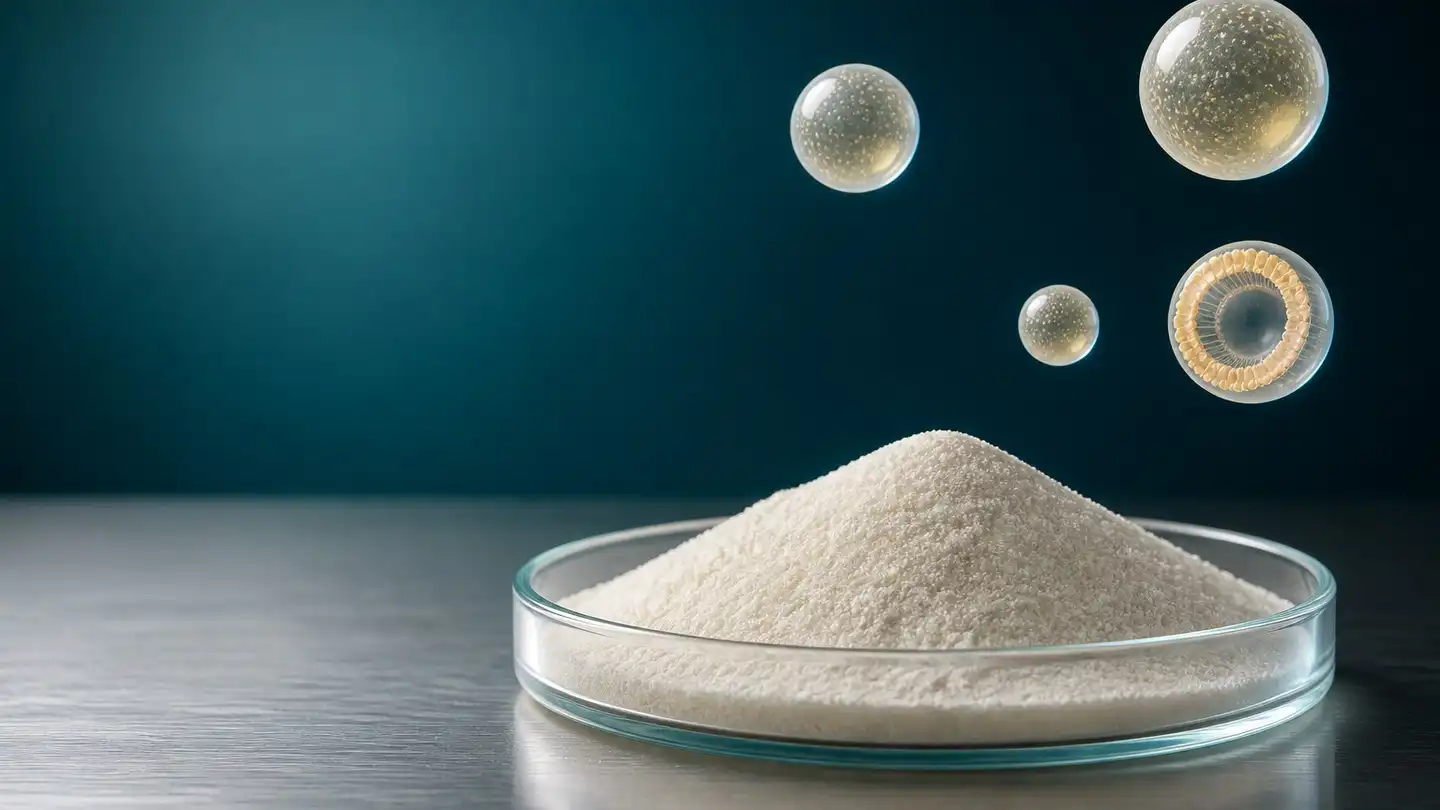
Thin-Film Hydration
Lipid is dissolved in an organic solvent, evaporated to a film on the vessel wall, then hydrated with an aqueous ascorbate phase above the lipid transition temperature, with agitation supplying the energy for bilayer curvature [1]. Control points are film uniformity, hydration temperature, agitation intensity and hydration time. The characteristic deviation is incomplete hydration: part of the film never lifts, leaving a bimodal distribution instead of a single population.
Ethanol Injection
Here the lipid stays in solution and is injected into the aqueous phase, where vesicles assemble as the solvent disperses. Injection rate, mixing intensity, temperature and solvent removal matter, and residual-ethanol data belongs in the batch file. A drift in injection rate is easy to miss because the dispersion still looks uniform; it surfaces later as a coarser distribution. The bilayer behaviour behind these systems is covered in the science behind the delivery system.
Hydration Records
- Solvent or medium lot, grade and volume; lipid weight and hydration volume.
- Temperature profile with timestamps; agitation rate and duration.
- Appearance at the end of hydration; residual-solvent data for the injection route.
Step 3 — Size Reduction: High-Pressure Homogenization and Extrusion
Hydration leaves large, multilayer vesicles with a wide distribution and a low captured volume. Size reduction narrows the distribution, reduces lamellarity and sets the usable payload. It is also the step with the narrowest window, since the energy that reorganises bilayers will, past a point, disrupt them.
High-Pressure Homogenization
The dispersion is forced through a narrow gap, and shear, cavitation and particle impact reduce vesicle diameter [2]. Pressure, pass count and product temperature rise are the parameters to hold; heat is often the limiting factor, not the pressure itself. Over-processing is the deceptive deviation: particle size may look excellent while encapsulation efficiency drops as payload leaks from disrupted bilayers. Dispersion samples are diluted for dynamic light scattering at defined points rather than only at the end, and the analytical families used at release are described in the quality tests applied to liposomal vitamin C powder.
Extrusion
Membrane extrusion through defined-pore filters remains a useful reference method and a bridge between bench and production sizing. Pore size, pass count, temperature relative to the lipid transition and membrane integrity all matter. Clogging raises driving pressure, sizes the batch unevenly and risks membrane rupture; an unlogged pressure spike is a deviation nobody can reconstruct.
Step 4 — Loading and Encapsulation Efficiency
Loading is not always a separate vessel, but it is always a separate objective: keeping ascorbate inside the bilayer once the vesicles have been sized.
Passive Entrapment Versus Gradient Loading
With passive entrapment the ascorbate sits in the hydration medium and only the enclosed volume is captured, so efficiency tracks the captured volume of the population. Gradient loading drives a weak acid across the bilayer after vesicle formation and is standard practice for some actives; ascorbic acid processes generally rely on passive entrapment plus a lipid-to-active ratio that favours retention, which is why that ratio is held as a critical parameter.
How Encapsulation Efficiency Is Measured
The free fraction is separated from the encapsulated fraction — by centrifugal ultrafiltration, dialysis or size-exclusion separation — and both are assayed so the ratio can be calculated. EmerWell's product page lists a typical encapsulation efficiency of 85–95%; the batch-specific figure sits on the certificate of analysis. The informative pair is the result before and after drying: a fall across the dryer points to leakage, a low value from the start points back to loading.
Step 5 — Drying: Spray Drying or Freeze Drying
Drying immobilises the vesicles and yields a powder that can be weighed, blended and stored. The route is selected on feed solids, heat sensitivity and the equipment validated on site; either way it is controlled against two threats, oxidative loss of the active and physical damage to the bilayers.
Spray Drying
The feed is atomised into a heated gas stream and water evaporates within seconds. Feed solids, inlet and outlet temperature, atomiser settings and feed rate determine particle structure, and where oxidation is a concern the drying gas becomes a control point. Post-processing studies report that spray drying can improve the handling and storage stability of lipid-based systems, while wall deposition and thermal exposure stay the practical limits [3].
Freeze Drying
In lyophilisation the dispersion is frozen and the ice removed under vacuum. Freezing rate and annealing determine ice morphology and the mechanical stress the vesicles experience; a lyoprotectant protects the bilayer through the phase change, and secondary drying sets the residual moisture that governs stability [4]. Typical deviations are cake collapse, meltback when shelf temperature exceeds the collapse temperature, and a size increase on reconstitution from vesicle fusion.
What the Cycle Record Should Show
- Freezing rate and final freezing temperature, or atomiser and gas conditions for spray drying.
- Shelf temperature and vacuum profile through primary and secondary drying, with timestamps.
- Residual moisture, yield and mass balance, including material retained on the chamber wall.
Step 6 — Milling, Screening and Packaging
These final operations look minor and are routinely under-documented, yet they decide whether the batch arrives as a free-flowing powder or as a caked solid.
Screening and Blend Uniformity
Dried powder is delumped and screened to the target mesh before blending, and screen integrity is checked at the start and end of the run: a torn screen risks both poor uniformity and foreign matter. Blend uniformity is shown by sampling across the blender, not from a single point.
Moisture and Oxygen Barriers
Ascorbate is sensitive to moisture and oxygen, so packaging is part of the process rather than an afterthought. The barrier system on the product page — nitrogen flushing with multilayer aluminium foil packaging — holds headspace oxygen and moisture out in storage and transport. Dispersibility and sedimentation are the release attributes that show how well it worked, and the factors that influence the solubility of liposomal vitamin C powder covers how those measurements are read.
Where Batches Usually Deviate
Deviations cluster around a few recurring symptoms. Knowing which unit operation each symptom points to shortens the investigation.
| Observed at release | Traced to | Likely causes | Batch action |
|---|---|---|---|
| Wide or bimodal particle-size distribution | Hydration or size reduction | Incomplete hydration, insufficient pass count, lipid below its transition temperature | Hold the batch; review hydration temperature and pass count before re-processing |
| Encapsulation efficiency below specification | Loading or drying | Ratio off target, excessive homogenization energy, feed temperature too high | Quarantine and handle as a process deviation, not an analytical error |
| Darkening toward deep yellow or brown | Drying or packaging | Oxidative exposure in the dryer, incomplete nitrogen blanket | Check headspace oxygen and residual moisture against the appearance specification |
What a Batch Record Should Contain
The documentation set turns a sequence of steps into a reproducible process. A record that supports a technical review carries:
- Material lot numbers, COA sign-offs and weighing reconciliation.
- In-process results at each control point, including particle size and assay.
- Drying cycle records, residual moisture and finished-goods results against the specification.
- A deviation section with the investigation and the disposition of the batch.
Buyers comparing suppliers can use the same list as an audit checklist; wider expectations for documentation and premises are summarised in the manufacturing standards for quality liposomal vitamin C powder.
Requesting Samples, COA and Process Documentation
Buyers evaluating this ingredient normally want three things before committing a formulation: the specification sheet, a certificate of analysis from a representative lot, and a sample to run through their own process. EmerWell supplies all three for its liposomal vitamin C powder, and the technical team can discuss which concentration suits a capsule, gummy, stick pack or ready-to-mix beverage project, and which clean-label options apply to the grade quoted. Send your format, process constraints and documentation requirements to info@emerwell-bio.com to start the technical file and sample request.
References
- Lombardo D, Kiselev MA. Methods of Liposomes Preparation: Formation and Control Factors of Versatile Nanocarriers for Biomedical and Nanomedicine Application. Pharmaceutics, 2022;14(3):543. https://pmc.ncbi.nlm.nih.gov/articles/PMC8955843/
- Tang Y, et al. Preparation of VC nanoliposomes by high pressure homogenization: process optimization and evaluation of efficacy, transdermal absorption, and stability. Heliyon, 2024;10(8):e29516. https://pmc.ncbi.nlm.nih.gov/articles/PMC11066132/
- Yu JY, Chuesiang P, Shin GH, Park HJ. Post-Processing Techniques for the Improvement of Liposome Stability. Pharmaceutics, 2021;13(7):1023. https://pmc.ncbi.nlm.nih.gov/articles/PMC8309137/
- Franzé S, Selmin F, Samaritani E, Minghetti P, Cilurzo F. Lyophilization of Liposomal Formulations: Still Necessary, Still Challenging. Pharmaceutics, 2018;10(3):139. https://pmc.ncbi.nlm.nih.gov/articles/PMC6161153/
- U.S. Electronic Code of Federal Regulations. 21 CFR Part 111 — Current Good Manufacturing Practice in Manufacturing, Packaging, Labeling, or Holding Operations for Dietary Supplements. https://www.ecfr.gov/current/title-21/chapter-I/subchapter-B/part-111
This article is written for formulators and ingredient buyers. It describes ingredient and process characteristics only, is not medical or dietary advice, and should not be read as a claim about the effect of any finished product.
Online Message
YOU MAY LIKE
High quality furniture manufacturer
_1776234307158.webp)