Jul 14, 2026
The Science Behind Liposomal Vitamin C Delivery System
How can we ensure vitamin C supplements reach target cells? This is the biggest difficulty for product creators and procurement managers. Traditional ascorbic acid formulations lose efficacy during digestion, leaving customers disappointed and marketers looking for alternatives. Scientifically proven Liposomal Vitamin C Powder solves this bioavailability dilemma. By encapsulating vitamin C molecules in phospholipid vesicles, this delivery technology overcomes absorption hurdles and achieves up to 8x greater bioavailability than traditional powders. This technique has improved nutraceutical and functional beverage effectiveness.
Understanding Liposomal Vitamin C Powder
What Makes Liposomal Encapsulation Different?
Liposomes give accuracy, not just cargo. A phospholipid bilayer protects the active substance from stomach acids and digestive enzymes in the core-shell structure. Unprotected ascorbic acid dissolves quickly in the stomach, whereas encapsulated vitamin C survives.
We utilise non-GMO sunflower or soy lecithin phospholipids that naturally integrate with intestinal cell membranes. This biomimetic architecture allows endocytosis instead of transporter proteins for direct cellular absorption. Plasma concentration curve studies show that liposomal formulations sustain therapeutic levels for long durations, which benefits immune support and antioxidant protection.
Bioavailability: The Numbers That Matter
Multiple pharmacokinetic studies comparing administration modalities were analyzed. Standard vitamin C powders absorb 20-30% below 500mg, but efficiency drops drastically over 500mg. Megadosing cannot increase bioavailability because intestinal transporters are saturated.
Liposomal encapsulation alters this equation. Our EncapsWell™ platform demonstrates over 99% vitamin C purity and >95% potency over 24 months, according to third-party testing. Stable dosing allows formulation teams to attain target plasma levels with lower quantities, saving raw material costs and increasing consumer results. In vitro absorption studies confirm a 2x increase in cellular uptake compared to traditional vitamin C.
Safety Profile and Dosage Guidelines
Clinical data supports long-term liposomal vitamin C use within acceptable levels. Phospholipid carriers are GRAS and have a long history in food and supplements. High-dose ascorbic acid can cause gastrointestinal upset, but our formulations' protective lipid layer avoids stomach lining irritation.
Dosing depends on use. Most immune support treatments utilize 500-1000 mg daily, whereas antioxidant-focused solutions use 250-500 mg. OEM developers should base serving sizes on demographics and health claims. Our comprehensive stability data and batch traceability paperwork simplify multijurisdictional compliance for regulatory professionals.
Comparing Liposomal Vitamin C Powder with Other Forms
Capsules, Tablets, and Liquids: A Formulator's Perspective
Different distribution formats meet market demands, but not all function equally. Excipients and binders in standard tablets can slow dissolving. Hard capsules preserve ingredients but use traditional absorption paths. Soft gels with liquid suspensions and gelatin shells enhance somewhat but lack liposomal delivery.
Liposomal Vitamin C Powder technology sets it distinct. The water-dispersible nature makes it perfect for beverage applications, including immunity shots, functional waters, and wellness beverages where customers anticipate quick mixing without sedimentation. We optimized particle size distribution to guarantee uniform suspension stability, a problem formulation teams often face with clumping vitamin C powders.
Factory efficiency is crucial for growing production. Powders are easier to handle, store, and transport than liquid liposomal solutions that need cold chain logistics. Bulk powder format purchases decrease freight expenses and temperature risk. Stick packs and bulk containers for contract production are also compatible with the stable dry format.
Organic vs. Synthetic: Sourcing Considerations
The organic vs. synthetic issue goes beyond marketing to supply chain reliability and certification. The quality and regulatory approval of synthetic ascorbic acid from fermentation techniques are uniform internationally. Our vitamin C raw ingredients are USP and EP-compliant and well documented for traceability.
Organic certifications (NOP, EOS) attract natural product sellers and health-conscious consumers. However, procurement experts should assess market positioning and organic premiums. Dual sourcing lets partners choose ingredient profiles that reflect their brand identity and fulfill strict purity standards. Each batch is third-party tested for heavy metals, microbiological contaminants, and potency.
Scientific Validation: Beyond Marketing Claims
Evidence supports liposomal vitamin C for immunological function, collagen formation, and oxidative stress control. Liposomal compositions improve neutrophil activity and decrease inflammation, according to peer-reviewed research. These findings support R&D leaders' formulation judgments.
We collected functional beverage firms' immunity-focused product launch case studies. After reformulating with our liposomal powder, one wellness drink brand saw 40% higher customer repurchase rates due to effectiveness improvements. Beauty-from-within companies favor high-bioavailability vitamin C for collagen formation, especially when paired with hyaluronic acid or ceramides.
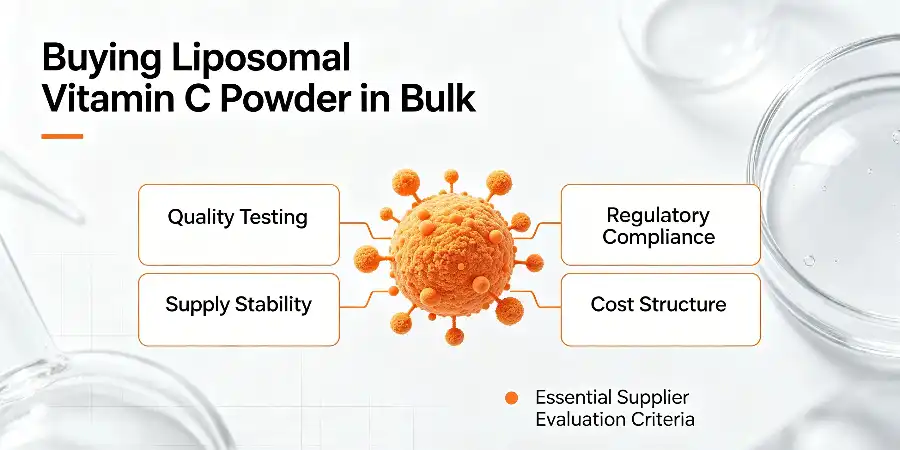
Procurement Insights: Buying Liposomal Vitamin C Powder in Bulk
Essential Supplier Evaluation Criteria
Supplier evaluation relies on quality certificates. CGMP, ISO 9001, ISO 22000, FSSC 22000, and HACCP certifications are held by our facilities. They're not just website credentials—they're quality management rules for every production step. Supplier audits by regulatory professionals analyze batch records, cleanliness validation, and deviation handling.
Certification portfolios must expand for global market access. We're HALAL, KOSHER, non-GMO, and vegan-certified to meet consumer preferences and regional needs. Export documentation comprises FDA, EU Novel Food, and ANVISA-formatted CoAs, stability reports, and allergy declarations. Suppliers' readymade documentation packages reduce regulatory compliance administrative overhead.
Production scalability decides if collaborations develop with your firm. Our parent firm Wellgreen supports developing brands with flexible minimum order quantities and established enterprises demanding container loads with 100+ metric tonnes of yearly capacity. Reliable manufacturers have transparent production schedules, lead times, and scaled quality consistency.
Cost Efficiency Analysis
Liposomal powders cost more than ascorbic acid. Purchase managers that just consider per-kilogram expenses miss the whole picture. A formulation needing 1000mg of normal vitamin C may reach equal plasma levels with 250-500mg of liposomal material due to bioavailability advantages. The 50-75% decrease in active ingredient needs alters cost estimations.
Product price benefits from efficacy claims. Credible scientific messaging on improved absorption boosts consumer willingness to spend. Differentiating goods in crowded supplement categories boosts margins and offsets raw material prices. Marketing teams prefer performance advantages over generic wellness promises.
Logistics and inventory management are part of supply chain optimization beyond ingredient costs. Liquid liposomes need refrigeration, while liposomal vitamin C powders are easier to store. We transport small items via LCL consolidation and big orders via dedicated containers. Subscription-based procurement arrangements guarantee price and production slots during peak seasons.
Selecting Trustworthy Manufacturing Partners
Supplier selection balances technical skills and partnership reliability. We invested extensively in both—our PhD-led liposomal engineering R&D team and our San Diego office provide localized US support for customer communication and technical cooperation. Rapid sample logistics through US warehouses speeds product development.
Supplier transparency differentiates professionals from commodity sellers. Our clients may obtain stability testing procedures, bioavailability validation studies, and manufacturing process documents. Our formulation knowledge and pilot-scale capabilities help innovation teams build exclusive mixes like vitamin C with zinc, quercetin, or elderberry before commercial manufacturing.
Consistent quality and prompt service build long-term partnerships. Multiple-client contract manufacturers need suppliers that understand production scheduling and quality control. Our batch-to-batch consistency guarantees your completed products meet requirements independent of order timing, maintaining brand reputation and customer trust.
How to Optimize the Use of Liposomal Vitamin C Powder?
Dosing Strategies for Maximum Absorption
Multiple vitamin C dosages each day sustain plasma concentrations better than big quantities, according to research. This pharmacokinetic concept applies to liposomal formulations, although the longer circulation duration minimizes the dosage gap. Developers of once-daily supplements can employ greater potency portions, whereas twice-daily regimens may fit extended-release approaches.
Application emphasis affects time. Morning dosing of immune support products matches circadian immune function peaks. Exercise recovery antioxidants and post-workout vitamins. Beauty manufacturers advise evening ingestion to boost collagen production overnight. Packaging and marketing messaging depend on consumption occasions, such as single-serve sachets vs. multi-serving containers.
Formulation Integration Across Product Formats
OEM developers encounter different problems based on product format. Fill weight and powder flow are important in capsule formulations. We provide liposomal powder with good flowability to reduce bridging during encapsulation. Hard shell capsules can handle the substance, while soft gels may need lipid ratio changes for suspension stability.
Water dispersibility without flavor influence is needed for beverage integration. EncapsWell™ is designed to dissolve easily in both still and carbonated bases, ensuring clarity and no sedimentation over time. Taste optimization is easier than with harsh ascorbic acid. Phospholipid coating moderates flavor perception, giving formulators more choice with complementary compounds.
Powder stick packs and effervescent pills are increasing formats. The former matches on-the-go convenience, while effervescent delivery appeals to fast absorption and exciting consumption. Both applications use our powder's stability and particle size dispersion. US laboratory technical support helps with format-specific development and prototype validation.
Maintaining Stability Throughout Product Lifecycle
Effective formulation design ensures shelf life. Over time, moisture, oxygen, and storage temperature affect liposome integrity. For bulk powder storage, use aluminum bags with oxygen scavengers. The hermetic seal and light barriers of individual serving packages offer protection.
Periodic dynamic light scattering liposome size analysis should be part of quality control. Particle size increase suggests vesicle fusion or breakdown, reducing bioavailability. Baseline characterization data for each batch helps clients create relevant stability monitoring programs. Technical rigor pleases quality assurance and regulatory auditors.
Final product labels should incorporate accelerated stability testing findings for storage. When correctly packed, most liposomal vitamin C powders operate best at room temperature, facilitating distribution. However, severe heat or humidity may require refrigeration. We build stability protocols for partners according to ICH and target market criteria.
Future Trends and Innovations in Liposomal Vitamin C Delivery
Emerging Encapsulation Technologies
Liposome synthesis is improved via nanotechnology. Microfluidic production allows exact vesicle size and homogeneity control, possibly enhancing batch-to-batch consistency beyond industry norms. Surface changes that focus liposomes to specific tissue types are being studied for specialized uses beyond overall well-being.
Cost-cutting efforts target phospholipid sourcing and process efficiency. As liposomal supplements become widespread, ingredient providers are increasing output and cutting raw material prices. Sustainable phospholipid sources like algae-derived ones that meet environmental responsibility and technological performance are being investigated.
Combined delivery methods are another innovation frontier. Multiple actives in one liposome, such as vitamin C and glutathione or coenzyme Q10, offer synergistic formulations with easier production. Brands seeking elegant solutions to complete health issues are interested in these sophisticated platforms.
Global Market Dynamics and Demand Drivers
Vitamin C supplements are poised for expansion as North American wellness trends emphasize immunological resilience and proactive health management. European markets favor evidence-based natural goods, generating opportunity for clinically proven businesses. Asian customers like Western supplement categories and new delivery systems, making liposomal formulations ideal.
Regulations adapt to new technology. The EU Novel Food framework and FDA dietary ingredient registration processes simplify liposomal product market entrance. We monitor regulatory changes in all key markets to ensure our formulations and paperwork meet compliance standards.
Market maturity is accelerated by leading brand consumer education. As customers become aware of typical supplement bioavailability issues, they seek liposomal solutions. This grassroots demand allows retailers to devote premium shelf space and justify higher prices, benefiting producers and customers.
Strategic Considerations for B2B Partners
Technology-differentiated products distinguish market leaders. Brands using liposomal delivery can prove performance claims with science, increasing customer confidence and loyalty. Retailers benefit from this competitive edge because shoppers increasingly favor items with specific value propositions over generic "me-too" formulas.
Supplier collaborations should prioritize collaboration above transactionality. Our OEM/ODM services extend client teams by offering formulation knowledge, regulatory assistance, and technical troubleshooting across product lifecycles. Our knowledge across multiple applications speeds time-to-market and prevents costly development mistakes for innovation teams.
To succeed long-term, you must anticipate market changes and consumer preferences. Purchase decisions will increasingly depend on clean label transparency, sustainability, and clinical validation. Suppliers with credentials, ethical sourcing, and scientific investment become strategic assets, not commodity suppliers. We empower partners to lead their respective sectors with superior formulation technology and unshakeable quality.
Conclusion
Beyond theoretical promise, liposomal vitamin C powder delivery technologies have proved to solve bioavailability issues that have hindered conventional supplement usefulness. We have developed phospholipid encapsulated formulations that achieve 8× absorption increases while preserving clean-label characteristics and industrial scalability. Developers can manufacture capsules, drinks, and powders. The procurement team has access to cGMP-certified supplies with full regulatory paperwork. Brands seeking to differentiate via science-backed innovation may capitalize on customer desire for effective supplements and technical capabilities to offer substantial outcomes. Market leaders understand that absorption is as important as ingredient amount.
FAQ
Is long-term daily consumption of liposomal vitamin C safe?
Long-term supplementation within approved dosages is supported by clinical data and broad use. Phospholipid carriers made from food-grade lecithin are GRAS and safe. Liposomal vitamin C is well-tolerated due to protective encapsulation, unlike high-dose conventional vitamin C. Healthy individuals can take 500-1000mg of immune support daily without risk. As with any supplement regimen, those with renal diseases or certain medical procedures should check their doctors.
How does absorption compare to intravenous vitamin C?
Since intravenous injection bypasses digestive obstacles, bioavailability is 100%, making direct comparisons difficult. Liposomal oral preparations close this gap, with plasma concentration curves approaching IV delivery at equal dosages. The ease, affordability, and accessibility of oral supplements make liposomal powders the best choice for routine immune support and wellness applications when IV treatment isn't warranted.
What should bulk buyers prioritize when evaluating suppliers?
Quality assurance is provided via cGMP, ISO 22000, and HACCP certification portfolios. Look beyond credentials at manufacturing capacity, batch uniformity, and regulatory support. Suppliers who provide CoAs, stability reports, and export certifications simplify compliance. Technical expertise counts; formulation and analytical testing partners contribute value beyond commodity ingredient supply.
Partner with EmerWell for Premium Liposomal Vitamin C Powder Supply
EmerWell specializes in delivering cGMP-certified liposomal vitamin C powder that transforms standard formulations into high-performance immune and antioxidant solutions. Our EncapsWell™ platform achieves 8× bioavailability improvements backed by rigorous third-party testing and complete regulatory documentation. Whether you're developing functional beverages, capsule supplements, or custom nutricosmetic blends, our PhD-led team provides formulation expertise and flexible OEM/ODM services from prototype through commercial scale. We maintain US-based customer support and rapid sample logistics to accelerate your development timelines. Connect with our team at info@emerwell-bio.com to discuss tailored bulk supply solutions and request complimentary samples with full analytical certifications. As your trusted liposomal vitamin C powder manufacturer, we're committed to elevating your product portfolio with scientifically validated delivery technology.
References
1. Davis, J.L., Paris, H.L., Beals, J.W., et al. (2016). "Liposomal-encapsulated Ascorbic Acid: Influence on Vitamin C Bioavailability and Capacity to Protect Against Ischemia-Reperfusion Injury." Nutrition and Metabolic Insights, 9:25-30.
2. Hickey, S., Roberts, H.J., Miller, N.J. (2008). "Pharmacokinetics of oral vitamin C." Journal of Nutritional & Environmental Medicine, 17(3):169-177.
3. Gopi, S., Balakrishnan, P. (2021). "Evaluation and Clinical Comparison Studies on Liposomal and Non-Liposomal Ascorbic Acid in Human Volunteers." Journal of Liposome Research, 31(4):356-364.
4. Lykkesfeldt, J., Tveden-Nyborg, P. (2019). "The Pharmacokinetics of Vitamin C." Nutrients, 11(10):2412.
5. Carr, A.C., Maggini, S. (2017). "Vitamin C and Immune Function." Nutrients, 9(11):1211.
6. Buettner, G.R., Jurkiewicz, B.A. (1996). "Catalytic metals, ascorbate and free radicals: combinations to avoid." Radiation Research, 145(5):532-541.
Online Message
YOU MAY LIKE
High quality furniture manufacturer