

Sep 24, 2026
Does Liposomal Vitamin C Powder Work Better for Immune Support?
Ask whether a liposomal vitamin C powder works better for an immune-support position and two different rooms will give you two different answers. The laboratory answers with assay values, encapsulation efficiency and particle size distribution. The regulator answers with a question of its own: which claim category are you making, and where will that wording appear? For brand owners, private-label teams and procurement managers, the second answer governs the first. The practical task is to buy a liposomal vitamin C powder from EmerWell against criteria that are measurable and documentable, and to keep the claim language inside the line your destination market draws.
Why “Does It Work Better?” Is the Wrong Question for a Brand Owner
A supplier can document composition, processing and consistency, not what your customer’s body will do; no certificate of analysis carries that burden. When a marketing brief asks for an efficacy angle, the useful translation is a list of measurable ingredient attributes: what the material is, how well the active is encapsulated, how it behaves in water, how uniform it is between lots, and how complete the file is.
Where the claim legally lives
A claim lives on the finished label and in your advertising, in your market, under your brand. Review therefore starts with the destination market, not with the ingredient. Two brands buying the same powder can face completely different constraints, because one sells where claim wording must be pre-approved and the other where substantiation sits with the brand.
What an ingredient file can and cannot support
An ingredient file supports identity, purity, composition, process control and traceability. It does not support statements about body function, and it should never be presented as though it did. Buyers who ask a supplier to “back the claim” are asking for something no technical document can lawfully provide; what they can ask for is a file strong enough that their own review is straightforward. Teams that screen suppliers on certification scope before anything else tend to find that conversation easier, and a practical starting point is this checklist of what to look for in liposomal vitamin C powder certifications.
The Claim Categories Buyers Have to Separate
Before any draft sentence survives review, sort it into a category. The categories answer to different regulators, carry different evidence expectations and create very different downstream work.
| Claim category | How it is typically handled | What an ingredient file can contribute |
|---|---|---|
| Statement about normal body function (United States) | Permitted on dietary supplement labels without pre-market approval if the statement is truthful, not misleading and substantiated by the brand that uses it, with the required disclaimer wording | Composition, assay, encapsulation and process data; it supports the ingredient, not the statement |
| Health claim (European Union) | Only wording from the authorised list may be used; the EU Register is the first document a reviewer opens | The same technical data; authorisation is a product-level matter, not an ingredient attribute |
| Formulation and quality positioning (any market) | Usually the least restricted route, because it describes the material, the process and the format | Direct support: specification ranges, certificates, dispersibility data, clean-label statements |
| Comparative or outcome wording | Highest-risk category; restricted or prohibited in many markets | None; no ingredient document can carry it |
Structure and function statements in the United States
A dietary supplement label may describe the role of a nutrient or ingredient in affecting the normal structure or function of the body. That route needs no pre-market approval, but the statement must be truthful, not misleading, substantiated by the firm that makes it, and notified to the Food and Drug Administration no later than 30 days after first marketing. The label must also carry the standard disclaimer required for such statements. Copy that wording verbatim from the current regulatory text rather than paraphrasing it; the notification rule is set out in 21 CFR 101.93, linked under References.
Authorised claims in the European Union
In the European Union the logic reverses. Only health claims that appear on the authorised list may be used, and the wording must stay within the authorised formulation. Regulation (EC) No 1924/2006 establishes that framework, and the EU Register is the reference document. A phrase that reads as harmless promotional language in one market can be an unauthorised claim in another, so product copy rarely travels unchanged.
Markets that pre-approve wording
Some markets, China among them, tie permitted functional wording to product categories that must be registered or filed before the wording is considered at all. The sourcing consequence is the same everywhere: the specification you buy does not change, but the volume of documentation your regulatory colleague requests does.
Five Verifiable Metrics That Replace an Efficacy Promise
These are attributes a brand can write into a purchase specification today, check on a certificate of analysis, and repeat on a technical sheet without entering body-function territory. The assay menu behind them is summarised in which quality tests are used on liposomal vitamin C powder.
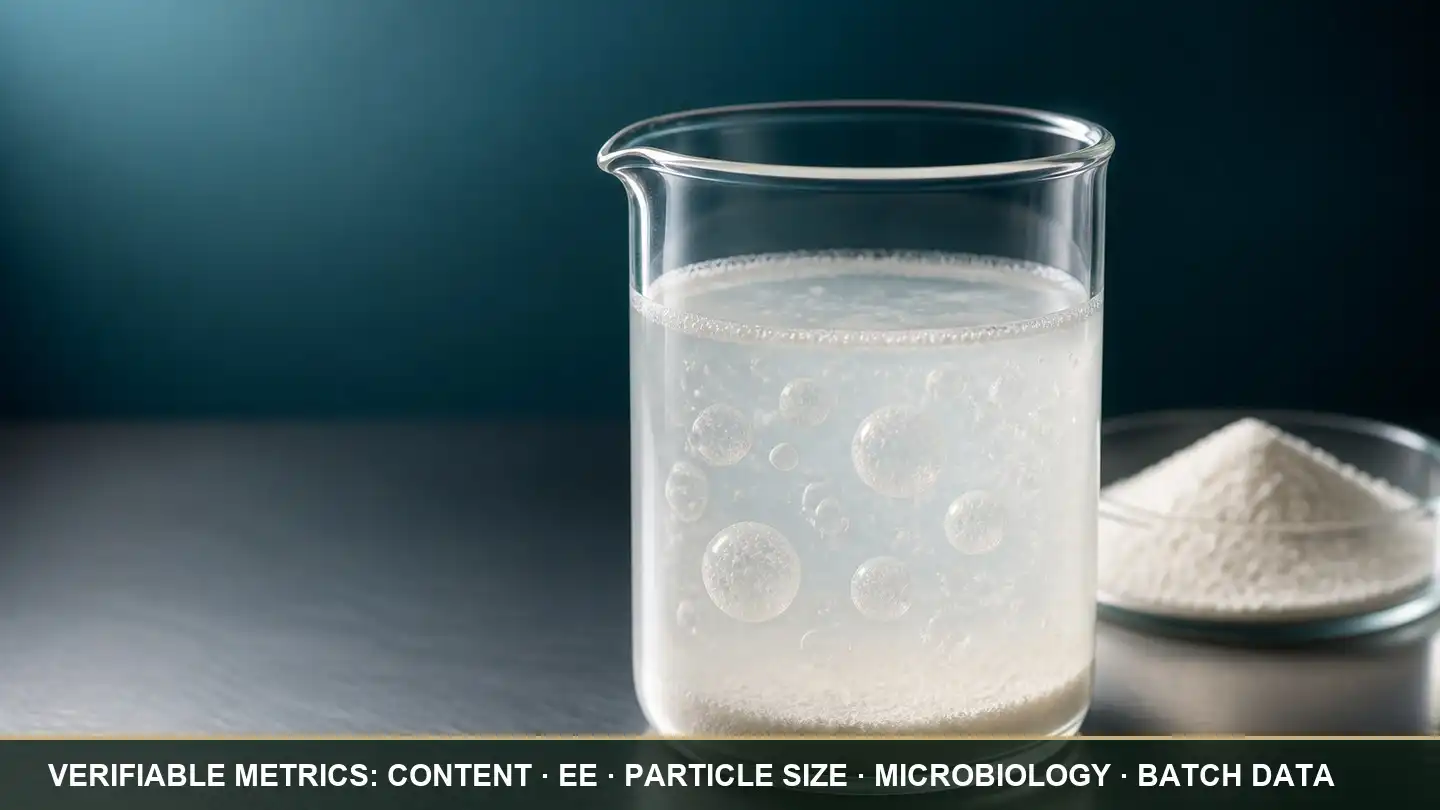
Content and assay
Ascorbic acid content is normally confirmed by HPLC. Ask for the specification range and the lot value side by side, plus a method summary, so your quality team can judge the data rather than accept a single flattering number.
Encapsulation efficiency
Encapsulation efficiency describes how much of the active sits inside the phospholipid structure rather than remaining free in the powder. The EmerWell specification for this material states a typical range of 85% to 95%. Read it as a process-control parameter: request the lot value, the method outline and the calculation basis.
Particle size distribution
DLS returns a distribution, not a headline figure. A specification that reads “uniform” is a starting point; the document worth filing is the distribution plot with percentile values, ideally supported by a microscopy check. Distribution data speaks to process control and batch uniformity, and to nothing beyond that.
Microbiological limits and heavy metals
Plate count and lead limits belong on the certificate of analysis with the method named. For this material EmerWell lists total plate count below 1,000 cfu/g and lead below 0.5 ppm.
Batch-to-batch consistency
Consistency is the attribute a formulator feels first. Ask for the last several lot results in a single table so the spread is visible instead of one favourable example. The manufacturing controls behind those results are described in the manufacturing standards behind quality liposomal vitamin C powder.
| Parameter | Typical method | What to request | What it does not establish |
|---|---|---|---|
| Ascorbic acid content | HPLC | Specification range plus actual lot value | Any effect in the body |
| Encapsulation efficiency | Supplier’s validated method | Lot value and calculation basis | Whether the figure becomes a permissible label claim |
| Particle size distribution | DLS with TEM support | Distribution plot with percentiles | Uptake, delivery or any outcome |
| Dispersibility | Cold-water dispersion test | Time to a uniform suspension, plus notes on separation | Behaviour in your specific finished matrix |
| Microbiological limits and lead | Plate count; elemental analysis | Limit values named on the COA | That your finished product is sterile |
| Batch data | Retention samples across lots | Trend table covering several lots | Shelf life of the finished product |
| Document set | COA, technical data sheet, method summaries | One complete package per lot | Market clearance for your label |
Writing the Label Without Crossing the Boundary
The safest label language describes the material and the process, because those statements can be checked. Formulation-side wording that survives review usually sounds like this:
- Contains encapsulated ascorbic acid at the declared concentration
- Cold-water dispersible; reconstitutes without visible separation
- Manufactured under cGMP conditions; certificate of analysis provided per lot
- Clean-label options: gluten-free, non-GMO, vegan-friendly and soy-free
- Neutral taste profile suitable for ready-to-mix formats
What has no place on the label or in the copy is any statement about what the nutrient will do in the body, any reference to a disease or symptom, and any comparison with an administered clinical preparation.
Stability and Storage Data You Can Actually Defend
Stability is where a supplier file earns its keep: retention over a defined period at defined conditions is what lets your team set a shelf life. Read the specification closely: the EmerWell page for this material describes resistance to light and heat with a lower degradation rate over shelf life, and a solubility profile that holds without layer separation. Where numbers matter to your dossier, ask for the study design and the interim results. Handling guidance for the incoming powder — moisture, packaging, temperature excursions — is set out in how liposomal vitamin C powder should be stored to maintain its quality, and the variables that move a real shelf-life figure are covered in what factors affect the shelf life of liposomal vitamin C powder.
What a Supplier Technical File Should Contain
A specification alone is not a file. A file is the package your quality and regulatory teams can work from without returning to the supplier for every detail.
| Document | What it should state | Why it matters |
|---|---|---|
| Certificate of analysis, per lot | Lot number, assay, encapsulation efficiency, lead, total plate count, methods used | Links every delivered bag to measured values |
| Technical data sheet | Specification ranges, solubility, particle size, storage guidance | Basis for formulation decisions |
| Method summaries | Instrument, standard and acceptance criteria for HPLC, DLS, TEM and iodometric titration | Lets your QA assess data quality independently |
| Certificates and scope | cGMP, ISO 9001:2015, ISO 22000, Kosher and Halal, with issuing body and scope wording | Supports audits and market-access paperwork |
| Storage and retest guidance | Recommended conditions and retest interval | Input for your own stability protocol |
| Clean-label and allergen statements | Gluten-free, non-GMO, vegan-friendly and soy-free options | Determines which label copy you can print |
Six Questions Worth Sending Before You Request a Sample
- Which method is used for the assay, and what acceptance range applies on the specification?
- What encapsulation efficiency did the last three lots return, and how is that figure calculated?
- Can you provide a particle size distribution plot rather than a single descriptor?
- Which bodies issued the cGMP, ISO 22000, Kosher and Halal documents, and what scope do they cover?
- What storage conditions and retest interval do you recommend for the delivered packaging format?
- Which clean-label and allergen statements apply to this material, in writing?
Documentation Red Flags
- Certificate values with no lot number and no method reference
- Encapsulation efficiency quoted as one impressive figure, with no range and no calculation basis
- Stability described only as a comparison with an unspecified material
- Certificates listed without an issuing body or a defined scope
- Particle size summarised only as “nano” or “uniform”, with no distribution data attached
Request the COA, Specification and Sample from EmerWell
If your next step is a technical review rather than a claim discussion, EmerWell can provide the documents that make that review concrete: the specification sheet for liposomal vitamin C powder, a certificate of analysis for the lot you are considering, encapsulation and particle size data, clean-label statements, and a sample for your own bench trial. Send your format, target concentration and destination market to info@emerwell-bio.com and the technical team will reply with the file package rather than a marketing sheet.
References
- U.S. Food and Drug Administration. Structure and Function Claims. https://www.fda.gov/food/nutrition-food-labeling-and-critical-foods/structurefunction-claims
- U.S. Food and Drug Administration. Label Claims for Conventional Foods and Dietary Supplements. https://www.fda.gov/food/food-labeling-nutrition/label-claims-conventional-foods-and-dietary-supplements
- U.S. eCFR. 21 CFR 101.93 — Certain types of statements for dietary supplements. https://www.ecfr.gov/current/title-21/chapter-I/subchapter-B/part-101/subpart-F/section-101.93
- U.S. eCFR. 21 CFR Part 111 — Current Good Manufacturing Practice in Manufacturing, Packaging, Labeling, or Holding Operations for Dietary Supplements. https://www.ecfr.gov/current/title-21/chapter-I/subchapter-B/part-111
- EUR-Lex. Regulation (EC) No 1924/2006 on nutrition and health claims made on foods. https://eur-lex.europa.eu/eli/reg/2006/1924/oj
This article is written from a supplement-ingredient and manufacturing perspective and is not medical or regulatory advice. Ingredient specifications and certification scope are stated as published on the product page; confirm the requirements that apply to your product and destination market with your own regulatory counsel.
Online Message