

Nov 24, 2026
Can Liposomal Resveratrol Powder Help Support Healthy Skin?
Skin is the most crowded shelf in the supplement aisle, and it is also the shelf where claim language is most tightly policed. For a brand building a beauty-from-within line around liposomal resveratrol powder, the practical question is not whether the ingredient is interesting. It is whether the formulation can carry a defensible claim, survive a year on a shelf, and taste acceptable in the format the consumer will actually use. This article works through those three constraints in that order.
What the Question Really Asks a Formulator
"Can it support healthy skin" is a consumer question wrapped around a technical one. The technical version is narrower: does the ingredient disperse uniformly at the intended load, does it remain chemically intact through processing and storage, and does the finished product have evidence behind the specific wording on the label? A supplier can answer the first two with a specification. Only the brand can answer the third, because only the brand knows the matrix, the serving size and the market.
That division of labour matters commercially. Brands that expect an ingredient supplier to hand them a skin claim usually end up with generic wording that no retailer's technical team will defend. Brands that arrive with a defined format and a defined statement get a much more useful conversation, because the supplier can then say precisely which parameters are relevant and which are not.
Where Resveratrol Sits in a Beauty-from-Within Brief
Resveratrol is a stilbene polyphenol. In a powder blend it behaves like a polyphenol first and like an active second, which means its physical and sensory properties often decide whether a formulation succeeds before its chemistry is ever discussed.
Solubility and Dispersion
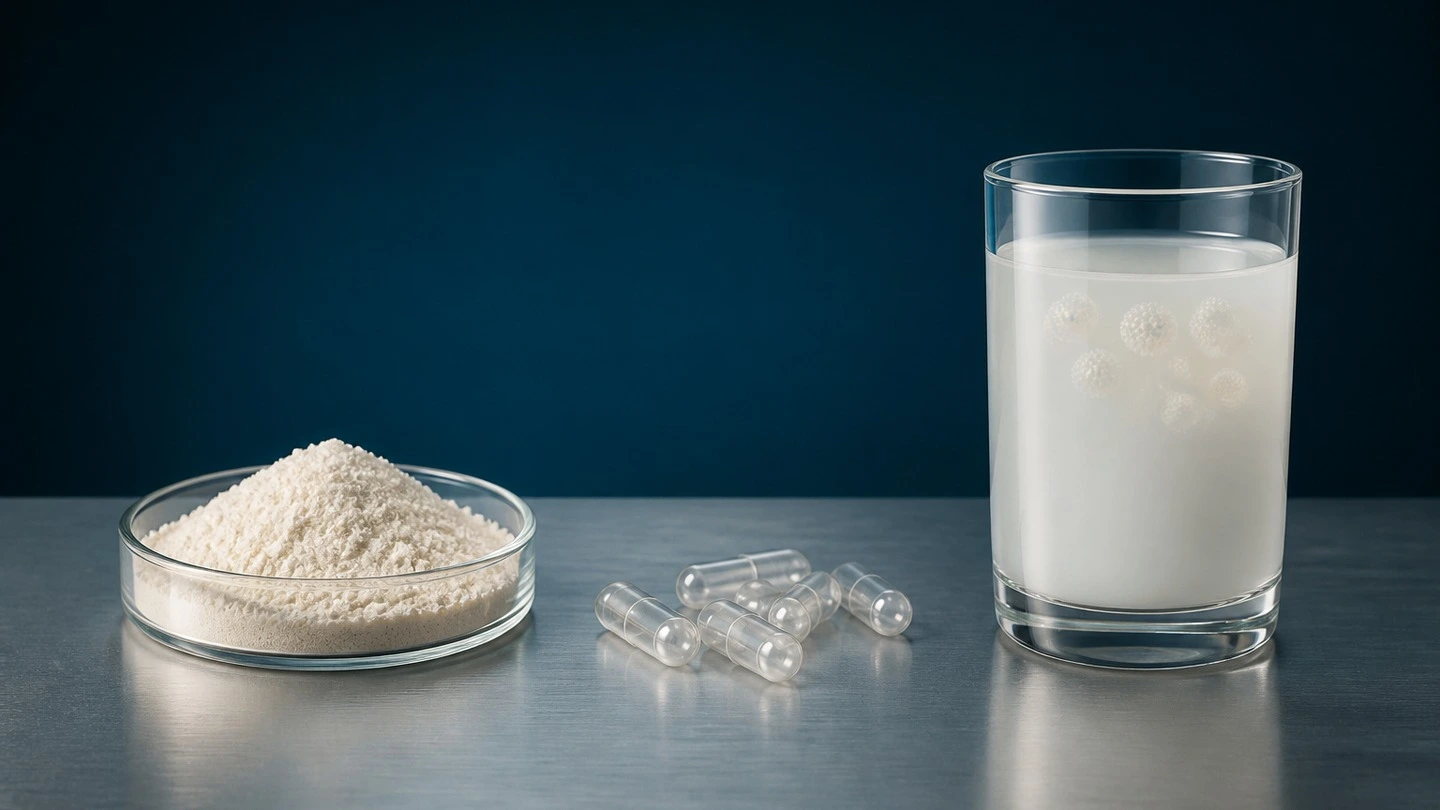
The molecule has limited aqueous solubility, so a conventional powder tends to sit at the bottom of a glass or leave a ring on the inside of a stick pack. Liposomal grades address this physically: the active is associated with a phospholipid phase that disperses in cold water and forms a colloidal suspension rather than a sediment. The specification supplied by EmerWell describes superior cold-water dispersibility with a stable, translucent colloidal suspension and no precipitation, which is the property a beverage developer should test first.
Colour and Oxidation
Polyphenols brown. Light, heat, trace metals and residual moisture all accelerate the change, and the visible result is a shift from off-white toward tan in a powder that is supposed to look clean in a clear sachet. The phospholipid bilayer limits isomerisation of trans-resveratrol under light and temperature fluctuation, and nitrogen flushing with multi-layer foil packaging removes the oxygen that drives much of the colour change. Neither measure makes the powder invulnerable. Both buy time, and time is what a 24-month shelf life is made of.
Taste and Mouthfeel
A meaningful polyphenol load is astringent. Encapsulation reduces the direct contact between the polyphenol and the palate, which is why liposomal grades are usually easier to place in a flavoured stick pack than a standard extract. This is a sensory claim rather than a chemical one, and it should be verified on a pilot batch rather than assumed from a data sheet.
The Delivery System and What It Changes
A liposomal powder is not a single substance. It is a population of vesicles with a distribution of sizes, a payload fraction, a residual moisture level and a certain amount of non-encapsulated material. Each of those contributes to how the powder behaves, and each should appear in the specification.
Encapsulation Efficiency
Encapsulation efficiency describes the share of the active associated with the lipid structure. For the grade supplied by EmerWell it is stated at 85% to 92%. That figure is a quality marker and a useful way to compare suppliers, but it does not describe release, and it does not by itself support a claim about appearance or anything else consumer-facing.
Trans-Isomer Integrity
Resveratrol exists as cis and trans isomers, and the trans form is the one most commercial specifications target. The EmerWell specification states trans-isomer purity of 99% or above with zero cis-isomer degradation, verified by HPLC. A buyer should ask for that value on the batch certificate rather than on the brochure, because isomerisation is a storage phenomenon as much as a manufacturing one.
Particle Size
Particle size distribution, measured by dynamic light scattering, governs both the visual appearance of a redispersed drink and the surface area available for interaction. A narrow distribution is easier to keep consistent than a broad one, and consistency matters more than the mean for a product that will be produced in millions of sachets.
| Specification | Stated value | Why a beauty line cares |
|---|---|---|
| Encapsulation efficiency | 85%–92% | Indicates how much active sits in the lipid phase |
| Trans-isomer purity | 99% or above | Protects the declared form through shelf life |
| Available concentrations | 10%–50% | Sets the trade-off between load and fill weight |
| Heavy metals, lead | Below 0.5 ppm | Required for a clean-label positioning |
| Total plate count | Below 1,000 cfu/g | Supports a preservative-light format |
| Shelf life | 24 months | Defines the label date and the stability protocol |
Reading the Evidence Without Overclaiming
Most of the published work on resveratrol and skin is in vitro or ex vivo, using cell cultures or tissue explants. That work is useful for mechanism and for choosing a dose range in a formulation study. It is not a substitute for a human trial, and it does not license a consumer statement about appearance. The distinction is not academic: a retailer's technical reviewer will ask for the study design, and "published research" is not an answer.
What Each Evidence Tier Can Support
| Evidence tier | What it can support | Typical documentation |
|---|---|---|
| In vitro cell work | Mechanistic rationale and dose selection | Peer-reviewed paper with method detail |
| Ex vivo tissue work | Penetration and local behaviour | Study report with tissue source |
| Human trial, biomarker endpoint | A specific measured parameter | Protocol, ethics approval, results |
| Human trial, consumer perception | Self-reported outcomes only | Questionnaire design and analysis |
| Brand pilot in finished format | Stability, sensory and compliance | Internal report with pull points |
Claim Language That Stays Inside the Lines
In the United States, a dietary supplement may carry a structure or function statement, but not a statement that the product diagnoses, mitigates or otherwise addresses a disease. Wording such as "supports healthy skin" sits in the permitted category when it is truthful and not misleading; wording that implies a cosmetic outcome or a condition falls outside it. The notification requirement attached to such statements is a separate obligation, and the brand owns it, not the ingredient supplier.
Formulation Routes: Capsule, Stick Pack, Beverage
The same powder behaves differently in each format, and the specification that matters changes with it. A capsule hides colour and taste but constrains fill weight. A stick pack exposes both, and adds moisture migration as a variable. A ready-to-drink beverage adds pH, a thermal process and a shelf life measured in months rather than weeks.
Capsules and Tablets
Capsules are the simplest route for a liposomal powder because they protect the material from light and moisture. The main engineering question is fill weight: a 10% grade needs a much larger mass to deliver the same active as a 50% grade, and that difference decides whether the product fits in a two-piece capsule at all. Tableting adds compression, which can damage vesicle structure, so a direct-compression route should be tested before it is committed to.
Stick Packs and Powders
Stick packs are where dispersibility earns its keep. The powder must wet out quickly, disperse without lumps and stay in suspension long enough to be drunk. Flowability, bulk density and hygroscopicity all matter on the filling line, and moisture pickup during filling is the most common cause of caking in a product that tested well in the lab.
Ready-to-Drink and Shots
Liquid formats are the hardest, because the material is exposed to water activity, pH and often heat. A liposomal powder can be dispersed into a beverage, but the stability of the dispersion over the declared shelf life has to be demonstrated rather than assumed. Brands weighing the trade-offs can compare formats in liposomal resveratrol powder versus liquid form.
How Load and Fill Weight Interact
Beauty formats tend to carry several actives at once: a collagen or a peptide, a vitamin, a mineral, sometimes a botanical. Each one takes mass, and the capsule or sachet has a fixed capacity. A 50% grade of liposomal resveratrol leaves more room for the rest of the formula than a 10% grade, but it also narrows the tolerance for blending error and makes uniformity harder to hold. The right choice is usually the lowest concentration that still fits the serving, not the highest concentration available.
Uniformity in a Low-Dose Sachet
When the active is a small fraction of the total fill, blend uniformity becomes the limiting factor rather than assay. A powder with a narrow particle size distribution and good flow mixes more predictably than a fine, cohesive one, and the difference shows up as variation between sachets rather than as a lower average. Brands should ask for a uniformity study on the finished blend, not only a content assay on the raw material.
Stability and Shelf-Life Planning
A 24-month shelf life is a claim about the material in its supplied packaging, not a guarantee for the finished product. Once the powder is blended with acids, flavours, vitamins and minerals, the relevant stability question changes. Accelerated studies at elevated temperature and humidity should track assay, encapsulation efficiency, moisture, colour and microbial status at each pull point, and the results should be read against the specification rather than against the starting value alone.
Two failure modes deserve particular attention. The first is moisture migration from a hygroscopic partner ingredient, which can raise water activity in the sachet and accelerate both colour change and vesicle disruption. The second is metal-catalysed oxidation, which is often traced to an unbuffered mineral salt in the same blend. Both are formulation problems rather than ingredient problems, and both are cheaper to find in a pilot than in a recall.
Declarations and Allergen Control
Phospholipids are often derived from soy or sunflower, and the source belongs in the allergen assessment even when the finished material tests below labelling thresholds in some markets. The declaration should match the source actually used, and a supplier that changes lipid source between batches without notice creates a labelling problem for the brand. Confirm the source in writing and make it part of the specification, not a note in an email.
Supplier Questions That Separate Grades
The questions that produce useful answers are specific. Ask for the particle size report with the distribution rather than a single average. Ask which method was used for encapsulation and what the acceptance criterion is. Ask for a certificate from the batch that will ship, not a representative example. Ask how the material is packed and what the headspace oxygen level is. Ask whether the grade has been run in a beverage or a stick pack before, and what changed.
EmerWell supplies liposomal resveratrol powder manufactured in cGMP, ISO 9001 and ISO 22000 certified facilities, with Kosher, Halal, Non-GMO and Vegan compliance and gluten-free and soy-free options. Documentation covers assay, encapsulation efficiency, particle size, heavy metals, microbiological status, appearance and stability, with third-party testing available. Brands comparing ingredient strategies can read how to evaluate liposomal resveratrol powders for skin health, and formulators can work through formulation tips for OEM and ODM projects.
The physical chemistry behind dispersion is set out in enhancing resveratrol solubility with liposomal delivery, and the supplier evaluation criteria are collected in how to choose a trustworthy liposomal resveratrol powder supplier.
To test a grade in your own matrix, request the current specification, a batch certificate and a sample from that batch. Write to info@emerwell-bio.com or review the liposomal resveratrol powder page for the full parameter list.
This article is written for ingredient buyers, formulators and quality reviewers. It describes raw material specifications and analytical practice only, and is not medical or nutritional advice.
References
- U.S. Food and Drug Administration. Dietary supplements: regulatory and safety information. https://www.fda.gov/food/dietary-supplements
- Office of Dietary Supplements, National Institutes of Health. Dietary supplement fact sheets and research resources. https://ods.od.nih.gov/factsheets/list-all/
- PubMed search results, resveratrol and skin formulation research. https://pubmed.ncbi.nlm.nih.gov/?term=resveratrol+skin+formulation
- PubMed search results, phospholipid vesicle encapsulation efficiency. https://pubmed.ncbi.nlm.nih.gov/?term=phospholipid+vesicle+encapsulation+efficiency
Online Message