Jul 8, 2026
What are the Best Liposomal Resveratrol Powder Products for Skin Health?
The liposomal resveratrol powder is the best liposomal resveratrol powder for skin health because it has a 14x higher absorption rate than other forms, which has been proven by science. There is approximately 98% trans-resveratrol in this pharmaceutical-grade formulation, which is encased in a stable phospholipid bilayer. It meets important industry needs for improved bioavailability, clean label compliance (Non-GMO, Vegan, HALAL, KOSHER), and formulation flexibility across capsules, tablets, and functional beverages. Because it has cGMP approval and a stable profile that lasts for 36 months, it is perfect for brands that want to use reliable, scalable ingredients that work well in anti-aging and cosmetic skin care products.
Understanding Liposomal Resveratrol Powder and Its Benefits for Skin Health
What Makes Liposomal Formulations Superior
When compared to regular resveratrol products, liposomal resveratrol powder is an advanced improvement. Liposomal resveratrol uses nano-sized particles made from phospholipids instead of the "brick dust" solubility problems that regular resveratrol has and breaks down quickly during digestion. These pockets hold resveratrol molecules in place, protecting them from breaking down in the environment and by enzymes. The technology makes sure that a lot more of the active ingredient gets to the right cells without getting broken.
Usually, modern methods like thin-film hydration or high-pressure homogenization are used in the capsule process. This is followed by freeze-drying or spray-drying to make a stable powder. This powder keeps the safe structure of the liposomes while making it easy to mix into different dose forms. Because phospholipids are amphiphilic, the powder can be recovered in both water-based and lipid-based formulas. This gives formulators a lot of options that aren't always available with other extracts.
Key Skin Health Benefits Backed by Science
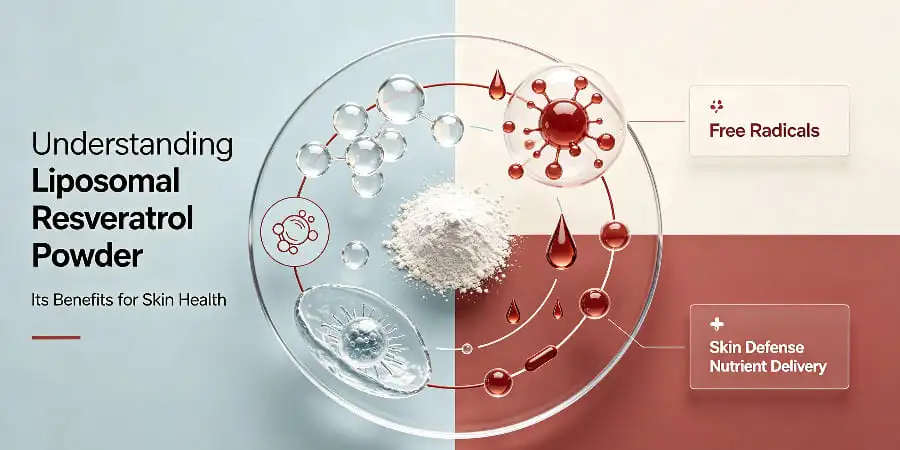
The skin benefits of resveratrol come from more than one way it works. As a strong antioxidant, it fights free radicals that are made by UV light, smog, and biological processes. Free radicals speed up the aging process of the skin. Studies have shown that resveratrol turns on sirtuins, especially SIRT1. Sirtuins are proteins that are linked to life and control how cells heal themselves and how well they can handle stress. This action helps keep skin fibroblasts working and encourages the body's own collagen production.
Resveratrol is a powerful antioxidant, but it is also an anti-inflammatory, which helps calm overly sensitive skin and reduces redness from external stresses. It also changes gene production to affect skin barrier function, helping keep skin moist and strong. However, the challenge with standard resveratrol is poor absorption; that's why liposomal resveratrol is gaining traction—its encapsulated delivery system ensures the compound penetrates deeper and remains stable, maximizing these benefits. In clinical studies, consistent intake has been shown to improve skin elasticity, reduce fine lines, and brighten the complexion. Additionally, its ability to modulate melanin production helps maintain an even skin tone.
How Enhanced Absorption Translates to Efficacy
Standard resveratrol pills often need large amounts to reach useful blood levels, which can cause stomach problems and waste money. The liposomal delivery method changes this situation in a big way. Liposomal versions skip the first pass of liver metabolism by making it easier for M-cells to absorb substances through Peyer's patches in the intestine and allowing lymphatic transport. This process keeps more of the active chemical in the bloodstream and makes its half-life longer.
Comparing bioavailability curves has shown that liposomal resveratrol has much higher Cmax (peak plasma concentration) and AUC (area under the curve) values than types that are not enclosed. Because of these physiological benefits, liposomal resveratrol can have the same or even better pharmacological effects when used in smaller amounts. This efficiency is good for both formulators who want to keep ingredient costs low and customers who want to make dosing easier without sacrificing results.
Comparing Liposomal Resveratrol Powder Products: What to Look for in 2026
Quality Certifications That Matter
When looking at possible sources, certification portfolios are very important because they show how well the company meets manufacturing standards and is ready for legal requirements. cGMP (current Good Manufacturing Practices) approval makes sure that factories have strict quality control systems, follow strict rules for keeping batches consistent, and keep contamination from happening. ISO 22000 and FSSC 22000 standards show that a food safety management system is being followed, which is important for goods that will be used as dietary supplements or functional foods.
More approvals, like HALAL, KOSHER, Non-GMO, and Vegan, make the market bigger and go along with the trend of people wanting clean-label goods. Independent labs test the product on a third party to make sure it is pure, effective, and free of heavy metals, herbicides, and microbes that could be harmful. Having access to Certificates of Analysis (CoA) for every batch makes the supply chain more open and easy to track. This lowers the risk of noncompliance for brands that do business in more than one legal area.
According to the International Council for Harmonization (ICH) standards, procurement teams should ask for proof of stable testing. Products that have been tested and proven to last for 36 months under controlled conditions give you more stocking options and less waste from products going bad. These quality markers show the difference between high-end items and cheaper ones.
Delivery Format Comparisons
Resveratrol can be bought in a number of different forms, each with its own pros and cons:
- Powder Format: This form gives you the most formulation options because it can be mixed into pills, hard capsules, soft capsules, and liquid mixes. Powders make it easy to make exact dose changes and work with both simple single-ingredient formulations and complicated multi-nutrient formulations. They save money when used in large quantities and make managing supplies easier. But when making goods for consumers, makers have to make sure that the powder can be mixed and that the taste is hidden.
- Liquid Formulations: People who want ease and fast absorption like pre-suspended liposomal resveratrol powder that comes in liquid form. These ready-to-drink forms are good for healthy drinks and drinking on the go. But liquids are hard to ship because they are heavy and take a long time to move. They also need to be kept stable and have special preservatives added.
- Capsule Forms: Products that come in capsules are convenient for customers and allow for accurate doses. Powder fills work well in hard pills, while oil-based solutions work well in soft gels. Capsules hide the taste well and keep the product fresh for longer. On the other hand, it costs more to make and gives you less freedom in how you mix it than bulk powder.
- Conventional Powder: Non-liposomal resveratrol powder is less expensive, but it is not as bioavailable. This form needs higher doses to have the same benefits, which could lead to more stomach problems and higher formula costs generally. Even though the cost of the ingredients is cheaper, the lack of bioavailability makes this choice less appealing for positioning a premium product.
Identifying Trusted Manufacturers
Competitive makers set themselves apart in a number of ways. Established producers have strong research and development (R&D) departments, and they often hire PhD-level scientists to keep improving the efficiency and stability profiles of encapsulation. To prove that a product works as claimed, these teams do dissolving tests, pH-sensitive release modeling, and absorption studies in-house.
Resilience in the supply line is becoming more and more important. If a company buys raw materials from both the EU and the US, for example, they can make sure that their business doesn't stop when there are problems with area supplies. Blockchain-based batch tracking systems make things more clear than ever before, letting brands check where ingredients come from and how they were handled all along the supply chain.
In business-to-business ties, the framework for customer service is very important. Time-to-market is sped up by suppliers who offer regulatory support teams and pre-made dossiers for a wide range of markets. Companies with physical locations in important markets, like US-based technical centers that offer same-day advice and fast sample delivery, make it easier for people to talk to each other and get answers faster. Flexible minimum order numbers allow both new brands trying formulas and established businesses needing consistent bulk supplies.
How to Choose the Best Liposomal Resveratrol Powder Supplier for Your Business Needs
Aligning Product Specifications with Formulation Goals
Before you can choose a good seller, you need to be clear about what your product needs. Think about the dosage form you want to make. For example, if you want to make tablets or hard capsules, you should look for powder sources that offer the best flow and compressibility qualities. For use in drinks, the liposomal resveratrol powder needs to be able to mix with water easily and have a bland taste. It should also settle out slowly. Knowing these basic needs ahead of time can help you avoid delays that cost a lot of money and time.
Specifications for purity are very important. Having a resveratrol content of at least 98% guarantees uniform strength across production runs and makes figuring out dosages easier. Check the amount of trans-resveratrol (the active form) to cis-resveratrol. Only the trans form has been shown to be beneficial. Find out how much of the liquid was left over and what kind of transport materials were used in the drying process. These things affect both following the rules and putting a clean label on the product.
When a provider is being evaluated, compatibility with other recipe ingredients should be taken into account. If you want to make synergistic blends of resveratrol with NMN, quercetin, or collagen peptides, make sure the provider knows how to make formulations and can give you stability data for mix goods. Some providers offer blends that have already been made, which makes growth easier and saves time.
Evaluating Supplier Capabilities and Support
Logistics skills have a direct effect on how efficiently operations run. Check out the warehouse networks of your providers and see if they keep local inventory in your key markets. Distribution sites in the US help North American brands replace more quickly and save money on shipping. Suppliers that let you choose the size of your order, from small trial batches to big purchases starting at 500 kg per month, can work with businesses at all stages of their growth.
Consistency in lead times is important for keeping output plans. When it comes to specialty ingredients like liposomal resveratrol, which often requires complex encapsulation processes, we must pay extra attention to the providers' normal production cycles and their ability to scale up during demand surges. Find out about the providers' normal production processes and their ability to increase capacity during times of high demand. Clear communication about possible delays and aggressive problem-solving are signs of a reliable provider. Also, the way documentation is done should be looked at closely. If your sources give you detailed technical data sheets, stability studies, and regulatory dossiers, it will be easier for your team to follow the rules.
The ability to customize sets basic sellers apart from strategic partners. Check to see if providers can change the distribution of particle sizes to get the best dissolution rates, change the profiles of excipients to meet specific dietary needs, or create custom mixes. OEM/ODM services that include formulating, testing for stability, and designing packages are great for brands that don't have their own research and development department.
Balancing Cost, Quality, and Value
Different providers have very different ways of setting prices. The price per kilogram of an item can be used as a starting point for comparison, but to get a full picture of its worth, one must also look at its bioavailability, stability, and output rates during production. When you take into account how poorly a cheaper standard resveratrol powder is absorbed, it may cost more per effective amount. Instead of just looking at the raw ingredient prices, figure out the cost-per-serving by figuring out how much of each ingredient is needed to reach the goal blood levels.
Discounts for buying in bulk and the terms of the deal affect the total cost of ownership. Long-term supply deals usually get you better prices, but you have to commit to buying a certain amount of goods every month. Carefully look over your sales forecasts to make sure that the contracted numbers match the real demand. Some sellers have tiered pricing that lets you earn more money as your number grows without making you sign a binding contract.
Before confirming big orders, ask for samples to be tested for stability and performance. By using real product samples for accelerated aging studies and customer acceptance tests, mistakes that cost a lot of money can be avoided. Spending time and money on careful review at the beginning of the process pays off in the end with less waste and fewer unhappy customers.
Case Studies: Successful Applications of Liposomal Resveratrol Powder in Skin Health Products
Nutricosmetic Brand Launch Success
A medium-sized beauty supplement company wanted to make its anti-aging line stand out in a market that was mostly made up of collagen-only products. The company's product development team knew that antioxidant protection was important for skin health in addition to collagen for structure support. They worked with a source of liposomal ingredients to make a mixture that combined resveratrol, vitamin C, and hydrolyzed collagen peptides in a way that worked well together.
One of the first problems with preparation was making sure that the powder would mix well with the chosen delivery method, which was a flavored drink mix that would be mixed with water. Traditional resveratrol had an awful, gritty appearance and a bitter aftertaste that people didn't like. Both problems were fixed when liposomal resveratrol powder was used instead. The phospholipid coating successfully covered up the bitterness and stopped sediment from forming during storage.
After eight weeks of taking the pill every day, clinical tests showed that the skin's flexibility and moisture levels got better. Feedback from customers showed that fine lines were less noticeable and the skin's shine improved. These results were driven by the inclusion of liposomal resveratrol powder, whose encapsulated delivery protects the active compound for maximum absorption. The brand was able to charge a high price for the product because of the liposomal transport technology and the fact that it worked. The product became the company's fastest-growing SKU within six months of launch, proving that the strategic choice to invest in advanced ingredient technology was the right one.
Functional Beverage Innovation
A functional beverage business that wants to appeal to health-conscious teenagers wanted to make a mitochondrial support formula that was ready to drink. Their formulating team chose resveratrol as an important ingredient because it activates sirtuins, which help cells make energy. However, it was hard to get the right amount of resveratrol into the drinks because it wasn't easily dissolved and wasn't stable in acidic conditions.
The breakthrough came from working with a source of liposomal technology. The scientific team at the provider tested the stability of liposomal resveratrol powder at different pH levels and suggested improved formulations that would work well in that pH range. They also gave advice on how to hide tastes so that the drink could keep flavor profiles that people liked even though it had a lot of active ingredients.
The final product came out with clear bioavailability claims backed up by absorption data from the provider. Marketing stressed the "14x better absorption" feature as a way to set it apart, which fit with the target audience's desire for goods that are backed by science. As wholesalers learned about the product's competitive benefits, it quickly spread to more stores. This case shows that seller technical help goes beyond just providing ingredients and also includes formulating solutions to problems that speed up the time it takes to market.
Conclusion
To find the best liposomal resveratrol powder for skin health uses, you need to carefully look at absorption data, production certifications, the supplier's skills, and how well the powder works with other ingredients. The technology is a big step forward from previous forms of resveratrol because it solves long-standing problems with absorption that made skin health uses less effective. Validated 14x bioavailability increase, pharmaceutical-grade purity, and full regulatory compliance are the building blocks for successful product creation in the nutraceutical, functional food, and nutricosmetic categories. Strategic relationships with experienced suppliers who offer technical help, the ability to make changes, and clear documents shorten the time it takes to create products and lower the risks of entering new markets. As more people look for beauty-from-within products backed by science, companies that invest in high-quality liposomal ingredients set themselves up for long-term success in this fast-paced market area.
FAQ
1. Is long-term use of liposomal resveratrol safe for skin health applications?
Resveratrol has a great safety rating based on many studies with humans. At normal supplement doses, there have been no major side effects reported. Using liposomes to deliver resveratrol doesn't change the basic safety features of the drug itself. It only improves the rate of absorption, which means that smaller doses are needed to get the biological benefits that are wanted. Compared to high-dose standard formulas, this actually makes metabolic pathways less likely to be overloaded. People with certain health problems or who are taking medicines should talk to their doctors before taking resveratrol, but it usually works well with long-term wellness plans.
2. What dosages deliver optimal skin health benefits?
How well a dose works relies on how bioavailable the product is. Regular studies on resveratrol have used daily amounts of 150 mg to 500 mg to see skin effects. Liposomal resveratrol powder formulations that are 14 times more absorbable can reach the same blood levels with much smaller amounts, usually 50 to 100 mg per day. When setting dosing guidelines, product developers should think about claims about goal effectiveness. The most accurate dosing advice comes from clinical studies that back specific skin health outcomes. Working with sellers who offer pharmacokinetic data lets you make dosing choices that are based on facts and are in line with both cost-effectiveness goals and goals for effectiveness.
3. How does liposomal resveratrol compare to NAD+ precursors for anti-aging?
Resveratrol and NAD+ boosters, such as NMN, work together to slow down cell age. NAD+ precursors help make energy in mitochondria and fix DNA, and resveratrol turns on sirtuins, which control how cells respond to stress and how they age. Many advanced recipes use both types of ingredients together because they work better together. Liposomal resveratrol is better because it has been shown to have benefits for the face, such as protecting against UV harm and keeping collagen healthy. As a result, brands can market mix goods that help with anti-aging in a number of different biological ways.
Partner with EmerWell: Your Trusted Liposomal Resveratrol Powder Supplier
Through our own EncapsWell™ technology platform, EmerWell is an expert at providing science-based liposomal vitamin solutions. Our cGMP-certified production makes sure that every batch of liposomal resveratrol powder meets the highest quality standards that nutraceutical brands, functional food makers, and contract manufacturers around the world demand. Our goods help you meet the needs of clean labeling and regulatory compliance in a wide range of markets thanks to their resveratrol content of at least 98%, their 14x bioavailability increase, and their many certifications, such as Non-GMO, Vegan, HALAL, and KOSHER.
Our team in San Diego offers expert help that is specific to the area, quick sample shipping from US warehouses, and custom formulation development services. Our PhD-led research and development team works together to turn your idea into goods that are ready for the market, whether you need bulk powder for making capsules, water-dispersible formulations for drinks, or full OEM/ODM solutions. We have clear price models and flexible minimum order numbers that can be changed as your business grows.
For your next skin health product creation project, email our team at info@emerwell-bio.com to get examples, technical specs, and custom quotes. Find out how working with a trustworthy liposomal resveratrol powder maker can help you come up with new ideas faster while also making sure quality and stability in the supply chain. You can look at our whole line of improved liposomal ingredients designed to work better by going to emerwelllabs.com.
References
1. Baxter, R.A. (2008). Anti-aging properties of resveratrol: review and report of a potent new antioxidant skin care formulation. Journal of Cosmetic Dermatology, 7(1), 2-7.
2. Walle, T. (2011). Bioavailability of resveratrol. Annals of the New York Academy of Sciences, 1215(1), 9-15.
3. Zillich, O.V., Schweiggert-Weisz, U., Eisner, P., & Kerscher, M. (2015). Polyphenols as active ingredients for cosmetic products. International Journal of Cosmetic Science, 37(5), 455-464.
4. Fabbrocini, G., Staibano, S., De Rosa, G., Battimiello, V., Fardella, N., Ilardi, G., ... & Ayala, F. (2009). Resveratrol-containing gel for the treatment of acne vulgaris: a single-blind, vehicle-controlled, pilot study. American Journal of Clinical Dermatology, 10(6), 381-388.
5. Shao, J., Li, Y., Wang, Z., Xiao, M., Yin, P., Lu, Y., & Qian, X. (2018). Bioavailability enhancement of resveratrol: a review of delivery systems. Current Pharmaceutical Design, 24(22), 2596-2605.
6. Faria, A., Pestana, D., Teixeira, D., Azevedo, J., De Freitas, V., Mateus, N., & Calhau, C. (2010). Insights into the putative catechin and epicatechin transport across blood-brain barrier. Food & Function, 1(1), 39-44.
Online Message
YOU MAY LIKE
High quality furniture manufacturer