Oct 10, 2026
What Causes Oxidation in Omega-3 Powder and How Can It Be Minimized?
Oxidation is the most common chemical failure mode in liposomal Omega-3 powder, and it is the one a specification sheet rarely reveals on its own. Two lots can report identical EPA and DHA content while differing by an order of magnitude in oxidative status. For formulators, brand owners and buying teams that gap is the real risk: oxidation changes flavour, shortens shelf life and degrades the encapsulation that makes a powder format attractive in the first place. This guide sets out the chemistry of polyunsaturated fatty acid (PUFA) oxidation in powder systems, explains why peroxide value (POV) rather than content alone belongs in an acceptance specification, and maps the control points — formulation, processing, packaging, storage and incoming verification — that keep a lot within specification.
How Oxidation Starts in an Omega-3 Powder
EPA and DHA are long-chain PUFAs. The methylene-interrupted double bonds that define them are also what makes them chemically fragile: the allylic hydrogens sitting between double bonds are readily abstracted.
Autoxidation: initiation, propagation, termination
Lipid autoxidation runs in three stages. Initiation abstracts a hydrogen atom from a bis-allylic methylene group and produces a lipid radical. Propagation adds molecular oxygen to form a peroxyl radical, which then abstracts another hydrogen to give a lipid hydroperoxide (LOOH) and a fresh radical, so the chain continues. Termination combines two radicals into non-radical products. Because a single initiation event can consume many fatty acid molecules, oxidation in a stored powder is rarely linear; it can look flat for weeks and then accelerate sharply. Trace transition metals such as iron and copper catalyse hydroperoxide decomposition and effectively re-initiate the chain. How these reactions behave inside a bilayer is discussed in our technical note on the science behind liposomal Omega-3 powder formulation.
Primary and secondary oxidation products
Hydroperoxides are the primary products of the reaction and they are largely odourless. Their significance is analytical: they are what peroxide value measures. LOOH are unstable, however, and decompose into secondary products — aldehydes including malondialdehyde and 4-hydroxynonenal, together with ketones, alcohols and short-chain acids. These volatiles are responsible for the rancid, fishy notes of spoiled material. In practice POV captures the early stage of the reaction while sensory and anisidine-based measurements capture the later stage; a single number never describes the whole picture.
Why a powder matrix raises the risk
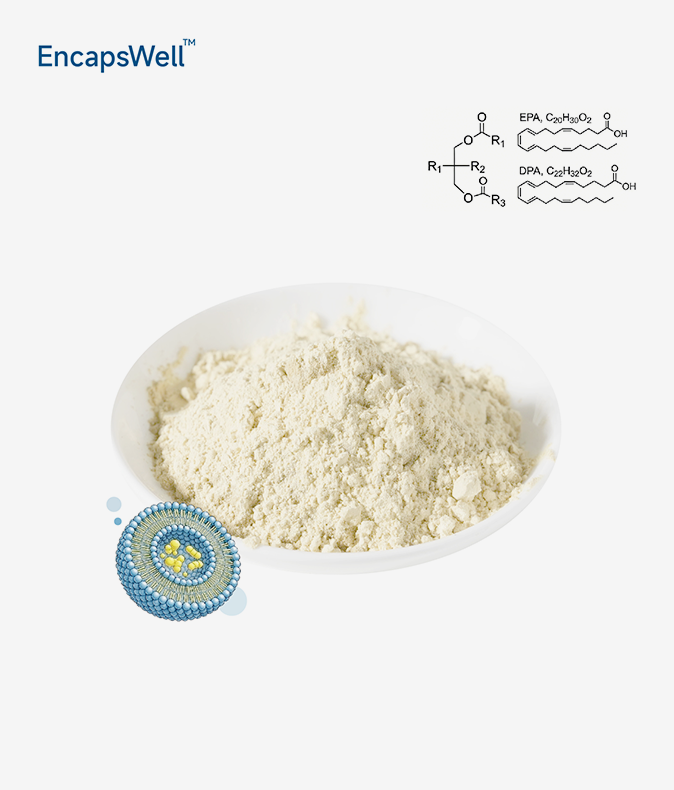
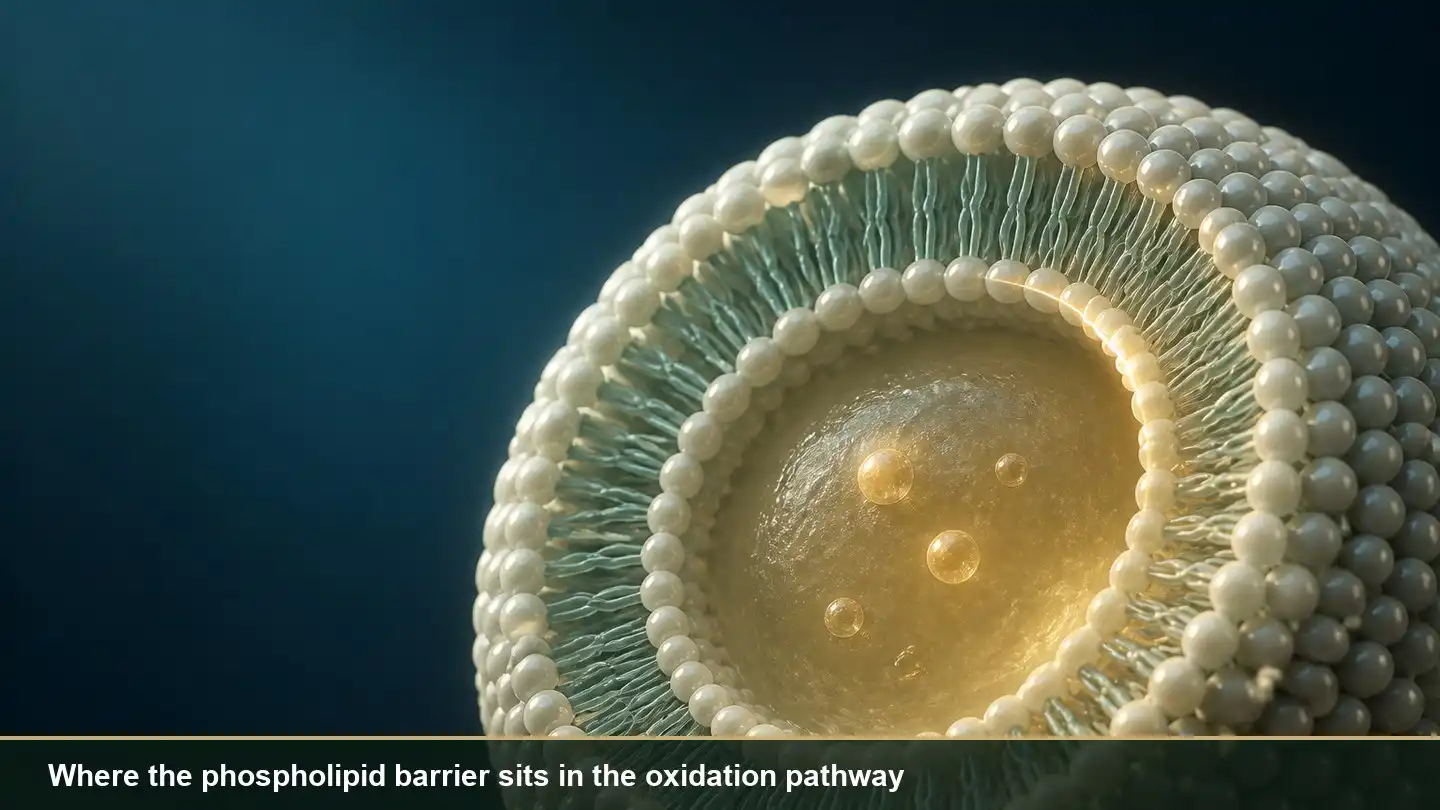
A powder presents a far larger surface-area-to-volume ratio than oil sealed inside a softgel. More interfacial area means more locations where oxygen, light and moisture meet the lipid phase. Encapsulation is therefore not a marketing term but a material-science requirement: the phospholipid bilayer surrounding each oil droplet acts as a physical barrier that slows oxygen diffusion toward the PUFA core.
What Accelerates the Reaction
| Factor | Mechanism | Relevance to powder |
|---|---|---|
| Oxygen | Direct reactant in propagation; present as dissolved and headspace gas | Residual headspace in drums, bags and sachets drives peroxide formation during storage |
| Light, including UV | Photo-oxidation through singlet oxygen, bypassing normal radical initiation | Typically faster than thermal autoxidation; clear or translucent packaging is the main exposure route |
| Heat | Raises rate constants for initiation and for hydroperoxide decomposition | Spray-drying inlet and outlet temperatures, and warehouse temperature, both matter |
| Metal ions | Catalyse LOOH homolysis; traces of iron or copper are sufficient | Contact surfaces in processing equipment and impurities carried in raw materials |
| Water activity | Changes reactant mobility and the barrier properties of the wall material | Humid or partly rehydrated powder behaves differently from a dry powder |
| Specific surface area | Increases the exposed particle-to-air interface | Additional milling or particle-size reduction raises exposure |
These factors rarely act alone. A warm warehouse combined with a moisture-permeable liner and a metal-contaminated raw material will produce a faster decline than any single factor in isolation. Our newsroom article on why Omega-3s go rancid follows the same reaction chain from a packaging standpoint.
Why Peroxide Value Belongs in the Acceptance Specification
Content assays answer one question: how much EPA and DHA is present? They do not answer how much has already degraded. A lot that ships at label content can still be partly oxidised, and the hydroperoxides already present will keep decomposing while the material sits in a warehouse and then inside a finished product. Peroxide value, expressed in milliequivalents of active oxygen per kilogram (meq/kg), is the most direct available measure of oxidative status and is therefore the parameter to set as an acceptance limit. A supplier that can report only content is not describing the parameter your finished product is most exposed to.
Sampling and iodometric titration
Peroxide value is normally determined by iodometric titration: hydroperoxides oxidise iodide to iodine under acidic conditions and the liberated iodine is titrated with sodium thiosulfate. Several practical points decide whether the number means anything. Draw a composite sample from several positions in the container rather than from the surface layer alone. Protect the sample from light and heat between drawing and analysis, and run the determination promptly, because hydroperoxides are labile. Report the value alongside the sampling date, the storage condition and the method used, since a POV without that context cannot be compared with a limit. Broader guidance on evaluating encapsulated powder quality is collected in our article on assessing Omega-3 powder purity before purchase.
POV next to the rest of the specification
The table below places the peroxide limit in the context of the other parameters a buyer should see. The full parameter set for a high-quality grade is reviewed in our note on key features of high-quality Omega-3 powder.
| Parameter | Specification or limit | Method or note |
|---|---|---|
| Appearance | Off-white to light yellow, fine free-flowing powder | Visual inspection |
| Active concentration | 10%–25% (standard grade: DHA 10%, EPA 5%) | Per specification sheet |
| Encapsulation efficiency | >85% | Encapsulation assay |
| Peroxide value (POV) | <2 meq/kg | Iodometric titration |
| Water dispersibility | Disperses in cold water to a stable suspension with no oil separation | Dispersion test |
| Particle size distribution | Uniform | DLS |
| Heavy metals (Pb) | <0.5 ppm | Elemental analysis |
| Total plate count | <1000 cfu/g | Microbiological testing |
| Certifications | cGMP, ISO 9001:2015, ISO 22000, HACCP, Kosher, Halal | Facility and product certifications |
Control Points from Formulation to Storage
Formulation
The first control is compositional. A phospholipid encapsulation system isolates the oil phase from the surrounding matrix, while an antioxidant system — typically tocopherol-based and sometimes paired with a chelator for trace metals — slows the propagation step at the interface. Both decisions belong in the formulation record and should be confirmed by an accelerated stability protocol rather than assumed.
Processing
Process control is where most avoidable oxidation enters a batch. High-pressure homogenisation sets the droplet size distribution and therefore the interfacial area available to oxidation. Spray drying must run inside a temperature window that dries the material without thermally stressing the PUFA. Nitrogen blanketing during processing and before sealing displaces the headspace oxygen that would otherwise drive propagation. The full sequence is described in our walkthrough of how liposomal Omega-3 powder is produced.
Packaging
Multi-layer aluminium foil laminates combine a light barrier with a moisture and oxygen barrier, and vacuum or nitrogen-flushed sealing removes residual headspace. Seal integrity is part of the specification rather than an afterthought: one compromised seal restarts the oxidative clock. Barrier selection and its effect on shelf life are reviewed in our article on stability challenges in powder formulations.
Storage and handling
Keep sealed product in a cool, dry, dark area away from direct sunlight, and rotate stock first-in, first-out. As a general industry convention rather than an EmerWell specification, warehouses for lipid powders typically target at or below 25 °C and below 60% relative humidity. Once a container is opened the objective changes: minimise the time the powder spends exposed to air and humidity, reseal promptly, and use opened material before unopened stock. Documenting these habits gives the retention sample a meaningful baseline for comparison. For the buyer-side view of these logistics, see what wholesale buyers should know.
Incoming Acceptance, Re-testing and Trend Tracking
Verification at goods-in is the point where the specification either holds or fails. The discipline is straightforward: sample properly, re-test the parameter that matters, retain material, and read results as a trend rather than as a series of isolated events. The supplier assessment that underpins this stage is covered in our guide to choosing a reliable Omega-3 powder supplier.
Sampling on receipt
Check container integrity and seal condition first. Then draw a representative composite sample across packaging units and positions, recording the container identifiers, the sampling date and the conditions under which the material was held in transit.
Retention samples and trending
Keep a retention sample from each lot under defined conditions. Re-testing POV at 3, 6, 12 and 24 months turns a single batch result into a stability profile, and it also exposes a supplier whose material is drifting toward the upper limit before a lot actually fails.
Out-of-specification handling
Define the disposition path in advance: quarantine the lot, repeat the determination on a fresh sample to exclude a sampling or handling error, then choose between rejection, a documented concession with a defined use window, or return to the supplier with a corrective-action request. File the decision and its rationale with the batch record.
How Oxidation Shows Up in Flavour and Shelf Life
Oxidation reaches the end user first through sensory quality. The aldehydes and other secondary products formed as hydroperoxides break down give stale and fishy notes that are difficult to mask in sachets, chewables and beverages, and the effect compounds across the shelf life of the finished product. The practical implications are simple: specify POV on incoming material, keep sensory evaluation in release testing alongside the analytical panel, and read flavour drift as an early warning of oxidative change rather than as an isolated quality complaint. These interlocking issues are examined in our piece on solving taste and stability issues.
Control point summary
| Control point | Responsible party | Typical evidence |
|---|---|---|
| Raw material oxidative status at intake | Supplier QA / buyer QA | COA with POV and fatty acid profile; retention sample |
| Antioxidant system and bilayer formulation | R&D / formulation | Formulation record; accelerated stability protocol |
| Homogenisation and droplet size | Production | In-process particle size data (DLS); homogenisation parameters |
| Spray drying and nitrogen blanketing | Production | Batch record showing inlet and outlet temperature, plus purge record |
| Packaging and sealing | Packaging / QA | Foil laminate specification; seal integrity check; headspace oxygen record |
| Warehouse environment and stock rotation | Logistics | Temperature and humidity logs; FIFO records |
| Incoming re-test and release | Buyer QA | POV re-test result; retention sample; batch disposition record |
Source Oxidation-Resistant Omega-3 Powder from EmerWell
EmerWell supplies liposomal Omega-3 powder for dietary supplement, functional beverage and food manufacturers, with documentation built for incoming verification: specification sheets, batch COAs, peroxide value data by iodometric titration and stability support material. Buyers and formulators can request a sample, the current specification sheet or a certificate of analysis, and our technical team supports formulation questions, stability planning and packaging selection. Reach us at info@emerwell-bio.com.
References
1. EFSA Panel on Biological Hazards (BIOHAZ). Scientific Opinion on Fish Oil for Human Consumption. Food Hygiene, including Rancidity. EFSA Journal 2010;8(10):1874. https://efsa.onlinelibrary.wiley.com/doi/10.2903/j.efsa.2010.1874
2. FAO/WHO Codex Alimentarius Commission. Standard for Fish Oils (CXS 329-2017). https://www.fao.org/fao-who-codexalimentarius/codex-texts/list-standards/en/
3. International Organization for Standardization. ISO 3960:2017 — Animal and vegetable fats and oils — Determination of peroxide value — Iodometric (visual) endpoint determination. https://www.iso.org/standard/71268.html
4. Perez-Palacios T, Ruiz-Carrascal J, Solomando JC, de-la-Haba F, Pajuelo A, Antequera T. Recent Developments in the Microencapsulation of Fish Oil and Natural Extracts: Procedure, Quality Evaluation and Food Enrichment. Foods 2022;11(20):3291. https://pmc.ncbi.nlm.nih.gov/articles/PMC9601459/
5. Hadian Z. A Review of Nanoliposomal Delivery System for Stabilization of Bioactive Omega-3 Fatty Acids. Electron Physician 2016;8(1):1776–1785. https://pmc.ncbi.nlm.nih.gov/articles/PMC4768928/
Disclaimer: EmerWell is a supplier of liposomal raw materials. This article is provided for formulation and quality-assurance professionals for informational purposes only. It does not constitute medical or nutritional advice and makes no claim about the effects of any ingredient on human health. Ingredient use, labelling and any claims are the responsibility of the finished-product manufacturer and must be assessed against the requirements of each market.
Online Message
YOU MAY LIKE
High quality furniture manufacturer
_1776234266736.webp)