

Nov 18, 2026
What Can Liposomal Resveratrol Powder Do for Your Health?
Read literally, the question of what liposomal resveratrol powder can do sits in the brand's domain rather than the supplier's. Read as a sourcing question, it becomes answerable: what will this grade do inside a specific finished format, over a stated shelf life, at a stated load? Those are engineering questions with numbers attached, and they decide whether a product reaches the market in the shape the brand planned. This article works through the format and release side of that equation, which is where resveratrol projects most often diverge from their specification.
The Question Behind the Title
Resveratrol is a stilbene with three properties that shape every formulation decision: it is poorly soluble in water, it is sensitive to light, and its trans isomer converts to the cis form under ultraviolet exposure. A liposomal format addresses the first two by enclosing the molecule in a phospholipid bilayer and by shielding it from light within the dried matrix. What it does not do is remove the need to specify the isomer content, because a grade that is 99% trans at release can still drift if the finished pack does not block light.
That is why a sourcing conversation about this ingredient is really a conversation about three numbers and one format. The numbers are isomer purity, encapsulation efficiency and loading level. The format is the pack. A grade chosen well and packed badly will lose its advantage before the end of the first stability interval, and no specification can compensate for that.
Specification Baseline
The figures below describe the grade as supplied. Each one should appear on the specification sheet with its method named, because each is measured differently and the techniques are not interchangeable.
| Parameter | Specification | What it controls in a finished product |
|---|---|---|
| Trans-resveratrol content | ≥ 99% of total resveratrol | The active fraction, and the starting point for any isomer drift during storage |
| Encapsulation efficiency | 85%–92% | How much of the molecule sits inside the bilayer rather than in the continuous phase |
| Release profile | Extended release over roughly 8–12 hours in vitro | Whether the format behaves as a single fast dose or a sustained one |
| Appearance | Off-white to light beige, free-flowing powder | The baseline for colour trending, which is the earliest indicator of isomerisation and oxidation |
| Lead | < 0.5 ppm | A metal-trace ceiling appropriate to a redox-active polyphenol |
| Total plate count | < 1,000 cfu/g | Microbial headroom for formats without a preservation step |
| Testing methods | HPLC for assay and isomer ratio, DLS for particle size, TEM for morphology, iodometric titration for peroxide value | Whether the reported figures can be reproduced independently |
The release figure is the one most often omitted from a quotation and the one that most changes a formulation decision, so it is worth asking for explicitly. A supplier that can state a release window has characterised its own material; one that cannot has probably not run the dissolution work.
Release Profile as a Format Decision
An extended release window changes what the finished product is. A fast-releasing powder produces a short exposure peak; a matrix that releases over eight to twelve hours produces a flatter profile. Neither is inherently better, but they suit different commercial positions: a capsule taken once daily is usually designed for the extended pattern, while a stick pack mixed into a morning drink is often designed for immediate dispersion and does not need the same control.
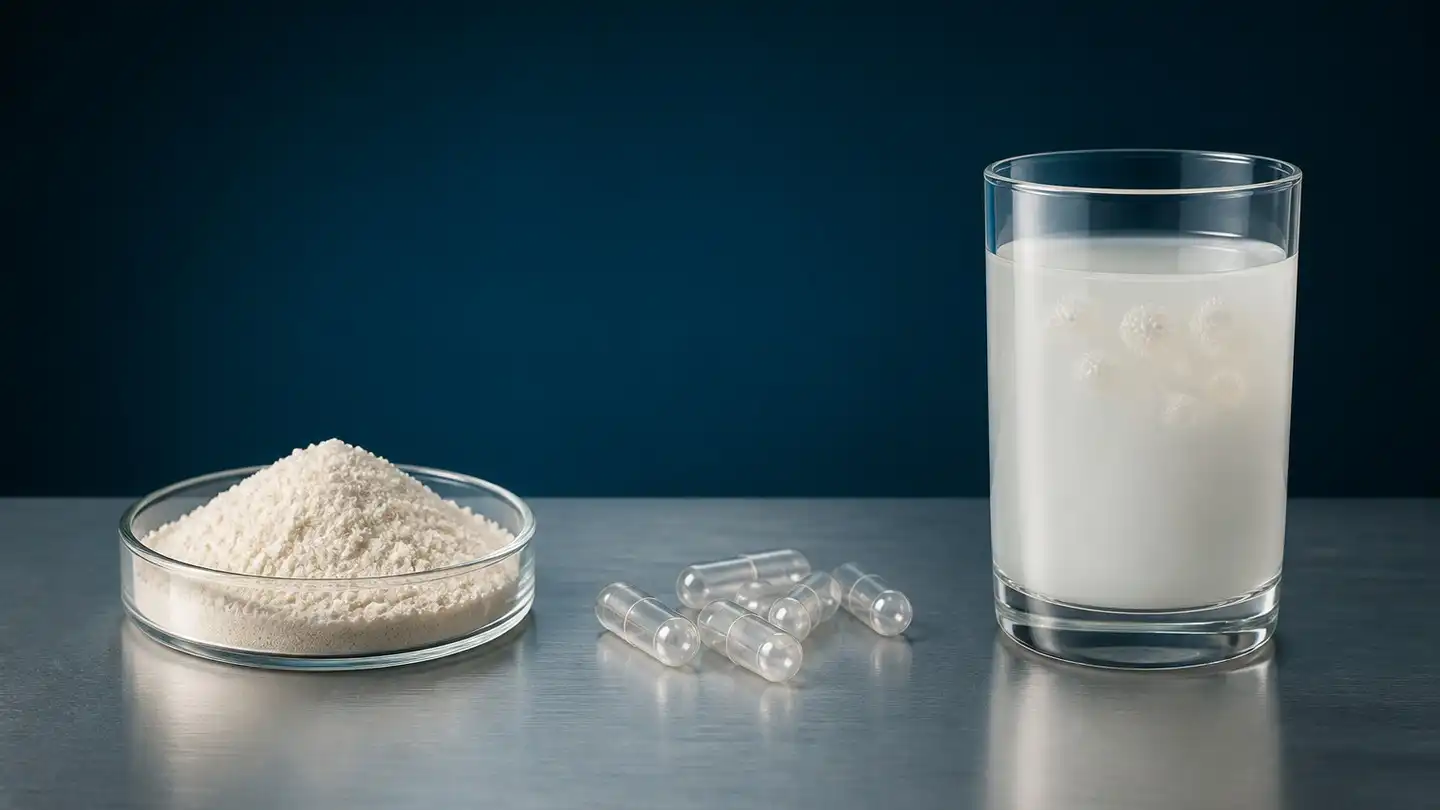
What matters for the buyer is that the release behaviour is a property of the particle system and the matrix together, not of the powder alone. A grade characterised in a simple aqueous medium will release differently in a matrix containing calcium, magnesium or a protein, because ionic strength and competitive binding both affect bilayer stability. When a supplier quotes a release window, the useful follow-up question is what medium it was measured in and whether the measurement was repeated in a matrix closer to the intended product.
Format Fit
Resveratrol's poor aqueous solubility makes format choice unusually consequential. The table below sets out how each common format constrains the grade.
| Format | Constraint the format imposes | What to specify |
|---|---|---|
| Two-piece capsule | No water in the matrix, so the bilayer is stable but dissolution depends on gastric fluid | Encapsulation efficiency, release window, fill weight against the target load |
| Hard tablet | Compression stress can rupture vesicles; heat during granulation adds a second risk | A compression trial, not a specification alone; particle size before and after |
| Stick pack | Dispersion in a small volume concentrates colour and taste defects | Rapid dispersion, colour trend, and a taste assessment on the finished blend |
| Gummy | Cooking temperature and water activity both attack the bilayer and the isomer | Thermal stability data at process temperature; overage justified by data |
| Ready-to-drink | Long aqueous residence at ambient temperature with light exposure | Photostability data, packaging light barrier, colour monitoring across shelf life |
The gummy format is the most demanding and the most popular. The combination of heat and moisture attacks both the bilayer and the isomer, and the visual result of failure is a colour shift that is difficult to hide in a translucent product. A project that intends to launch in gummies should ask for the thermal data before the mould tooling is ordered, because the answer sometimes redirects the project to a capsule.
Loading Limits and the Overage Arithmetic
A liposomal powder can only carry so much active before the bilayer structure becomes a minor component of the particle. In practice the commercial band runs from a low loading grade, where a large serving mass is acceptable, to a high loading grade that suits capsules. The constraint is physical rather than commercial: at high load the amount of phospholipid available per unit of active falls, encapsulation efficiency usually falls with it, and the resulting powder disperses less cleanly.
Overage follows from the same arithmetic. The declared quantity on the pack must be present at end of shelf life, so the quantity added at manufacture has to exceed the label figure by whatever the stability data justifies. A project that carries an overage across from a different active, or from an unencapsulated resveratrol grade, will usually find that the justification does not hold: the degradation route is different because the physical state is different. Overage should be set from the encapsulated grade's own stability data, in the intended matrix, and reviewed whenever the grade changes.
Colour, Light and the Isomer Question in a Matrix
Trans-resveratrol absorbs ultraviolet light and converts to the cis form, which is both less commercially valued and visually different. In a dried powder the conversion is slow because mobility is low. In a matrix with residual moisture, or in a translucent pack exposed to retail lighting, the rate increases. The practical control is a light barrier in the pack plus a colour specification that trends the b* value across stability timepoints.
Colour is useful here for the same reason it is useful in other oxidation-prone systems: it changes before the assay does. A subtle darkening in a resveratrol blend is usually the first sign that the isomer ratio is drifting, and it appears weeks before a chromatographic result would confirm it. Recording b* at every timepoint costs almost nothing and gives the formulator an early warning rather than a post-mortem.
Packaging Is Part of the Specification
Because photostability and moisture are the two variables that move the isomer ratio, the pack belongs in the technical discussion rather than only in procurement. A multi-layer aluminium foil structure with nitrogen flushing addresses both variables at once: the foil removes the light path and the nitrogen reduces the oxygen available for oxidation during storage. A translucent pouch with a metallised film addresses light partially and moisture poorly, which is adequate for a six-month product and marginal for a two-year claim. The practical test is simple. Ask what light transmission and what moisture vapour transmission the pack specification states, then compare those figures with the conditions used in the supplier stability programme. If the supplier tested in a foil pouch and the brand intends to pack in a clear stand-up pouch, the stability data does not transfer, and the brand is running an unqualified experiment on its own shelf. Agreeing the pack before the stability programme starts is the cheapest way to avoid that outcome, and the least likely item to be revisited once tooling is committed.
Claim Boundaries the Brand Should Set Early
The ingredient's contribution to a finished product is a specified quantity of a well-characterised molecule in a defined physical state. Everything beyond that belongs to the brand's own substantiation. The clearest way to keep the boundary is to write, at the start of the project, two short lists: statements the technical file can support, and statements that require separate evidence that the brand must generate or license.
Statements about what the ingredient is, how much is present, how it is encapsulated and how it behaves in a dissolution test sit in the first list. Statements about outcomes in people sit in the second. A supplier that blurs the two is not being helpful; it is moving risk from its own quotation onto the brand's regulatory file, where it is more expensive to resolve.
Documentation and Change Control
The documentation set for this grade follows the pattern of other liposomal actives: specification sheet with methods, lot-specific certificate of analysis, stability summary, safety data sheet, certification statements and a change-control commitment. The last item matters more for resveratrol than for many actives, because the isomer ratio and the photostability behaviour both depend on process details that are easy to change silently, such as the drying temperature or the light exposure during packing.
A buyer should also confirm which certifications apply to the manufacturing site rather than to a trading entity, and should check that the certificate of analysis reports the isomer ratio rather than total resveratrol alone. Total resveratrol can look reassuring while the trans fraction, which is the commercially relevant one, is lower than the specification implies. Reading the site's complete guide to liposomal resveratrol powder for supplement brands alongside the specification sheet gives a useful second view of how the parameters interlock.
What This Means for a Purchase Decision
If the aim is to launch quickly in capsules with a straightforward label, a standard grade with 99% trans content, encapsulation in the high eighties and a stated release window is sufficient, provided the pack includes a light barrier. If the aim is a gummy, a beverage or a translucent pack, the project needs thermal and photostability data before the format is fixed, and the grade choice follows from that data rather than preceding it.
Either way the decision rests on four questions that a supplier should answer without hesitation: what is the trans content at release, what is the encapsulation efficiency and by what method, what is the release window and in what medium, and what change-control commitment applies to the process. Where those answers are available and consistent with the specification sheet, the technical risk is largely transferred to the brand's own formulation work. Where they are vague, the risk stays in the supply chain and will surface during stability testing.
Next Step
For a specification review against a specific format, contact the formulation team at info@emerwell-bio.com with the intended format, the target load per serving and the pack type. Samples of the standard grade are available for trial work. The site's notes on choosing a high-quality liposomal resveratrol ingredient and on liposomal powder versus liquid formats cover the adjacent decisions, and the liposomal resveratrol powder specification sheet provides the baseline figures used throughout this article.
This article is intended for ingredient buyers, formulators and quality professionals. It describes raw-material specifications, format constraints and analytical practice. It does not address the use of any finished product by an individual, and statements about finished products remain the responsibility of the brand that markets them.
References
- U.S. Food and Drug Administration. Current Good Manufacturing Practice in Manufacturing, Packaging, Labeling, or Holding Operations for Dietary Supplements, 21 CFR Part 111. ecfr.gov
- U.S. Food and Drug Administration. Search for FDA Guidance Documents. fda.gov
- FAO/WHO. Codex Alimentarius Commission. fao.org
- European Food Safety Authority. Food Additives. efsa.europa.eu
Online Message