

Sep 23, 2026
Liposomal Resveratrol Powder for Athletic Performance Enhancement
Formulation teams building a performance-positioned sports nutrition line rarely ask whether liposomal resveratrol powder belongs in the concept; they ask whether the chosen format — stick pack, sachet, ready-to-mix scoop, gummy, tablet or capsule — can carry the ingredient without eroding the encapsulation the specification was bought for. That is a formulation and sourcing question, and it is settled by documents rather than by category language. The published specification for liposomal resveratrol powder gives 85%–92% encapsulation efficiency, ≥99% trans-isomer purity, available concentrations of 10%–50%, and a 24-month shelf life, and those four figures drive most of the practical decisions below. What follows covers matrix compatibility, sensory and dissolution behaviour, processing limits, storage and packaging, incoming-batch acceptance checks, label boundaries, and the technical file a buyer should expect before a first production order.
What a Sports Nutrition Brief Actually Asks of the Ingredient
Sports nutrition briefs differ from general wellness briefs in checkable ways. Single-serve fill weights are small, so a carrier-heavy premix can crowd out the rest of the formula. Blends routinely carry electrolytes, protein or peptide fractions, flavour systems and sweeteners that compete for water and for the consumer's palate. Formats are expected to disperse in cold water quickly. And one ingredient may be asked to appear in a sachet, a tub and a gummy — three formats with very different moisture and temperature histories.
Throughout this article, “performance” refers only to the finished-product form and to what the formulation can physically deliver in that form. It is not a statement about what the ingredient does in the body, and none is made here.
Matrix Compatibility in Powder, Semi-Solid and Compressed Formats
Compatibility work starts by classifying the format, because the encapsulation being purchased is a physical structure, and every downstream step either preserves it or disturbs it.
Dry blends and stick packs
Dry blending is the most forgiving step in a formulation project: low-shear ribbon or tumble blending at ambient temperature leaves the vesicle structure alone, provided the powder is not heated, wetted or over-compressed during conveying. The remaining questions are physical rather than chemical — whether the blend flows through a doser without segregation, and whether the liposomal fraction, typically the lightest and most cohesive component, stays evenly distributed. Practical starting points for contract projects, including where that fraction belongs in the addition order, are collected in these formulation tips for liposomal resveratrol powder in OEM and ODM work.
Semi-solid matrices: gummies, chews and bars
Gummies and chews are the hardest common home for an encapsulated powder. Gelation needs heat, acidity, high solids and low water activity, so the ingredient is normally added as late as the cooling curve allows. Even then, the encapsulated fraction sits in a matrix that drifts physically over shelf life; the solid-state stability and molecular mobility of resveratrol in amorphous polymer matrices has been characterised in the literature, a reminder that a matrix can be chemically inert and still alter the physical form of an active over months. Bars and soft chews add humectants and high-solids syrups that bind water and progressively firm the product, changing texture and the rate at which the powder disperses.
Sensory and Dissolution Behaviour by Format
Dispersion is the property most often assumed and least often measured. A specification line reporting cold-water dispersibility and a stable translucent suspension describes the ingredient in water, not in an acidic, flavoured, electrolyte-bearing matrix at full solids. Formulation work on resveratrol solubility in liposomal delivery systems is a better starting point than a water-only reference test, but the decisive data come from the finished matrix.
| Format | Formulation consideration | Sensory or dissolution risk | Processing caution |
|---|---|---|---|
| Stick pack / sachet | Small fill weight with low-shear dry blend | Powder clumping on opening; dry-mouth feel if the particle size is coarse | Avoid wet granulation; confirm dosing accuracy for the lightest component |
| Ready-to-mix tub | Dispersion in cold water at full matrix solids | Sedimentation during standing; surface film if the powder wets unevenly | Test dispersion in the flavoured matrix, not in plain water |
| Gummy / chew | Low water activity and a gel network | Texture change and flavour carry-through; phospholipid notes reaching the surface | Add after the gel mass cools; avoid long holds at gelation temperature |
| Bar / soft chew | Semi-solid, low-moisture matrix | Gradual hardening over shelf life; masking more difficult than in a drink | Screen interactions with humectants and high-solids syrups |
| Tablet / capsule | Compression or fill only | Disintegration time versus encapsulated structure | Roller compaction and direct compression pressure need a trial, not an assumption |
Two effects repeat across formats. Phospholipid carriers can contribute a savoury or beany note the flavour system has to mask, and encapsulation reduces that load rather than removing it. Packaging choice compounds it: for encapsulated lipid supplements, packaging and encapsulation act together on oxidative and sensory stability, so a flavour that performs in a freshly opened sample may not perform at month eighteen.
Processing Steps That Can Disturb the Encapsulated Structure
The ingredient is made by high-pressure homogenisation followed by spray-drying, the route the product page describes. A developer's process should therefore be read as a series of chances to reverse that work:
- Wet granulation: water, heat and a drying step rehydrate and re-dry a structure that was dried once already — usually the highest-risk operation.
- Roller compaction and direct compression: pressure and localised temperature spikes act on the vesicle wall, so a trial settles the question and an assumption does not.
- Extrusion and gelation: heat exposure is unavoidable, which makes the addition point and hold time the controlled variables.
- Slurry re-drying: dispersing a finished liposomal powder into a beverage concentrate and drying it again returns the material to an intermediate state.
- High-shear mixing: powders of very different density can separate the encapsulated fraction with no heat or water involved.
Where a brief allows a choice of vehicle, the trade-offs between the liposomal resveratrol powder and liquid formats are worth settling before the rest of the formula is locked, because that decision constrains every later step.
Storage and Packaging Conditions After Manufacture
A 24-month shelf life is only meaningful alongside a packaging format. The product page describes nitrogen flushing, vacuum sealing and multi-layer aluminium foil bags with light- and moisture-barrier properties, offered in sample and standard pack sizes. Those choices exist because moisture uptake and temperature change amorphous powders fastest: water activity and storage temperature govern caking and flow loss in amorphous carbohydrate powders, and the same mechanisms apply to a carrier-rich liposomal premix. A powder that cakes in the bag will not dose accurately on a customer's line, whatever its assay says.
What to verify in your own stability protocol
Run the finished product, not the raw material, and measure the parameters the release specification names — trans-resveratrol assay, particle size distribution, encapsulation efficiency and, for the lipid fraction, peroxide value — across the shelf-life window, with an in-use phase that mimics opening and reclosing a tub. Real-time data at the intended market's ambient conditions remain the reference; accelerated conditions support a decision but do not replace it.
Where This Article Stops: Formulation Reach Versus Recovery Positioning
This article deliberately stops at the bench. The site already covers the recovery-oriented positioning of the same ingredient, which belongs to how a category talks about a product. The subject here is narrower and verifiable: whether the powder blends, disperses, masks, survives processing and stays inside specification until the last serving. If a brief requires an outcome claim, that is a substantiation, labelling and regulatory project rather than a formulation one.
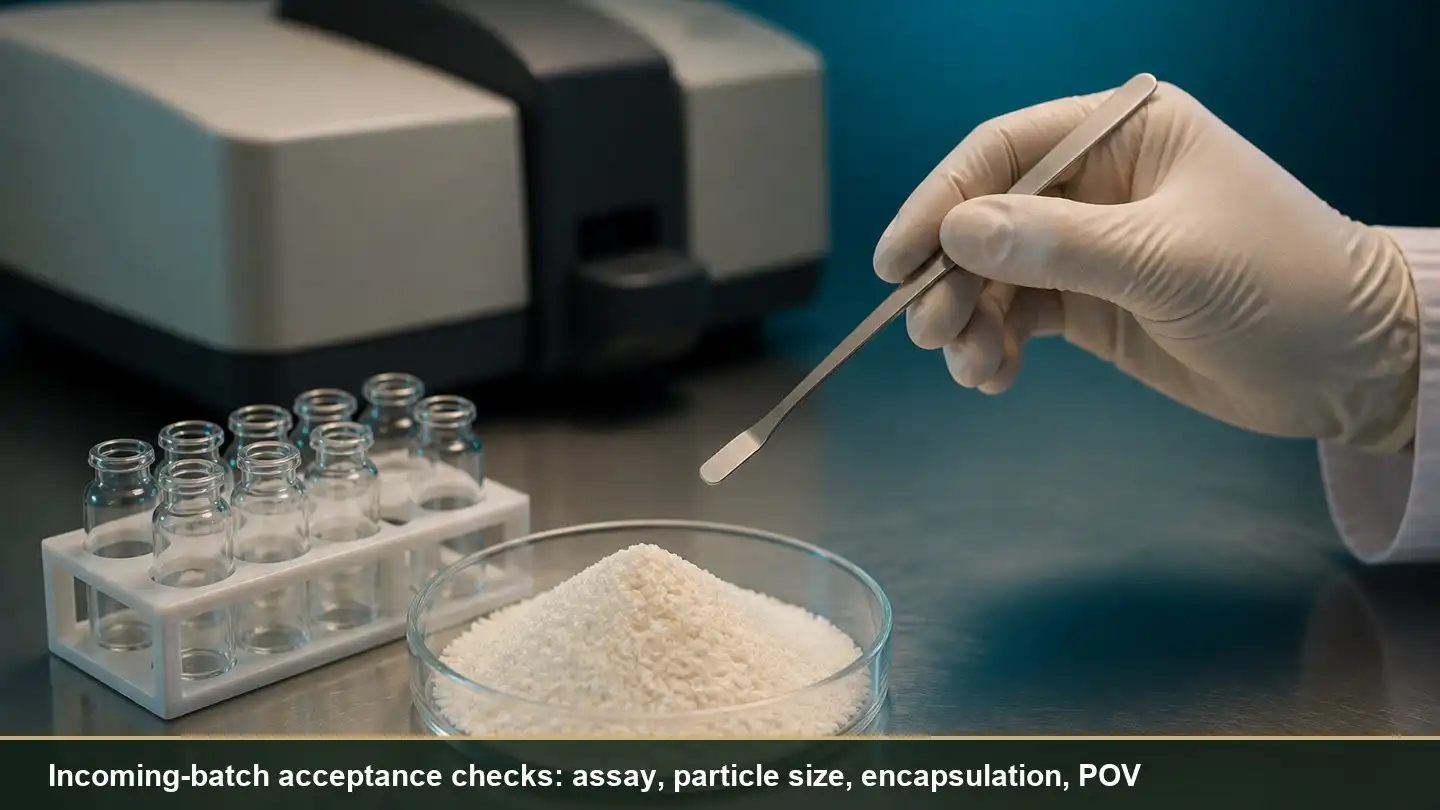
Incoming-Batch Acceptance Criteria and Documentation
Acceptance criteria work best when each check names the method behind the number, so a result can be compared with the reference batch rather than with a value from another supplier's sheet.
| Acceptance check | Method named on the specification | What the result confirms |
|---|---|---|
| Trans-resveratrol content | HPLC | Assay baseline for the lot received |
| Trans-isomer purity, ≥99% | HPLC | Isomer profile against the marketed specification |
| Particle size distribution | DLS | Colloidal consistency and comparability with the reference lot |
| Vesicle morphology | TEM | That lamellar structures are present in the material supplied |
| Encapsulation efficiency, 85%–92% | Lot-specific value on the COA | Batch result inside the published range |
| Peroxide value of the lipid fraction | Iodometric titration | Oxidative state of the carrier system |
| Heavy metals, Pb < 0.5 ppm | Third-party laboratory report | Contaminant screening per lot |
| Microbiology, TPC < 1,000 cfu/g | Total plate count | Hygiene status at release |
Keep the method list stable: switching mid-project, for example comparing a DLS result with a laser-diffraction result, produces an apparent quality change that is really a method change.
Label and Claim Boundaries for Finished Products
Label decisions sit with the brand, but they constrain what the ingredient documentation must support. Declare the ingredient as supplied, with carrier and phospholipid components listed according to the rules of the market where the product is sold. The amount per serving belongs to the formulation record as an input quantity, not as a recommendation to the consumer. Any structure-function style wording has to be substantiated and carry the disclaimer required in that market; the supplier's role is to describe the ingredient and its test results, not to supply campaign copy. Keep specification and label consistent too: if the label commits to an encapsulation figure, the release protocol has to measure it.
The Technical File to Request From a Supplier
For bulk supply into dietary supplement production, the most effective due-diligence step is a short, specific document request:
- A specification sheet listing the acceptance ranges actually tested per batch, not only target values.
- A Certificate of Analysis for the specific lot on offer, carrying lot number, production date, methods and results — not an illustrative certificate.
- A method list naming the technique behind each parameter: HPLC for content, DLS for particle size, TEM for morphology, iodometric titration for peroxide value.
- Certificates showing holder, manufacturing site and expiry: cGMP, ISO 9001, ISO 22000, Kosher and Halal, plus Non-GMO and Vegan statements where the label needs them.
- Traceability records and a change-control undertaking that flags any change of carrier, phospholipid source or drying route before shipment.
Failure Modes Worth Designing Out Early
- Pushing a high inclusion rate into a small fill weight, producing a carrier-heavy premix that fails on taste before it fails on chemistry.
- Assuming cold-water dispersion data transfers to an acidic finished beverage; the test belongs in the matrix.
- Re-wetting and re-drying a spray-dried liposomal powder through wet granulation and expecting the encapsulation figure to hold.
- Setting a shelf-life claim from raw-material stability data alone, without a finished-product protocol.
Requesting Specifications, COAs and Samples
EmerWell supplies liposomal raw materials for sports nutrition, functional food and supplement development. For an evaluation, request the specification sheet, a current Certificate of Analysis for the lot on offer, and a sample of the grade under review — concentrations from 10% to 50% are customisable, so the grade should be chosen against your fill weight and dispersion target. Details are on the liposomal resveratrol powder product page, or write to info@emerwell-bio.com with your format, inclusion rate and target shelf life. Commercial terms are confirmed in writing for each project.
References
- Rahim MA, et al. Liposomal Encapsulation in Food Systems: A Review of Formulation, Processing, and Applications. Food Science & Nutrition. 2025;13(8):e70587. https://pmc.ncbi.nlm.nih.gov/articles/PMC12321603/
- Physical Stability and Molecular Mobility of Resveratrol in a Polyvinylpyrrolidone Matrix. Molecules. 2025;30(9). https://pmc.ncbi.nlm.nih.gov/articles/PMC12073277/
- Development and Validation of an RP-HPLC Method for trans-Resveratrol in HPβCD-Loaded Stealth Liposomes: Stability and Release Studies. ACS Omega. 2025;10(51):62543–62553. https://pmc.ncbi.nlm.nih.gov/articles/PMC12756786/
- Effect of packaging and encapsulation on the oxidative and sensory stability of omega-3 supplements. Food Science & Nutrition. 2023;11(3):1426–1440. https://pmc.ncbi.nlm.nih.gov/articles/PMC10003024/
- Effects of Water Activity and Temperature on the Caking Properties of Amorphous Carbohydrate Powders. Journal of Applied Glycoscience. 2025;72(1):7201103. https://pmc.ncbi.nlm.nih.gov/articles/PMC11975220/
This article is written for B2B ingredient buyers and product developers and describes ingredient, formulation and documentation characteristics only. It is not medical or nutritional advice and makes no claim about the effect of any ingredient or finished product on human health.
Online Message