

Oct 16, 2026
Liposomal Omega-3 Powder Solubility: What Formulators Need to Know
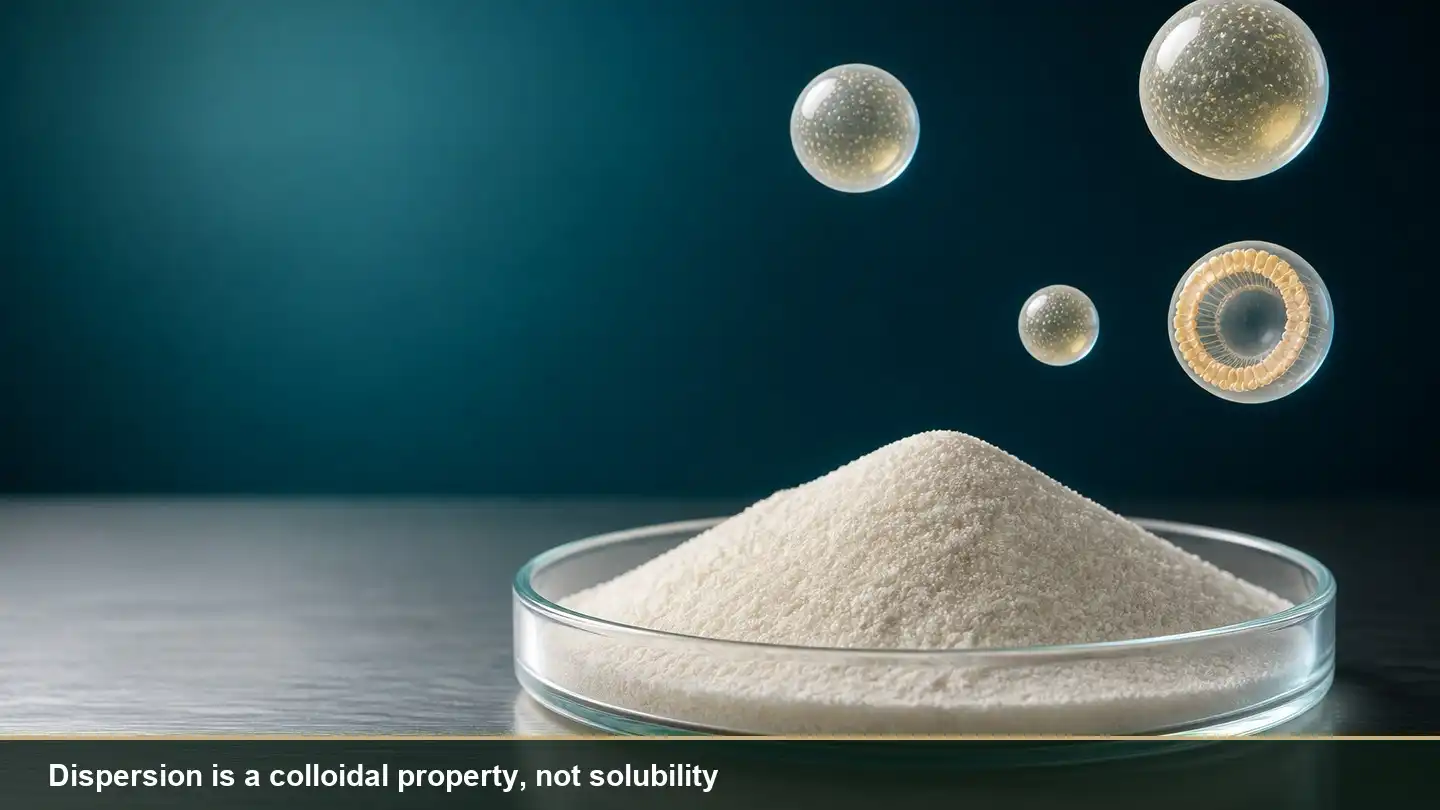
Ask a formulator whether liposomal omega-3 powder is “soluble” and the honest answer is that the question is mis-framed. EmerWell supplies liposomal omega-3 powder as a bulk raw material, and what the material actually does in water is disperse: the phospholipid vesicles wet out, separate into individual particles and stay distributed as a colloidal system. Nothing dissolves in the molecular sense. That distinction decides which measurements are meaningful, which lines on a specification sheet are worth negotiating, and how “water-dispersible” should be read on a supplier data sheet.
Solubility, Dispersion and Colloidal Stability Are Different Things
True solubility describes a molecularly dissolved state: a substance breaks down to single molecules or ions and the mixture becomes one phase. A liposomal dispersion is instead a two-phase system in which discrete vesicles stay suspended in water. The quality of that suspension, not its solubility, is what a formulator can measure and specify.
Why the Word “Solubility” Still Appears in Specifications
The vocabulary has stuck for commercial rather than scientific reasons: “water-soluble” is familiar shorthand and buyers ask for it by reflex. When a data sheet for this ingredient class uses the word solubility or dispersibility, it is describing two testable properties: how completely the powder re-disperses on reconstitution, and how long the resulting system stays homogeneous.
What Formulators Actually Need to Specify
Re-dispersibility is a property of the powder; system stability is a property of the finished liquid. Both need their own acceptance criteria, because a powder can re-disperse quickly and still settle within days.
The Material-Side Parameters That Decide Dispersion Quality
Dispersion behaviour is not random. It follows from a few parameters set during manufacture and reported on the certificate of analysis, so the science behind liposomal omega-3 powder formulation is worth reviewing before a specification is agreed.
| Parameter | Typical specification | Why it drives dispersion behaviour |
|---|---|---|
| Encapsulation efficiency | > 85% | Active left outside the bilayer behaves as free oil and forms a surface film instead of a distributed phase. |
| Particle size distribution (DLS) | Narrow, uniform distribution; repeatable lot to lot | Mean size and polydispersity set how quickly vesicles diffuse and how evenly the system scatters light. |
| Carrier composition | Food-grade phospholipid bilayer, controlled lipid-to-active ratio | Determines bilayer flexibility, surface charge and how readily the dried powder re-hydrates. |
| Peroxide value (POV) | < 2 meq/kg | Oxidised lipids form a weaker interfacial film, so the powder resists re-dispersion before processing even begins. |
| Active concentration | 10%–25% (standard grade DHA 10%, EPA 5%) | Fixes how much powder a formula must carry to reach the intended load, and therefore the solids level. |
| Lead | < 0.5 ppm | Reported with the heavy-metal panel and verified batch by batch. |
| Total plate count | < 1000 cfu/g | Microbiological baseline that reflects handling, yet part of the same release decision. |
| Analytical methods | HPLC, DLS, TEM and iodometric titration | The measurement route behind every number above. |
Encapsulation Efficiency Sets the Ceiling
Active material outside the bilayer behaves like ordinary oil: in water it forms a film and a surface ring. Encapsulation efficiency above 85% is the working floor for a powder expected to disperse cleanly, and it is the value most easily overstated on a summary sheet, so it is worth asking how liposomal omega-3 powder is made and which process stage sets the lipid-to-active ratio.
Particle Size Distribution and Surface Charge
Dynamic light scattering reports a mean size and a width. A narrow distribution scatters light consistently; a broad one contains large vesicles that settle first and small ones that stay up. Zeta potential explains why some dispersions resist aggregation and others do not.
Oxidative State Is a Dispersibility Parameter
Oxidation and dispersion are usually considered separately, and they should not be. A peroxide value below 2 meq/kg indicates how much oxidative change the lipid has already undergone, and oxidised phospholipids form a less coherent interfacial film. A powder that is already oxidised will disperse poorly however it is handled afterwards; the background is covered in this note on why omega-3 ingredients lose freshness.
The Rest of the Certificate
Lead below 0.5 ppm and total plate count below 1000 cfu/g do not change dispersion directly, but they belong to the same panel. Buyers who want a repeatable way to compare lots can follow a systematic approach to evaluating the purity of liposomal omega-3 powder before signing a specification.
How Dispersibility Is Actually Measured
Four techniques cover most of what a formulator needs. The practical value lies in pairing a fast visual check with an instrumented measurement, run under conditions that resemble the intended product. Failures that appear only after scale-up are described in the wider literature on stability challenges in liposomal omega-3 powder formulations.
Visual Observation: Sediment, Cream and Surface Film
Reconstitute the powder at the intended concentration, in the intended liquid and at the intended temperature, then look. Sediment, a cream layer and an oily ring on the glass are all informative. Because a colloidal system rarely looks the way people expect, this piece on what liposomal products actually look like is a useful reference before judging a sample by eye.
Turbidity and Light Scattering
Turbidity measures how much light a suspension scatters, which rises with particle concentration and size and falls as particles settle out. Read against a retained reference sample of the same grade, it is a quick way to detect settling before it becomes visible; the trend matters more than the absolute number.
Particle Size and Surface Charge by DLS
Dynamic light scattering recovers a mean particle size and a distribution width from the way particles move in suspension, and the technique is standardised: ISO 22412:2017 sets out how these measurements should be performed. Zeta potential indicates whether the surface charge is strong enough to keep vesicles from aggregating.
Accelerated Centrifugation
Spinning a reconstituted sample at high relative centrifugal force compresses days of settling into minutes. It is no substitute for real-time storage data, but it separates a powder that disperses robustly from one that only looks acceptable in the first hour. Record the sediment volume, not just the appearance of the tube.
| Observed behaviour | Most likely cause | Which parameter to check |
|---|---|---|
| Oily film or ring on the surface | Unencapsulated oil, or a system too dilute to hold the payload | Encapsulation efficiency; lipid-to-active ratio |
| Rapid sediment at the bottom | Vesicle population too coarse, or surface charge too low to keep particles apart | DLS mean size and polydispersity; zeta potential |
| Cream layer rising to the top | Density difference combined with a weak interfacial film | Carrier composition; visual assessment over time |
| Uniformly cloudy but stable | The expected appearance of a colloidal system, not a defect | Turbidity against a retained reference sample |
| Slow increase in haze or colour on storage | Oxidative change in the lipid phase | Peroxide value on the stored sample |
| Immediate clumping when powder meets liquid | Poor wetting, high local solids, or an aggressive ionic environment | Re-dispersion time; ionic strength of the test medium |
What Destabilises a Dispersion Once It Is Formed
A dispersion that is correct on the day of release can still fail later, and the causes are usually environmental rather than defects in the powder.
- pH and acidity. Acidic or alkaline media alter the charge on the vesicle surface, so a system that looks stable near neutrality may behave differently in a fruit-based base.
- Ionic strength. Dissolved electrolytes compress the electrical double layer around each particle, making high-salt and mineral-rich matrices harder environments than plain water.
- Thermal processing. Heat softens the phospholipid bilayer; the higher the temperature and the longer the hold, the greater the structural change.
- High shear. Aggressive mixing can tear vesicles apart, releasing active material and creating free oil.
- Prolonged standing. Gravity acts continuously, so a dispersion stable for a day may still settle over months on a shelf.
- Oxygen and light. Both accelerate oxidative change in the lipid phase, weakening the interfacial film over time.
Recognising these influences is not the same as correcting them; matrix selection, order of addition and shear limits belong to formulation development, and a beverage-focused walkthrough appears in this discussion of using liposomal omega-3 powder in beverage formats.
Reading a Specification Sheet: Turning “Water-Dispersible” into Acceptance Criteria
A specification only works as a contract if both sides test the same thing in the same way. The table below translates common data-sheet phrases into metrics that can be written down, measured and repeated.
| Data-sheet wording | What it should mean | Metric to agree on |
|---|---|---|
| Water-dispersible | The powder wets out and distributes in cold water without an added emulsifier | Time to full wet-out, and absence of a surface film at a defined concentration and temperature |
| Stable suspension in cold liquids | No measurable sediment or cream over a stated period | Sediment volume after centrifugation plus a visual grade against a reference |
| Uniform particle size distribution | A narrow distribution that repeats from lot to lot | Z-average and polydispersity index, with batch trend data |
| High encapsulation efficiency | The majority of the active is held inside the bilayer | Encapsulation efficiency above 85% by the agreed method |
| Oxidatively stable | Lipids within the agreed limit at release | Peroxide value below 2 meq/kg |
| Food-grade phospholipid carrier | The carrier comes from a permitted food source | Carrier specification and full ingredient statement |
Two points are worth adding. A dispersibility claim should state the medium, concentration and temperature it was tested in, because a result in deionised water says little about a finished product. And the parameters that make a powder reliable in use are the ones summarised in this overview of key features of high-quality liposomal omega-3 powder.
What to Ask a Supplier Before You Commit
Suppliers differ in the depth of the technical file they keep, and the difference rarely shows on a one-page summary sheet. Before committing, ask for:
- A dynamic light scattering report for the specific lot under discussion, not a generic range.
- Accelerated stability data showing how a reconstituted sample behaves over time.
- The specification sheet and certificate of analysis for that lot, naming the method used for each value.
- Batch trend data for encapsulation efficiency and particle size, so normal variation is visible.
- Confirmation of the carrier source and the complete ingredient statement.
- A reconstitution sample to test in the intended matrix.
A supplier that answers with documents is easier to work with than one that answers in prose, and the same logic sits behind this guide to choosing a liposomal omega-3 powder supplier.
Requesting Documentation and Samples from EmerWell
EmerWell supplies liposomal omega-3 powder as a bulk raw material for business-to-business customers, produced under cGMP and supported by ISO 9001:2015, ISO 22000, HACCP, Kosher and Halal certification. To discuss a dispersion question, or to request a specification sheet, a certificate of analysis or a reconstitution sample, visit the liposomal omega-3 powder product page or email info@emerwell-bio.com. The team can share the current specification, the analytical methods behind each value and stability data for the grade under consideration.
References
1. Akbarzadeh, A., Rezaei-Sadabady, R., Davaran, S., et al. (2013). Liposome: classification, preparation, and applications. Nanoscale Research Letters, 8:102. https://pmc.ncbi.nlm.nih.gov/articles/PMC3599573/
2. Stetefeld, J., McKenna, S. A., & Patel, T. R. (2016). Dynamic light scattering: a practical guide and applications in biomedical sciences. Biophysical Reviews, 8(4), 409–427. https://pmc.ncbi.nlm.nih.gov/articles/PMC5425802/
3. International Organization for Standardization. ISO 22412:2017, Particle size analysis — Dynamic light scattering (DLS). https://www.iso.org/standard/65410.html
4. U.S. Food and Drug Administration. Dietary Supplements. https://www.fda.gov/food/dietary-supplements
5. European Food Safety Authority. Novel Food. https://www.efsa.europa.eu/en/topics/topic/novel-food
Disclaimer: This article concerns a bulk raw material supplied to business-to-business customers and is provided for technical and informational purposes only. EmerWell is a raw-material supplier and does not sell finished consumer products; it makes no representation about how a finished product may be positioned, labelled or described in any market. Consumer-facing wording, serving information and market-specific labelling remain the responsibility of the brand owner and must be assessed against the rules of the destination market. Nothing here is a legal or regulatory determination; confirm permissibility with your local competent authority or a qualified regulatory adviser.
Online Message