

Nov 25, 2026
Liposomal NMN Powder vs. Standard NMN Powder: What Are the Main Differences?
Two powders can carry the same declared active and still be different products in every way that matters to a buyer: what else is in the drum, how the material behaves on a filling line, what the certificate reports, and what happens to the powder after six months in a stick pack. This comparison of liposomal NMN powder and standard NMN powder is written from the purchasing and formulation side rather than the consumer side, because that is where the decision is actually made.
The Difference Starts With the Bill of Materials
Standard NMN powder is essentially the active plus a small amount of processing aid, with the balance being the raw material's own residual moisture and minor impurities. A liposomal grade adds a phospholipid phase, a drying carrier in most cases, and the process steps needed to form and stabilise vesicles. That single difference propagates through content range, flow behaviour, testing burden and the commercial structure of the purchase.
None of this makes one format better in the abstract. It makes them suitable for different jobs. A buyer who understands which job they are buying for will usually find that only one format survives the first round of screening.
Composition: What Is Actually in the Powder
The first practical difference is the relationship between declared content and total mass. In a standard grade, a 98% or 99% declaration means almost the entire drum is active. In a liposomal grade, the active is a fraction of the powder because the phospholipid and carrier occupy the rest. A 10% grade and a 70% grade are both legitimate products, and they behave very differently at the same serving weight.
| Parameter | Standard NMN powder | Liposomal NMN powder |
|---|---|---|
| Principal components | Active plus minimal processing aid | Active, phospholipid phase and drying carrier |
| Typical declared content | High-purity active | 10%–70% active, depending on grade |
| Dispersibility in cold water | Variable; prone to clumping | Instant dispersion into a translucent nano-emulsion |
| Encapsulation efficiency | Not applicable | 85%–95% by the supplier's method |
| Particle size reporting | Usually a milling specification | DLS distribution of the vesicle population |
| Testing burden | Assay, purity, moisture, microbiology | Assay, encapsulation, size, moisture, microbiology, stability |
For the grade supplied by EmerWell, the declared range is 10% to 70% NMN from 99% purity raw material, with encapsulation efficiency of 85% to 95%, lead below 0.1 ppm, total plate count below 1,000 cfu/g and a shelf life of 24 months or more in powder form. Those figures belong in the specification and in the batch certificate, and a buyer should compare them line by line rather than by headline.
Process: Why the Lipid Step Changes the Specification
Making a liposomal powder requires a step that standard powder does not need: the active has to be brought into contact with a lipid phase under conditions that form a stable structure, and then the whole system has to be dried without collapsing it. Each part of that sequence leaves a fingerprint in the specification.
Homogenisation
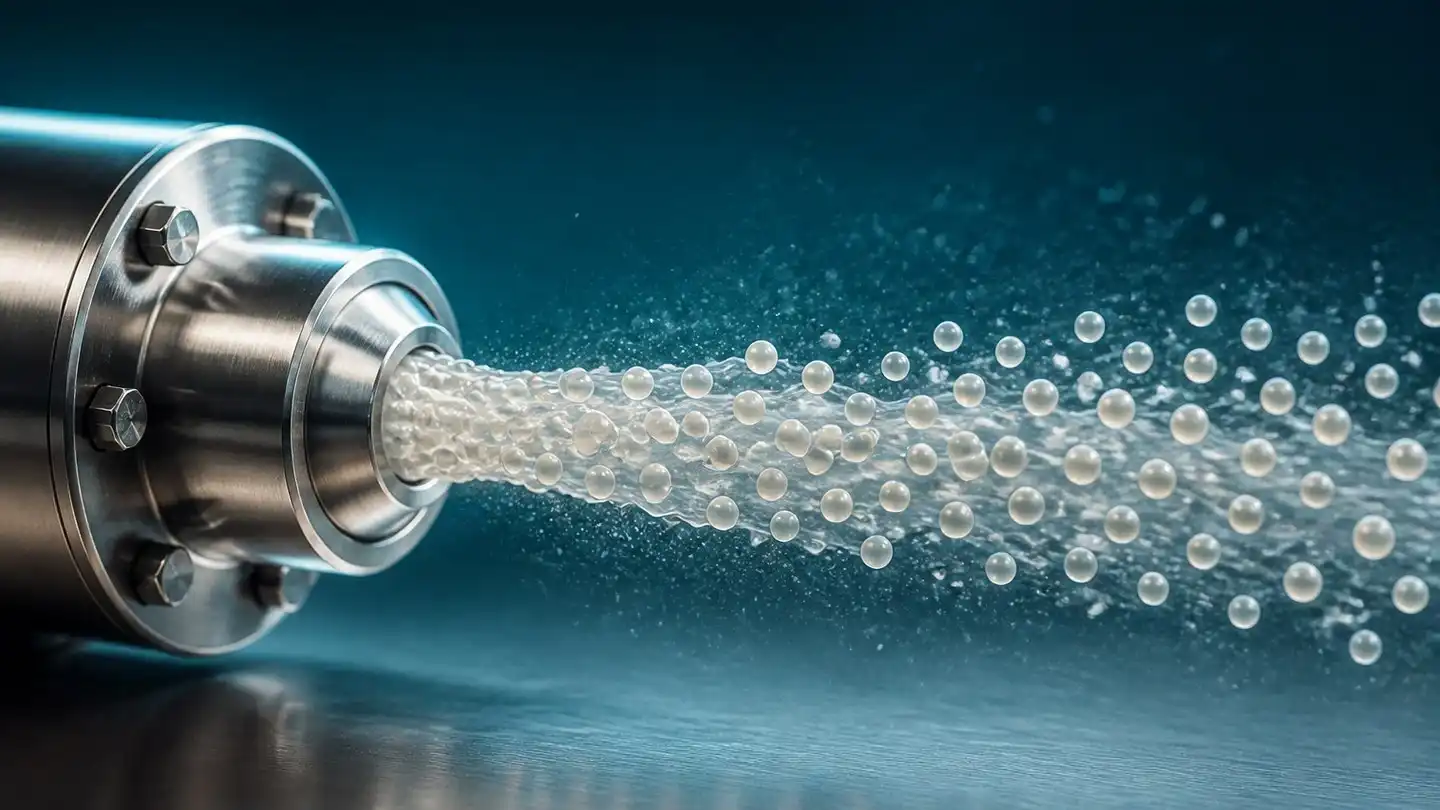
High-pressure homogenisation reduces the vesicle population to a controlled size range. Pressure, temperature, pass count and the ratio of payload to lipid all influence the result, and the consequences are visible in the DLS report. A supplier that can show a narrow, repeatable distribution across batches is demonstrating process control, not just analytical capability.
Drying
Spray drying is the usual route because it produces a free-flowing powder that redisperses in cold water. The inlet and outlet temperatures matter: too much heat damages the lipid structure and raises the non-encapsulated fraction, while too little leaves residual moisture that shortens shelf life and encourages caking. The certificate should report moisture, and the specification should state the limit.
Quality Control
A liposomal grade needs at least three measurements a standard grade does not: encapsulation efficiency, particle size distribution, and a stability protocol that tracks both over time. Assay alone will not distinguish a well-formed batch from one whose vesicles collapsed during drying, because the total active is unchanged in both cases.
Behaviour in a Finished Format
Most purchasing decisions are settled by what happens on the line rather than in the drum. The two formats diverge most sharply in three common formats.
Capsules
Standard NMN is dense and flows well, which makes it easy to fill at high speed. A liposomal grade is lighter and more cohesive, so the filling window is narrower and the fill weight tolerance deserves attention. Tableting is harder still: compression can rupture vesicles, and a direct-compression route should be validated before it is scaled.
Stick Packs
This is where liposomal grades earn their place. Instant cold-water dispersion without the clumping typical of standard NMN is a consumer-visible property, and it also reduces the chance of a hard plug forming in the sachet during storage. Flowability and hygroscopicity still need checking, because a powder that disperses well but picks up moisture on the line will cake in the box.
Ready-to-Drink Beverages
A standard powder dissolves with difficulty and can leave sediment; a liposomal grade forms a translucent nano-emulsion that holds in suspension. The advantage is physical, not chemical, and it has to be demonstrated over the declared shelf life rather than at the moment of mixing. Heat processing, pH and the presence of minerals all affect how long the dispersion stays stable.
| Application | Standard NMN | Liposomal NMN | Deciding factor |
|---|---|---|---|
| Two-piece capsule | Straightforward | Workable, narrower fill window | Fill weight and flow |
| Hard tablet | Common | Requires compression validation | Vesicle survival |
| Stick pack | Clumping risk | Strong fit | Dispersion and taste |
| Ready-to-drink | Sediment risk | Strong fit | Suspension stability |
| Premix with minerals | Simple | Needs compatibility work | Moisture and metal contact |
Documentation and Testing Differences
The documentation package is where the two formats separate most clearly for a quality team. A standard grade can be released on assay, purity, moisture, heavy metals and microbiology. A liposomal grade needs those plus evidence that the delivery structure exists and survives.
What the Certificate Should Carry
At minimum: assay of the active, identity confirmation, moisture, heavy metals, microbiological status, appearance, and the encapsulation result with the method named. Particle size should be reported as a distribution with a span rather than a single figure. Where the supplier uses NMR, HPLC and DLS, the certificate should say which technique produced which number, because the three answer different questions.
Stability Protocols
Accelerated and real-time studies should track assay, encapsulation efficiency, particle size and moisture at each pull point. A protocol that tracks only assay will miss the failure mode that matters most for a liposomal product, which is the gradual loss of structure while the total active remains unchanged. Buyers should ask for the protocol, not just the conclusion.
Batch Traceability
Traceability from raw material lot to finished batch is a regulatory expectation in most markets and a practical necessity in a recall. The lot number on the certificate should connect to the production record, the packaging record and the stability samples retained from that batch.
Commercial Structure Without Quotation Guessing
The two formats carry different cost structures even before any quotation is issued, and understanding those structures makes a negotiation more productive. A liposomal grade consumes more processing time, more energy and more testing per kilogram, and it yields less active per kilogram of powder. Those three facts explain most of the difference in quoted value without anyone having to disclose a number.
On the brand side, the relevant comparison is cost per serving rather than cost per kilogram. A 50% grade delivers the same active with half the powder mass of a 25% grade, which changes capsule size, freight volume and packaging. A format that looks more expensive per kilogram can be cheaper per finished unit once fill weight and shipping are included, and the reverse is also common.
Yield, Overage and Fill Weight
Liposomal powders are lighter and more cohesive, so line losses during filling tend to be higher than with a dense standard powder. That loss has to be covered somewhere, either through an overage or through a larger batch. Brands should measure line loss on a pilot run rather than assume the same efficiency they achieve with a standard grade.
Sampling and Incoming Inspection
A sample that arrives in a plain bag with a handwritten label is not a sample of the batch you will buy. Ask for the lot number, the certificate for that lot, and a sample drawn from it after packing. On receipt, verify the seal, the headspace condition and the net weight before opening anything, then retain a portion in the original packaging for comparison at the end of the project.
The tests worth running in house depend on capability. Moisture and appearance are cheap and reveal handling problems early. Assay by HPLC confirms the declared content. Encapsulation and particle size usually require a partner laboratory, which is why the supplier's own reports and the third-party reports should be requested together and compared for consistency.
What a Discrepancy Means
If the incoming assay differs from the certificate by more than the method's expected variation, the first question is whether the two laboratories used the same method and the same sample preparation. If they did, the difference is a finding about the batch, not about the analysis, and it should be raised before the material enters production. Suppliers who answer that question with a fresh certificate rather than an explanation are telling you something about their quality system.
Decision Checklist
A short checklist resolves most of these comparisons quickly. Does the format require dispersion in water? If yes, the liposomal grade is usually the simpler route. Is the serving small enough that a low-concentration grade would not fit? If yes, a higher-concentration liposomal grade or a standard grade may be the only options. Does the brand need a differentiated technical story for retail? If yes, the documentation behind a liposomal grade is an asset, provided it is complete. Does the project have the analytical capacity to verify encapsulation on receipt? If not, the supplier's third-party reports become the only control, and they should be requested for every batch.
Scale-Up Risks Worth Planning For
The failure modes that appear at scale are rarely the ones seen on the bench. Moisture pickup during long filling runs, static charge in a dry room, and segregation of a light cohesive powder from denser partners in a blend all emerge once the batch is measured in hundreds of kilograms. A pilot run at production speed, with samples taken at the start, middle and end, will expose most of them while they are still cheap to fix.
Packaging deserves the same attention. A multi-layer foil with nitrogen flushing protects the powder only if the seal is intact and the headspace is genuinely low in oxygen. Brands should ask for the seal integrity test and the residual oxygen figure, and should repeat both after transit on at least one shipment.
EmerWell supplies liposomal NMN powder manufactured in cGMP, ISO 9001, ISO 22000, FSSC 22000 and HACCP certified facilities, with Kosher, Halal, Non-GMO and Vegan compliance, packed under nitrogen in multi-layer foil. Buyers comparing formats can read the delivery and absorption comparison and how liposomal NMN compares with other forms, then review what to check in a liposomal NMN certificate of analysis. The production route is described in how liposomal NMN powder is made, and the naming question is answered in the difference between NMN and liposomal NMN.
To compare a sample against your own specification, request a batch certificate and a sample from the same lot. Write to info@emerwell-bio.com or review the liposomal NMN powder page for the current parameter list.
This article is written for ingredient buyers, formulators and quality reviewers. It describes raw material specifications and analytical practice only, and is not medical or nutritional advice.
References
- U.S. Food and Drug Administration. Dietary supplements: regulatory and safety information. https://www.fda.gov/food/dietary-supplements
- Office of Dietary Supplements, National Institutes of Health. Dietary supplement fact sheets and research resources. https://ods.od.nih.gov/factsheets/list-all/
- PubMed search results, nicotinamide mononucleotide pharmacokinetics. https://pubmed.ncbi.nlm.nih.gov/?term=nicotinamide+mononucleotide+pharmacokinetics
- PubMed search results, liposomal encapsulation and bioavailability. https://pubmed.ncbi.nlm.nih.gov/?term=liposomal+encapsulation+bioavailability
Online Message