Oct 12, 2026
Liposomal NMN Powder Dosage: What Buyers Should Know
Sourcing liposomal NMN powder? The word “dosage” appears early in almost every brief, and it is almost always misread. In this article the term is used in a strictly engineering sense: unit dosage-form design and load conversion — how a chosen active content translates into the mass of powder that goes into one capsule, sachet, tablet or gummy. It is not a serving recommendation: EmerWell supplies raw material to businesses, and the quantity a consumer takes is set by the brand owner under its own market rules. What a technical buyer engineers is the arithmetic between a specification line such as NMN 10%–70% by weight and a reproducible finished unit. Reference values below come from our published liposomal NMN powder specification, and every figure in this article is a formulation input rather than a human intake instruction.
Dosage Here Means Dosage-Form Design, Not a Serving Instruction
Three questions get collapsed into the single word “dosage.” The first is a formulation question: how much active a unit is designed to carry. The second is arithmetic: how much powder that load requires at a given content. The third is regulatory: how an end consumer is told to use the finished product. A raw-material supplier informs the first two; only the brand owner, working to its own market rules, answers the third. When a specification sheet and a finished label appear to disagree, these three layers have usually been merged somewhere in the chain.
From Active Content to Powder Mass: The Arithmetic of Load
Liposomal NMN is not a single fixed substance on a scale. It is an active carried on a phospholipid system, so the material is described by an active content by weight, published as NMN 10%–70%. Everything that follows is a consequence of that one number.
Setting a Target Active Load per Unit
Design work starts from a target active load per unit — the quantity of NMN that one finished capsule, sachet or tablet is designed to carry. That target is a brand decision and the pivot for every conversion that follows; the hypothetical value used below is chosen only to make the numbers readable and is not a recommendation.
A Worked Conversion Table (Illustration Only)
| NMN content (raw material, by weight) | Active in 1 g of powder | Powder mass for a 250 mg active load* | Single size 0 capsule (approx. 0.5 g fill) |
|---|---|---|---|
| 10% | 100 mg | 2,500 mg | Not feasible |
| 20% | 200 mg | 1,250 mg | Not feasible |
| 50% | 500 mg | 500 mg | Marginal; little room left |
| 70% | 700 mg | 357 mg | Feasible; room for excipients |
*The 250 mg active load is an arithmetic anchor chosen only to make the columns readable. It illustrates conversion and is not a serving recommendation; the actual target load is set by the brand owner under its own market rules.
Why the Same Target Needs Different Powder Masses
The conversion is pure division: powder mass equals target active load divided by active content, so halving the content doubles the powder. A brand with a fixed target load therefore faces a real constraint: a lower-content material spreads the active evenly through a large bed of carrier but demands far more powder per unit, while a higher-content material shrinks the powder burden but concentrates the mixing challenge. Weighing those trade-offs is the substance of choosing liposomal NMN powder for your formula, and it is decided long before a purchase order is raised.
How Powder Mass Drives Dosage-Form Format
Powder mass per unit decides which dosage forms are physically open to a project: a capsule that cannot hold the powder, a sachet reformulated around a bulky fill, or a gummy whose matrix will not accept the load are all downstream of the conversion table.
Hard Capsules
Free-flowing powders fill a size 0 capsule at roughly 0.5 g and a size 00 at roughly 0.7 g in typical practice. Those are hard ceilings: a project whose conversion table calls for 1.25 g per unit cannot be built in a single size 0 capsule, whatever the label says, so content tier and capsule size have to be solved together rather than sequentially.
Sachets and Stick Packs
Stick packs and sachets hold gram-scale fills, commonly 2–6 g, making them the most forgiving format for lower content tiers. The trade-off is that a larger powder bed must disperse cleanly and carry an acceptable taste, so dispersion behaviour and particle-size distribution matter more here than in a capsule. The reach of liposomal NMN powder applications in wellness products is largely decided by which of these formats a formulation can reach.
Tablets and Gummies
Tablets compress a fixed unit weight and reward a compact, free-flowing powder; gummies are constrained by a matrix that can only carry so much active before texture and content uniformity suffer. A higher content tier reduces how much powder either format must host, which is often the difference between a feasible design and one that has to be reworked. Since the powder is processed before it reaches these formats, it also helps to understand how liposomal NMN powder is made and where the mixing steps sit.
| Dosage form | Typical unit fill | What the format rewards | Effect of a higher content tier |
|---|---|---|---|
| Hard capsule, size 0 / 00 | approx. 0.5 g / 0.7 g | Precise unit weight | Fewer or smaller capsules for the same load |
| Sachet / stick pack | 2–6 g | Dispersion and taste balance | Lighter fill, easier mixing, less bulking |
| Tablet | 300–1,000 mg | Compressibility of the blend | Less powder to compress; compressibility must be re-checked |
| Gummy | matrix-limited, roughly 2–3 g | Texture and sensory profile | Eases the matrix load but tightens content uniformity |
Why “Higher Content Is Better” Is a Misconception
It is tempting to fall back on the top of the range, reasoning that less powder must be simpler, but the opposite is often true. A higher content tightens the mixing and assay burden: with more active packed into every gram, a small blending error becomes a larger deviation in content uniformity, and the acceptable window around the target narrows. High content also leaves less room for co-actives and excipients, and a very high tier leaves less tolerance for batch-to-batch variation in the carrier. The “best” content is the one that matches the dosage form, the rest of the formula, the blending equipment and the analytical control of the specific manufacturer — which is why two brands apparently making the same product can specify this material quite differently. The contrast with an unencapsulated alternative is a further input to how liposomal NMN powder compares with other forms of NMN.
Content, Purity and Encapsulation Are Three Different Numbers
Three figures across a specification are routinely read as if they meant the same thing. They do not.
Content
Content is a blend ratio: the percentage of NMN by weight in the material as supplied, published here as 10%–70%. It is a property of the mixture and can be set high or low without any change to the NMN molecule itself.
Purity
Purity is a property of the active on its own. The NMN used in this material is 99% pure — a statement about the molecule, measured before it is blended onto the carrier, and not interchangeable with the content figure.
Encapsulation Efficiency
Encapsulation efficiency describes structure: the percentage of the active physically enclosed within the liposomal system rather than loosely associated with it. This material is published at 85%–95%, and a supplier could quote the same content and purity at two different encapsulation efficiencies and be describing two different materials. Keeping the three apart is the same discipline that checking a liposomal NMN powder COA demands line by line.
How Testing Backs Up a Content Claim
A content figure is only as good as the method behind it, which is why this specification names three. HPLC is the reference method for purity and assay, resolving the NMN molecule from related species. DLS maps particle-size distribution, how the powder’s dispersion behaviour is characterised rather than merely asserted. NMR quantifies encapsulation, distinguishing material genuinely inside the liposome from material only present in the blend. Each method answers one question; a single certificate line, read without its method, tells a buyer very little. The theme of sourcing liposomal NMN powder for potency and purity turns on exactly this pairing of a number with its method.
The Most Common Labelling Error: Confusing Raw-Material Content with Finished-Product Content
By far the most frequent mistake at the receiving end is to lift the raw-material content straight onto the finished label. If a brand buys material at 50% NMN and repeats “50%” as the finished product’s active share, it has omitted the carrier and every other ingredient. The correct figure comes from the actual blend: how much material, at its stated content, sits inside the finished unit, divided by the finished unit’s weight. Getting this wrong is not a rounding issue but a label-accuracy one, and it compounds across a range of SKUs. A disciplined routine of asking the right questions up front — specification, certificate and a third-party result reconciled item by item — is what keeps the number honest, the purpose of what to ask a liposomal NMN powder manufacturer.
Choosing a Content Tier: A Short Framework
Work through these steps in order, and the content tier usually selects itself:
- Fix the dosage form first, and read its realistic unit fill capacity.
- Fix the target active load per unit, then run the division for each candidate content.
- Check whether the required powder mass fits the chosen format; if it does not, move the format or the content, not the target.
- Check the room left for co-actives and excipients at the candidate tier.
- Confirm the manufacturer’s blending and content-uniformity capability at that tier, together with the analytical method that will stand behind the content claim.
- Confirm the certification set the destination market expects, as set out in what certifications to look for in liposomal NMN powder.
Request a Specification, COA or Sample
EmerWell supplies liposomal NMN powder at NMN 10%–70% with encapsulation efficiency 85%–95%. If you are setting a content tier for a new formula, send us the dosage form, the unit fill and the target active load, and we will return a specification, a batch certificate of analysis and a sample so your team can repeat the conversion and dispersion checks.
| Published parameter | Value |
|---|---|
| NMN content | 10%–70% (customizable; raw material 99% purity) |
| Encapsulation efficiency | 85%–95% |
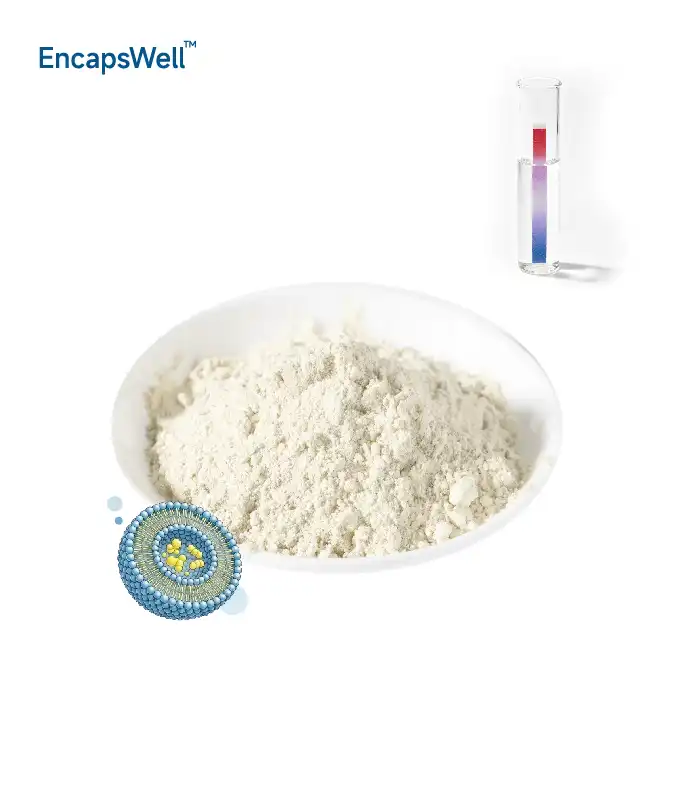
| Appearance | White to off-white free-flowing fine powder |
| Dispersion | Instant cold-water dispersion; stable semi-translucent nano-emulsion |
| Stability | 24+ months (powder, correct storage) |
| Lead (Pb) | < 0.1 ppm |
| Total plate count | < 1,000 cfu/g |
| Methods | HPLC (purity) / DLS (particle size) / NMR (encapsulation) |
| Certification | cGMP, ISO 9001, ISO 22000, FSSC 22000, HACCP, HALAL, KOSHER, Non-GMO, Vegan |
Start from the liposomal NMN powder product page or write to info@emerwell-bio.com with your target unit load, and we will match the specification to it.
References
1. U.S. Food and Drug Administration. Liposome Drug Products: Chemistry, Manufacturing, and Controls; Pharmacokinetics and Labeling Documentation. Guidance for Industry. fda.gov.
2. International Council for Harmonisation. Q2(R2) Validation of Analytical Procedures. 2023. database.ich.org.
3. Rodriguez-Loya J, Lerma M, Gardea-Torresdey JL. Dynamic light scattering and its application to control nanoparticle aggregation in colloidal systems: a review. Micromachines (Basel). 2023;15(1):24. PMC10819909.
4. International Council for Harmonisation. Q1A(R2) Stability Testing of New Drug Substances and Products. database.ich.org.
Disclaimer: this material is a raw material supplied to businesses and is not directed to end consumers. Any end-use quantity or performance statement is determined and borne by the brand owner in accordance with its own market regulations. Nothing in this article is a serving recommendation or a statement about human health outcomes, and buyers should confirm regulatory requirements with their own authorities.
Online Message
YOU MAY LIKE
High quality furniture manufacturer