

Nov 23, 2026
Liposomal NAD+ Powder and Brain Health: What Does the Research Say?
The question of what the research says about liposomal NAD+ powder and brain health is worth answering carefully, because it is usually two questions wearing one coat. The first is what the published literature establishes about NAD+ and nervous-system tissue. The second is what a supplier of a raw material can document about their grade. The two are related but not interchangeable, and reading them as one is how brands end up with a claim they cannot defend.
Separating the Literature Question From the Product Question
Published work on NAD+ precursors and brain tissue is dominated by animal models and by mechanistic studies in cell systems. That body of work is genuinely useful for understanding pathways, and it is not evidence that a specific finished product will do anything in a person. A raw material supplier cannot close that gap, and a buyer should be sceptical of any supplier who implies otherwise.
What a supplier can document is narrower and more concrete: identity, content, encapsulation efficiency, particle size, oxidative and microbiological status, and the stability of those parameters over a stated shelf life. Those are the facts that belong in a technical agreement. The efficacy question belongs to the brand's own substantiation work, and it will require its own evidence.
What Each Kind of Study Can Support
Research literacy here means knowing what a given study design can and cannot establish. The table below is the version worth keeping at hand during a claim review.
| Study type | What it can establish | What it cannot establish |
|---|---|---|
| Cell-culture mechanistic work | Whether a pathway exists and responds to a substrate | Whether an oral dose reaches that tissue |
| Animal model | Whether an effect is observable in a controlled organism | Whether the same effect occurs in humans at a tolerable intake |
| Human pharmacokinetic study | Whether a marker in blood changes after intake | Whether any tissue-level or functional outcome changes |
| Human intervention trial | Whether a measured outcome differs from control | Whether the result generalises to a different population or product |
| Review or meta-analysis | What the aggregate of available studies suggests | Anything the underlying studies did not measure |
The third row is where most marketing language quietly overreaches. A change in a circulating marker is a real result, but it is a result about the marker. Moving from there to a statement about brain function requires an additional study that measured brain function, and that study is a different study.
Where the Delivery System Enters the Argument
Liposomal delivery makes a physical argument, not a pharmacological one. The argument is that a vesicle can carry the active through the gastric environment with less loss than a bare powder, that the particle size influences what happens at a membrane, and that encapsulation efficiency determines how much of the declared amount is actually inside a structure. Those statements can be measured and specified.
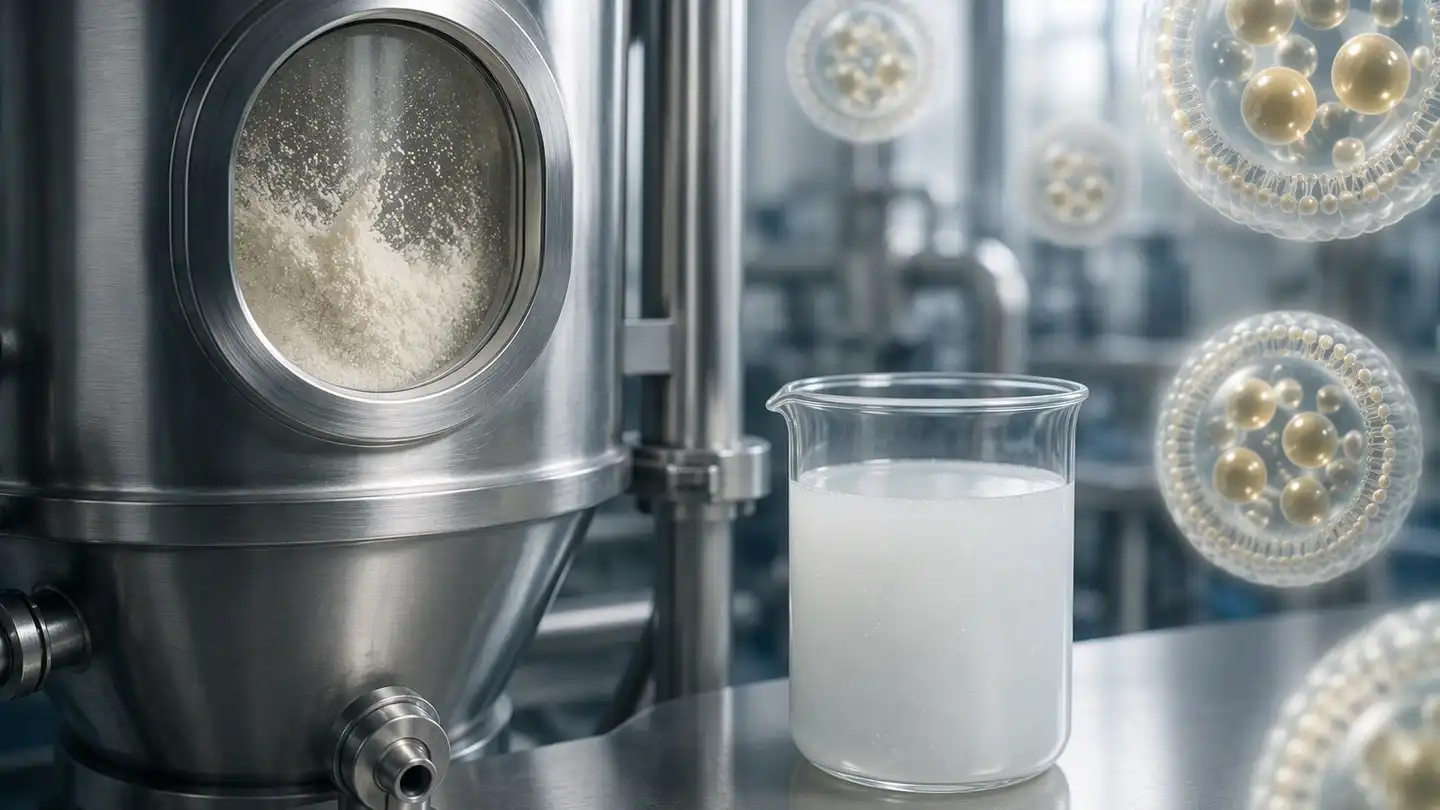
They do not, on their own, establish an outcome in humans. What they establish is that the grade has a delivery property worth testing. That distinction matters commercially as well as scientifically: a brand can say the powder is liposomal, with data, long before it can say anything about what the product does.
The specification for this grade reflects that position. Encapsulation efficiency is stated in the 85% to 95% range, particle size is measured by dynamic light scattering, and content is available across a range that allows a formulator to fit a declared amount to a format. Those are delivery parameters, and they are the correct basis for a supplier conversation.
The Four Numbers a Supplier Can Actually Provide
When a buyer asks a supplier for evidence, what arrives is usually a mix of parameters and citations. Keeping the two apart makes the reply easier to assess.
| Parameter | What it describes | How it is measured |
|---|---|---|
| Content of the active | How much NAD+ the powder contains | High-performance liquid chromatography |
| Encapsulation efficiency | How much of the active sits inside a vesicle | Separation of free and encapsulated fractions, then assay |
| Particle size distribution | The size and spread of the vesicle population | Dynamic light scattering, with electron microscopy for confirmation |
| Stability over shelf life | Whether those parameters hold at stated conditions | Accelerated and real-time studies at defined temperature and humidity |
These four answer the question "what did you make, and does it hold?" Nothing in the list answers the question "what will it do for a person?" That is not a gap in the supplier's offering; it is the boundary of what a raw material specification is for.
Reading an Animal Study Without Overreaching
The animal literature on NAD+ precursors is worth reading, and worth reading with three questions in mind. What species, and how close is its metabolism to human metabolism for the pathway in question? What route of administration, and does it correspond to swallowing a capsule? What was measured, and was it a tissue concentration, a functional readout, or a surrogate marker?
Dose translation is the point where most reviews become unreliable. A dose expressed per kilogram of body weight in a rodent does not translate linearly to a human intake, and converting it by simple scaling produces a number that looks precise and means very little. Reviews that skip the conversion deserve a lower weight than reviews that discuss it openly.
The practical use of this literature for a formulator is hypothesis generation, not claim drafting. It tells you which pathways are plausible and which endpoints a future human study might measure. It does not tell you what to print on a pack.
What a Brand's Substantiation File Needs
If a brand intends to make any statement beyond composition and process, it needs evidence that stands on its own. Three elements are usually required: a study conducted on the finished product or on a material demonstrably equivalent to it, endpoints that match the wording of the claim, and a population that matches the intended user.
Substituting a study on a different material is the most common failure. A trial run on a bare NAD+ precursor does not substantiate a claim about a liposomal powder, because the delivery system is part of what is being sold. Conversely, a supplier's encapsulation data does not substantiate the claim either, because it says nothing about outcome. Both documents are necessary and neither is sufficient.
For buyers assembling this file, the certificate of analysis contents and the testing methods behind them are the supplier-side half of the record. The other half is the brand's own clinical and regulatory work.
Where the Claim Boundary Sits in Practice
Most regulators draw a line between describing what a product is and describing what it does for a body. Composition statements sit on the safe side: the powder contains a stated amount of NAD+ in a phospholipid delivery system, measured by named methods. Structure and function statements sit further along and need substantiation. Statements about a disease sit on the far side of the line and are not available to a supplement at all.
In the brain-health space, the wording that causes trouble is usually soft rather than explicit. Phrases that pair a nutrient with an organ, or that describe support for a mental function, read as structure and function language and will be assessed as such. A brand that wants to use them needs the trial described above, run on the material in the pack.
| Wording type | What it requires | Practical position for a raw material buyer |
|---|---|---|
| Composition and process | Specification and COA | Available from the supplier |
| Structure and function | Substantiation on the finished product | Brand responsibility; supplier data supports but does not satisfy it |
| Disease-related | Not available for supplements | Avoid entirely |
One practical test of a draft claim is to ask what document would be produced if a regulator requested support. If the answer is a supplier certificate, the claim is almost certainly a composition or process statement wearing the language of a benefit. If the answer is a study report, the claim may be supportable, and the next question is whether that report was generated on the material in the pack or on something merely similar. Running that test before the wording is finalised saves the cost of redesigning a label after launch.
Questions Worth Asking Before Citing Anything
Four questions filter most weak citations. Was the study conducted on a material equivalent to the one in the pack? Was the route of administration oral? Was the endpoint the same as the outcome being claimed? And was the population comparable to the intended user?
A citation that fails any one of those is not necessarily wrong, but it cannot carry the claim on its own. Reviews that assemble many such citations can look stronger than their components, which is why the component-level check is worth doing even when a summary statement is available.
How to Read a Review Article
Reviews are the most cited and least examined document type in this category. A review is an argument assembled from studies, and its quality depends on two things that are rarely stated in the abstract: how the studies were selected, and how conflicts between them were handled.
Four checks are enough to grade one. First, does the review state its search criteria, or does it simply cite what the authors already knew? Second, does it distinguish between animal and human evidence in the body of the text, or does it blend them into a single narrative? Third, does it report effect sizes and sample sizes, or only directions of effect? Fourth, does it name the material used in each study, or does it refer only to the compound class?
The fourth check matters most for a formulator. If a review pools results from studies that used different formulations, delivery systems and dose regimens, the pooled conclusion describes no product in particular. It may still be a fair summary of a research field, and it is not a description of a specific powder.
A useful habit is to keep two separate notes: what the field has shown, and what has been shown for a material comparable to the one being purchased. Most overclaiming happens when those two notes are merged during drafting.
What a Buyer Should Put in Writing
The supplier conversation becomes much shorter when the request is specific. Rather than asking for evidence, ask for the four documents and state what each is expected to contain.
| Request | What it should contain | What to do with it |
|---|---|---|
| Specification sheet | Parameters with acceptance ranges and named methods | Attach to the purchase agreement as the reference standard |
| Lot certificate of analysis | Measured results against that specification | File per lot; compare across lots for drift |
| Stability summary | Conditions, time points and parameters tracked | Check whether the proposed overage is supported |
| Sample | Enough material for a pilot run in the intended matrix | Test dispersion, flow and sensory in-house |
Two clauses are worth adding to the agreement while the conversation is open. The first requires notification before any change to the lipid source, the carrier or the process, because those changes move the delivery parameters without necessarily moving the assay. The second defines the sampling plan for retests, so that a disputed lot is settled by a procedure rather than by correspondence.
Ask for the Data That Exists, Not the Story
EmerWell supplies liposomal NAD+ powder with documentation that stays inside what a manufacturer can evidence: content, encapsulation efficiency, particle size distribution, heavy metals, microbiological status, and stability data at defined conditions. Buyers can request a lot COA, a testing summary and a sample for their own verification, together with guidance on maintaining stability through storage and transport.
If you are building a substantiation file and want the supplier-side half documented properly, send your format and intended claim category to info@emerwell-bio.com, or review the liposomal NAD+ powder specification directly. We will tell you which parameters we can support and where your own evidence will have to begin.
References
1. U.S. Food and Drug Administration. Current Good Manufacturing Practice in Manufacturing, Packaging, Labeling, or Holding Operations for Dietary Supplements (21 CFR Part 111). ecfr.gov
2. U.S. Food and Drug Administration. Guidance documents for the food and dietary supplement industry. fda.gov
3. FAO/WHO Codex Alimentarius Commission. Food labelling and food additive provisions. fao.org
4. European Food Safety Authority. Food additives and nutrient sources added to food. efsa.europa.eu
Disclaimer: This article discusses research methodology and ingredient documentation for business-to-business sourcing. It is not medical advice, makes no statement about any health outcome, and does not describe any product as suitable for a health condition. Finished-product claims remain the responsibility of the brand placing them on the market.
Online Message