

Oct 20, 2026
How to Improve the Dispersibility of Liposomal Omega-3 Powder in Beverages
Few formulation complaints are as common, or as misdiagnosed, as poor dispersion of a liposomal Omega-3 powder in a beverage. Clumping, floating oil, sediment, a ring of powder on the tank wall or a sudden haze in a clear drink look different on the line, yet they usually trace back to the same short list of variables: how the powder was wetted, how much shear it saw, how warm the water was, and what else was already dissolved. This guide is for teams who already work with liposomal ingredients and now need a repeatable way to fix dispersion. The grade referenced throughout is liposomal Omega-3 powder from EmerWell, a cold-water dispersible raw material supplied with an encapsulation efficiency above 85%.
Classify the Symptom Before Touching the Formula
Teams lose time when they read every dispersion defect as a powder problem. A powder that settles within minutes and a drink that turns milky after a day of standing are different failure modes with different causes. Record the symptom under standard conditions so batches stay comparable.
Three observations turn a vague complaint into a record: the liquid surface (clear, a film, floating droplets), the vessel bottom (loose sediment or a packed layer), and appearance at mixing, one hour and one day. A photographed reference set under identical lighting separates a wetting problem from a stability problem faster than words. Teams comparing sweeteners and pH ranges often find the pattern in our note on solving taste and stability issues. The table below is a diagnostic order, not a recipe.
| Symptom at the vessel | Most common causes | Check in this order |
|---|---|---|
| Dry powder islands or lumps that resist wetting | Full charge added at once; surface not wetted; water too cold or too hard | Water temperature → powder addition rate → carrier surface |
| Powder film or ring on the tank wall | Powder contacting the wall above the liquid line; weak surface movement | Fill level → impeller position → addition point |
| Oil droplets or a glossy film floating on the surface | Over-shearing that disrupts the bilayer boundary and releases free oil | Tip speed and mixing time → presence of a high-shear step |
| Dense sediment within hours | Aggregation of under-wetted particles; high ionic strength; electrostatic screening | Electrolyte load → pH → shear energy → particle size re-check |
| Uniform haze that appears only after storage | Slow aggregation during standing, not a mixing fault | Standing test at 24 and 48 hours → storage temperature |
| Viscosity creep or gelling | Interaction with a thickener or a high-sugar concentrate | Order of addition → thickener hydration → sugar level |
Pre-Dispersion: How the Powder Actually Enters the Water
A liposomal powder disperses well when each particle is wetted individually rather than as part of a mass. Almost every lumpy batch traces back to a full charge of powder hitting the surface at once, after which the outer layer hydrates into a skin that shields the dry core.
Dry-Blend Dilution
Dilute the powder into a dry carrier, or into a portion of the sugar or bulking agent, before it meets water. A one-to-five or one-to-ten pre-blend, tumbled until visually uniform, separates particles mechanically and breaks the electrostatic clumps that form in a settled bag.
Staged Addition and Pre-Hydration
Feed the pre-blend into the vortex as a thin, continuous stream, never onto a calm surface. Where the process allows, pre-hydrate part of the batch water first: prepare a dilute dispersion at 2-5% solids, hold it for the wetting period your trials identified, then fold it into the main batch. Teams building a full beverage platform will find the wider context in incorporating the powder into functional beverage formulations.
Do Not Tip the Powder Into a Concentrated Phase
Direct addition into a high-sugar syrup or a high-electrolyte concentrate is one of the most reliable ways to produce clumps. Both raise viscosity and ionic strength, slowing wetting and screening the repulsion that keeps particles apart. Add the powder to the dilute aqueous phase first, then introduce the sugar or electrolyte streams afterwards.
Shear and Temperature: Find the Window, Then Hold It
Mixer Type and Impeller Speed
For the dispersion step, a low-to-medium shear impeller - a pitched-blade or marine design running slowly enough to create a visible but gentle vortex - is generally sufficient. Record impeller type, diameter and tip speed; tip speed matters more than the rpm on the panel.
Why Over-Shearing Breaks the Bilayer Boundary
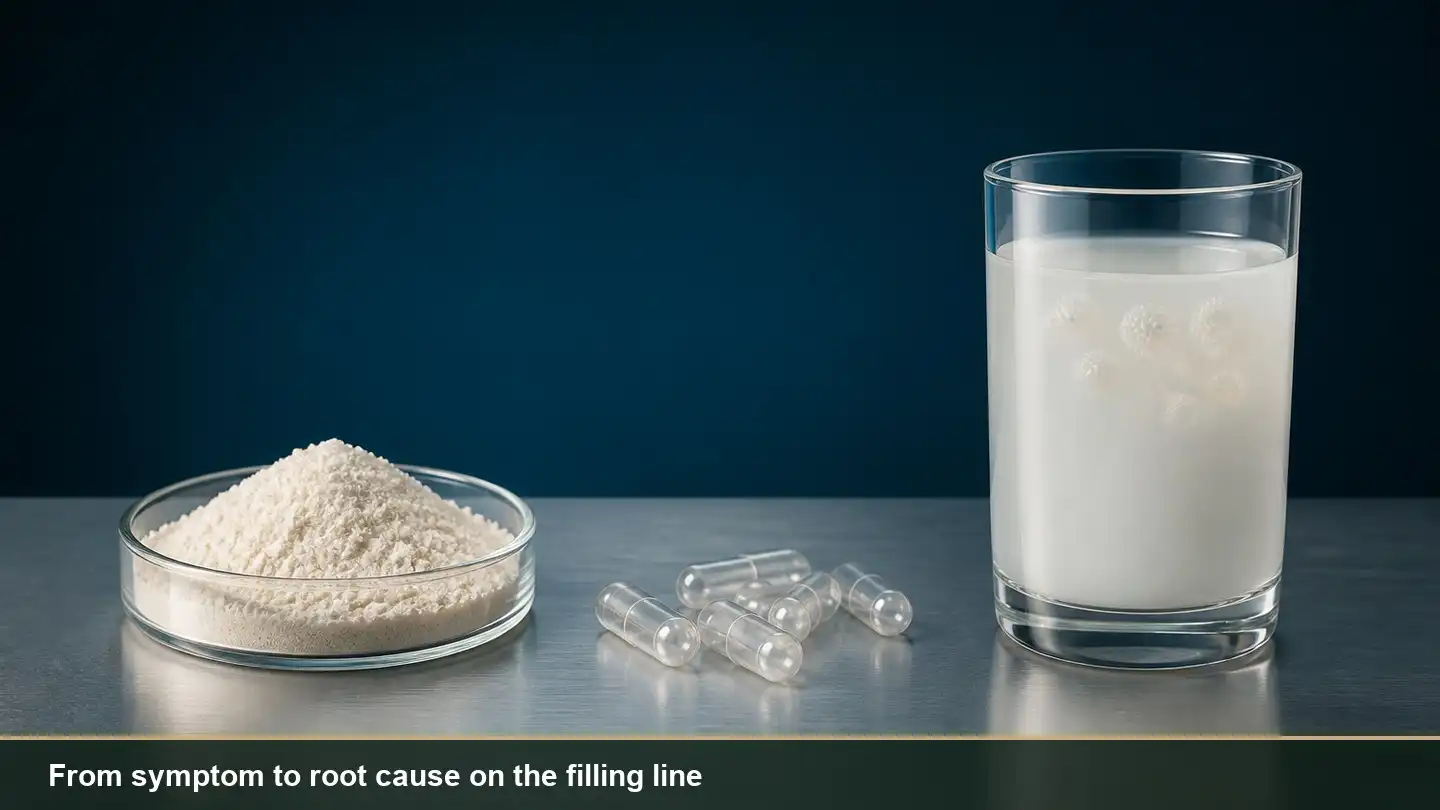
A phospholipid bilayer is a soft, self-assembled structure. High-shear homogenisation applied without validation can tear that boundary, let the oily core escape and produce exactly the floating oil film the encapsulation was designed to hold. Where a high-shear step is unavoidable downstream, keep exposure short, cool the product and confirm the effect by re-measuring particle size. The manufacturing reasoning behind this balance is summarised in how liposomal Omega-3 powder is made.
The Water Temperature Band
Cold liquids are pleasant to drink but punish wetting. As a working rule, wet the powder in water in the mid-teens to low twenties Celsius - warm enough to lower surface tension and speed hydration, cool enough not to soften the bilayer - then cool the finished dispersion to the target fill temperature. Water hardness is a separate variable: calcium and magnesium raise ionic strength, so an identical formula can behave differently at two sites.
Matching the Ingredient to the Beverage System
Addition Order for Thickeners, Emulsifiers, Sugars and Electrolytes
Compatibility is mostly a question of order and timing. Hydrate thickeners fully before the powder arrives, add emulsifiers early enough to be functional but late enough not to be displaced, and hold sugars and electrolytes until the dispersion is uniform. The formulation choices that follow, across sports and daily-use formats, are set out in formulation opportunities for sports nutrition.
Chelating and Antioxidant Co-Ingredients: Useful, Not Miraculous
Trace metal ions accelerate lipid oxidation, and a small amount of a food-grade chelating agent or antioxidant co-ingredient can lower that pressure as it does in any oil-containing system. Use these as formulation tools with a measurable effect on oxidative markers, not as remedies for poor dispersion. If an ingredient is added to control oxidation, its level should be justified by a peroxide value trend and declared on the label.
From Bench to Production: Where Scale-Up Breaks Down
Why a Pilot Batch Passes and a Production Batch Clumps
Larger vessels change the ratio of wall surface to volume, lengthen the distance a particle must travel before it is wetted, and shift the addition point relative to the impeller. Powder sprinkled into a 200-litre vortex is often dumped into a 2,000-litre tank, where it lands as a plug. Scale-up fails most often because the addition rate, the fill level at the moment of addition and the impeller position were never translated from the bench method - not because the ingredient changed. The behaviour to plan for is described in stability challenges in liposomal Omega-3 powder formulations.
Inline Filtration, Standing Time and Pre-Fill Inspection
A coarse inline filter protects the filler from undispersed particles, but the mesh must be chosen deliberately. A screen fine enough to catch every agglomerate will also blind quickly, raise line pressure and shear the product it is meant to protect. Match the mesh to the largest acceptable particle in your specification, monitor differential pressure and change the screen on a schedule rather than on failure. Before filling, allow a defined standing period so unstable material separates while the batch is still in the tank, then inspect surface and bottom under fixed lighting. Our newsroom notes on what we present on Omega-3 at industry events touch on how suppliers approach these line-side questions.
Quality Control and Acceptance Checks
Acceptance should rest on checks any operator can repeat, not on a single visual impression. Four methods cover most needs: a standardised visual assessment against a photo reference, a turbidity reading at a fixed dilution, a centrifuge-accelerated test that concentrates instability into minutes, and a particle size re-check by dynamic light scattering to confirm the distribution has not shifted.
The table below is a draft framework. Its targets are placeholders for your own validated limits and should be fixed in the internal specification agreed between your quality team and your supplier rather than copied from this page. Appearance in real products, including the difference between clarity and cloudiness, is discussed in what liposomal products actually look like.
| Check | Method | Draft target (to be agreed in your internal specification) |
|---|---|---|
| Wetting and dispersion | 1 g into 100 mL water at an agreed temperature; stir at an agreed tip speed | No dry islands or film after the wetting period |
| Appearance | Standardised visual assessment against a photo reference | Uniform; no floating oil film; no wall ring |
| Turbidity | Nephelometric reading at a fixed dilution | Within the range agreed for the product family |
| Accelerated separation | Centrifuge at an agreed force and time, then inspect | No visible sediment or cream layer |
| Particle size | Dynamic light scattering re-check of the dispersion | Distribution unchanged from the incoming raw material data |
| Oxidative status | Peroxide value on the finished dispersion where applicable | Within the limit agreed with the supplier |
| pH and conductivity | Bench or in-line meter | Within the window established in trials |
Specifications Worth Writing Into the Purchase Agreement
Dispersion performance starts with the raw material. Two lots of the same grade can differ in wetting behaviour if the drying profile or the particle size distribution moved. The features that separate a consistent grade from an inconsistent one are summarised in key features of high-quality liposomal Omega-3 powder. For the EmerWell grade, the published values are:
| Parameter | Value | Method or note |
|---|---|---|
| Concentration | 10%-25% (standard DHA 10% / EPA 5%) | As declared on the specification |
| Encapsulation efficiency | Above 85% | Per the batch certificate of analysis |
| Peroxide value (POV) | Below 2 meq/kg | Iodometric titration |
| Lead (Pb) | Below 0.5 ppm | Elemental analysis |
| Total plate count (TPC) | Below 1000 cfu/g | Microbiological testing |
| Dispersion behaviour | Disperses in cold liquids into a stable suspension | Application test in water |
| Particle size distribution | Uniform by DLS | Dynamic light scattering |
| Test methods | HPLC, DLS, TEM, iodometric titration | As listed for the grade |
Certifications listed for this grade are cGMP, ISO 9001:2015, ISO 22000, HACCP, Kosher and Halal. Any further requirement is best handled as a written specification amendment before the order is placed, since requirements differ by jurisdiction and should be confirmed with the relevant local authority.
Partner With EmerWell
EmerWell supplies liposomal raw materials from San Diego and supports beverage, powder-mix and private-label programmes with application-focused technical help. If you are working through a dispersion problem or evaluating a new format, we can share specification sheets, certificates of analysis and samples of liposomal Omega-3 powder so your team can run its own wetting and standing trials. Send your matrix details - pH, solids and process temperature - and we will respond with information that fits that system. Write to us at info@emerwell-bio.com.
References
- ISO 13320:2020, Particle size analysis - Laser diffraction methods. International Organization for Standardization. https://www.iso.org/standard/69111.html
- ISO 3960:2017, Animal and vegetable fats and oils - Determination of peroxide value - Iodometric (visual) endpoint determination. International Organization for Standardization. https://www.iso.org/standard/71268.html
- Perez-Palacios T, Ruiz-Carrascal J, Solomando JC, et al. Recent Developments in the Microencapsulation of Fish Oil and Natural Extracts: Procedure, Quality Evaluation and Food Enrichment. Foods. 2022;11(20):3291. https://pmc.ncbi.nlm.nih.gov/articles/PMC9601459/
- Hadian Z. A Review of Nanoliposomal Delivery System for Stabilization of Bioactive Omega-3 Fatty Acids. Electronic Physician. 2016;8(1):1776-1785. https://pmc.ncbi.nlm.nih.gov/articles/PMC4768928/
- FAO/WHO Codex Alimentarius Commission. Standard for Fish Oils (CXS 329-2017). https://www.fao.org/fao-who-codexalimentarius/codex-texts/list-standards/en/
Disclaimer: This article is written for ingredient buyers, formulators and manufacturers. EmerWell supplies liposomal raw materials on a business-to-business basis and does not sell to end consumers. Nothing here is medical or nutritional advice, and no statement about any ingredient should be read as a health claim. Formulators are responsible for confirming that their finished product, its labelling and its marketing comply with the regulations of each market in which it is sold.
Online Message