Sep 15, 2026
Liposomal Omega-3 Powder for Sports Nutrition: Formulation Opportunities
Liposomal omega-3 powder is changing how companies that make sports nutrition give EPA and DHA to people who are busy. By enclosing omega-3 fatty acids in phospholipid bilayers, liposomal encapsulation technology keeps these delicate fatty acids from oxidising, gets rid of the fishy smell, and makes omega-3 formats up to three times more bioavailable than regular ones. Product developers, original equipment manufacturers, and purchasing managers who are working on the next generation of performance nutrition can make a lot of money by learning how to use this delivery system.
Understanding Liposomal Omega-3 Powder and Its Advantages for Sports Nutrition
They don't work well with the body and break down quickly. This has been a problem with omega-3 supplements like softgels, fish oil pills, and normal powders for a long time. They are both important in sports nutrition because how nutrients are delivered affects how quickly you recover, how well you deal with inflammation, and how sharp your mind is while you train.
Both issues are solved by liposomal omega-3 powder distribution, which copies the structure of the body's own cell membranes. At the molecular level, phospholipid bilayers keep EPA and DHA from being broken down by digestion and let cells in the intestine epithelium take them in passively. This makes uptake much better without having to use emulsifiers or eat a lot of fat at the same time.
Why This Matters Specifically for Athletic Performance?
The muscles and blood vessels of athletes are under a lot of stress. There is more proof in a study published in the Journal of the International Society of Sports Nutrition that EPA supplements greatly reduce inflammation markers brought on by exercise. DHA supplements, on the other hand, improve brain function, which is important for quick movements and focus. Athletes only get a small part of the dose they were given when the way the drug is given changes how well it is absorbed. This is where liposomal omega-3 powder technology comes in, making sure that the active amount quickly gets into the bloodstream. For B2B buyers, this means more claims about how well the product works, better results for users, and a stronger product positioning.
Formulation Opportunities: Key Considerations for Sports Nutrition Products
It takes careful thought to make choices about where to get the omega-3s, how to stabilize them, how much to use, and how to stack them so that they work better together. These choices affect both the product's place in the market and its status with regulators.
Here are the core formulation considerations worth evaluating:
- Omega-3 Source Selection: EPA and DHA from deep-sea fish oil are still the best in terms of concentration and purity in the medical world. Vegan sports nutrition brands are starting to use DHA that comes from algae because it works just as well and has a better story about being environmentally friendly. The source you choose affects both the story on the label and the chemistry of the bubble wrap.
- Lipid Matrix and Stabilizer Selection: Phosphatidylcholine-rich sunflower or soy lecithin forms stable bilayers and helps with the emulsification profile needed for powders that dissolve in water. Stabilizers like maltodextrin or modified starch keep the structure of the liposomal omega-3 powder safe while spray drying without changing the way the fluid flows.
- Dosage Architecture: Most active athletes can benefit from taking 2–3g of combined EPA and DHA every day. Some endurance protocols recommend higher doses when supervised by a medical professional. Standardized concentrations, like 10% DHA and 5% EPA, make it possible to make a wide range of serving sizes and product formats, from single-serve sachets to recovery blends with multiple ingredients.
- Synergistic Stacking: When liposomal omega-3 powder is mixed with liposomal vitamin D, phosphatidylserine, or antioxidant complexes, they make "brain and joint" performance stacks that are very different from each other. These pairings cover more than one way for athletes to heal in a single SKU, which is a strong selling point for OEM clients who want to get their products on competitive store shelves.
All of these choices about formulation help companies make products that are safe for regulators to look at and work really well.
Comparing Liposomal Omega-3 Powder with Alternative Omega-3 Formats
There are a lot of different ways to get omega-3s on the market. If buying teams know where liposomal omega-3 powder really does better than other options, they can be more sure about where to get things.
The most common form of fish oil is still softgels, but they smell like fish, can go bad if the capsules are broken or cut, and their bioavailability changes a lot based on what the person is eating at the time of intake. Enteric-coated pills are harder to make and cost more, but they don't really help with absorption.
Spray-dried oil on a container makes traditional omega-3 powders easier to work with when making dry goods. However, they break down faster because the oil part is exposed to air and water directly. As they sit on the shelf, the amount of air in them quickly rises. This causes oxidation problems that the formulation teams have to carefully deal with.
On the other hand, liposomal omega-3 powder keeps its peroxide level below 2 meq/kg even when kept at room temperature, which is a level that most other powders don't meet. Multiple levels of protection from oxidation are provided by the phospholipid shell. This means that the food stays stable for longer without the need for added antioxidants. This is very important for sports goods with clean labels because a simple name helps with sales.
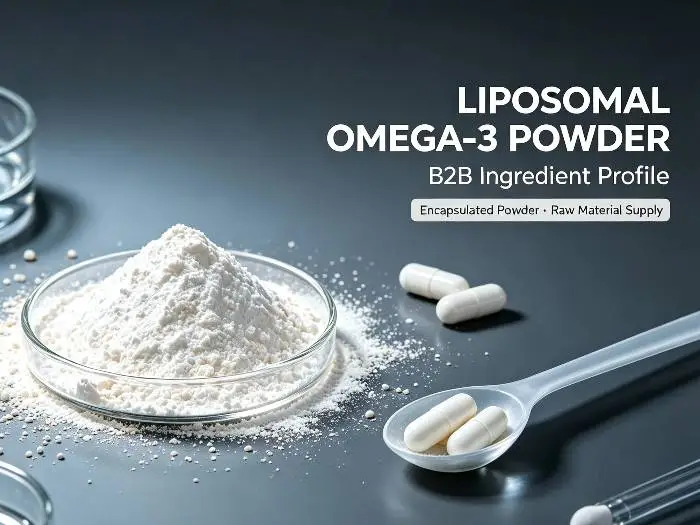
The off-white to light yellow powder is fine and free-flowing. It mixes evenly in cold liquids without oil separating, so it can be used in protein shakes, water pouches, sweets, and chewable pills. This gives formulation more freedom and speeds up the process of making new products for OEM clients.
Procurement Insights: Sourcing Liposomal Omega-3 Powder for B2B Clients
When you buy advanced encapsulated ingredients, you need to learn more than when you buy basic raw materials. It's not all liposomal omega-3 powder on the market is stable, comes in good capsules, or has all the necessary paperwork to be legal.
At the very least, companies you should work with should have cGMP, ISO 22000, and HACCP certifications that you can look at. If someone wants to buy something, they should ask for a full analytical package that includes a certificate of analysis (COA), heavy metal screening (lead below 0.5 ppm), total plate count data, and peroxide value tests. It's easier to trust the supply chain when there is proof of where the omega-3 oil comes from. This is especially true for brands that sell in regulated markets.
Encapsulation efficiency is a standard that is often forgotten. If a supplier says they offer liposomal omega-3 powder delivery but only achieves 60–70% encapsulation efficiency, they deliver significantly less protected active than a platform that consistently goes above 85%. Another way to make sure that the production process is the same from batch to batch is to ask for particle size distribution data (DLS measurement).
Prices change based on how many omega-3s you order, how good the phospholipids are, and how big your order is. You can save a lot of money per kilogram by making supply deals with different volume promises. This will also make sure that the right goods are sent out first when demand is high.
Future Trends and Innovations in Liposomal Omega-3 for Sports Nutrition
The market for sports nutrition is moving toward clear ingredients, long-term use, and specific functions. Several trends that are coming together are changing where brands get omega-3 ingredients and how they position them.
Algae-based EPA and DHA are becoming more popular in the business world, thanks to rising customer concern about marine sustainability and the need for vegan approval. Liposomal omega-3 powder encapsulation of algae omega-3 is technically possible and is already being worked on for commercial use. This puts brands ahead of a trend among consumers toward plant-based sports nutrition.
Multi-vesicular liposomal platforms, which can hold multiple actives at once, are making it possible for more complex delivery systems. Putting omega-3s, vitamin D3, and curcumin together in a single liposomal matrix makes a recovery-focused ingredient that can be used in a number of different SKUs.
Clean-label pressure is still pushing makers to list ingredients in shorter forms. This need is well met by liposomal powders that provide stability without using chemical emulsifiers or antioxidants. If OEM companies use these ingredients, they will be ahead of label-scratching customers, who will buy most supplements in the next ten years.
Conclusion
One of the most interesting ingredient additions for sports nutrition formulators today is liposomal omega-3 powder. Better EPA and DHA bioavailability, oxidative stability, taste masking, and water dispersibility get rid of the main problems that have been holding back omega-3 products for decades. Understanding and using liposomal omega-3 powder delivery technology is no longer a nice-to-have for nutraceutical brands, OEM makers, and functional food companies who want to break into the U.S. market; it's a must.
FAQ
What makes liposomal omega-3 absorption superior to standard fish oil capsules?
Protecting EPA and DHA inside phospholipid bilayers that look like human cell membranes is what liposomal omega-3 powder encapsulation does. This lets the active fatty acids go straight into the bloodstream instead of being broken down in the digestive tract. Researchers have found that bioavailability is up to three times better with encapsulated fish oil than with unencapsulated fish oil. This means that athletes get a higher percentage of the recommended amount with each serve.
What omega-3 concentrations are typically available for B2B formulation?
Standardized amounts of omega-3 content range from 10% to 25%. DHA 10% and EPA 5% is a usual standard. This gives formulators a lot of freedom when making capsules, powder sachets, drinks, and gummies.
Is liposomal omega-3 powder stable enough for long shelf-life products?
Yes. When it is made with a peroxide value below 2 meq/kg and kept in the right way, liposomal omega-3 powder stays oxidatively stable for a lot longer than regular spray-dried omega-3 powders. There are many layers of defense in the phospholipid shell against light, heat, and water.
Can liposomal omega-3 be combined with other encapsulated actives?
Of course. It works well with antioxidant, liposomal vitamin D, and phosphatidylserine mixes, so you can get a lot of different health benefits in just one daily dose. There is full technical documentation to back up regulatory filings.
Partner with EmerWell for Certified Liposomal Omega-3 Powder Supply
EmerWell connects U.S. brands directly with a reliable liposomal omega-3 powder supplier. Our R&D team is led by a PhD and works out of our San Diego facility, which also has local storage and quick sample logistics. Our own EncapsWell™ platform has cGMP, ISO 22000, Kosher, and Halal certifications and an encapsulation efficiency of more than 85%. You can email us at info@emerwell-bio.com or go to emerwelllabs.com to ask for samples and help with preparation.
References
1. Smith, G.I., et al. — "Omega-3 polyunsaturated fatty acids augment the muscle protein anabolic response to hyperinsulinaemia-hyperaminoacidaemia in healthy young and middle-aged men and women." Clinical Science, 2011.
2. Calder, P.C. — "Omega-3 fatty acids and inflammatory processes: from molecules to man." Biochemical Society Transactions, 2017.
3. Tartibian, B., Maleki, B.H., & Abbasi, A. — "Omega-3 fatty acids supplementation and upper respiratory tract infections in athletes: a cross-over study." Clinical Journal of Sport Medicine, 2011.
4. Mozaffarian, D., & Wu, J.H.Y. — "Omega-3 fatty acids and cardiovascular disease: effects on risk factors, molecular pathways, and clinical events." Journal of the American College of Cardiology, 2011.
5. Metherel, A.H., & Bazinet, R.P. — "Updates to the n-3 polyunsaturated fatty acid biosynthesis pathway: DHA synthesis rates, tetracosahexaenoic acid production, and mechanisms." Progress in Lipid Research, 2019.
6. Philpott, J.D., et al. — "Applications of omega-3 polyunsaturated fatty acid supplementation for sport performance." Research in Sports Medicine, 2019.
Online Message
YOU MAY LIKE
High quality furniture manufacturer