

Sep 23, 2026
Understanding Liposomal Omega-3 Powder in Modern Nutrition Science
Most technical questions about liposomal omega-3 powder arrive attached to the same short block of numbers: a concentration range, a particle-size note, an encapsulation figure and a peroxide value. Reading those fields correctly is what separates a formulation brief that survives scale-up from one that fails at the first stability pull. This primer for R&D, QA and procurement teams explains what each specification field describes, how the numbers are produced, and where the wording tends to go loose. Where an example helps, we follow the specification table published for EmerWell liposomal omega-3 powder.
What the Term "Liposomal Omega-3 Powder" Describes as a Material
Three ideas sit inside that phrase. Liposomal means the carrier forms bilayer structures rather than a simple oil-in-water emulsion; the phospholipid shell is what separates an encapsulated grade from a spray-dried blend in which free oil sits on the surface of a carrier solid. Omega-3 names the payload, the long-chain fatty acids EPA and DHA, usually supplied as a marine or algal triglyceride oil. Powder describes the format: a dry, free-flowing solid produced by drying a liquid dispersion — in practice high-pressure homogenisation followed by spray drying.
The third word carries more weight than buyers expect. A powder has to satisfy two sets of criteria at once: the solid state (appearance, moisture, flow, absence of caking) and the redispersed state (particle size, distribution, suspension stability in cold liquid). A grade that looks perfect in the bag can still fail the second test.
Material Composition: What Is Actually Inside the Powder
A liposomal omega-3 powder is a formulated carrier system, not a single ingredient, so the specification you receive is a summary of that system. For how the bilayer is assembled, see the science behind liposomal omega-3 powder formulation.
Membrane-Forming Phospholipids and the Omega-3 Payload
Phosphatidylcholine-rich lecithin is the usual membrane material, from sunflower or soy origin. The sheet should name the phospholipid source and class, because those choices shape the charge of the bilayer, the ease of redispersion and the allergen profile of the blend. The oil phase carries the declared EPA and DHA content: on the EmerWell omega-3 grade the concentration range is stated as 10% to 25%, with a standard grade at DHA 10% and EPA 5%, so the payload fraction is a field in its own right.
Carrier Solids, Drying Aids and Antioxidant Additions
Because drying removes the water that keeps a dispersion stable, the feed usually contains bulking and protectant solids — maltodextrin, trehalose or inulin are common — plus a small amount of anticaking agent such as silicon dioxide, and sometimes a tocopherol blend or rosemary extract. Each addition is a label-declaration event. Process discipline shows up here too: how liposomal omega-3 powder is produced walks through the operations in sequence.
Particle Size Language: Z-Average, PDI and Span
Dynamic light scattering (DLS) reports the hydrodynamic diameter of particles in suspension, weighted by scattering intensity. The headline number is therefore biased towards the larger objects in the sample — useful for spotting agglomerates, misleading as a simple average. ISO 22412:2025 defines sample preparation and data handling, so laboratory comparisons require the same dispersion protocol.
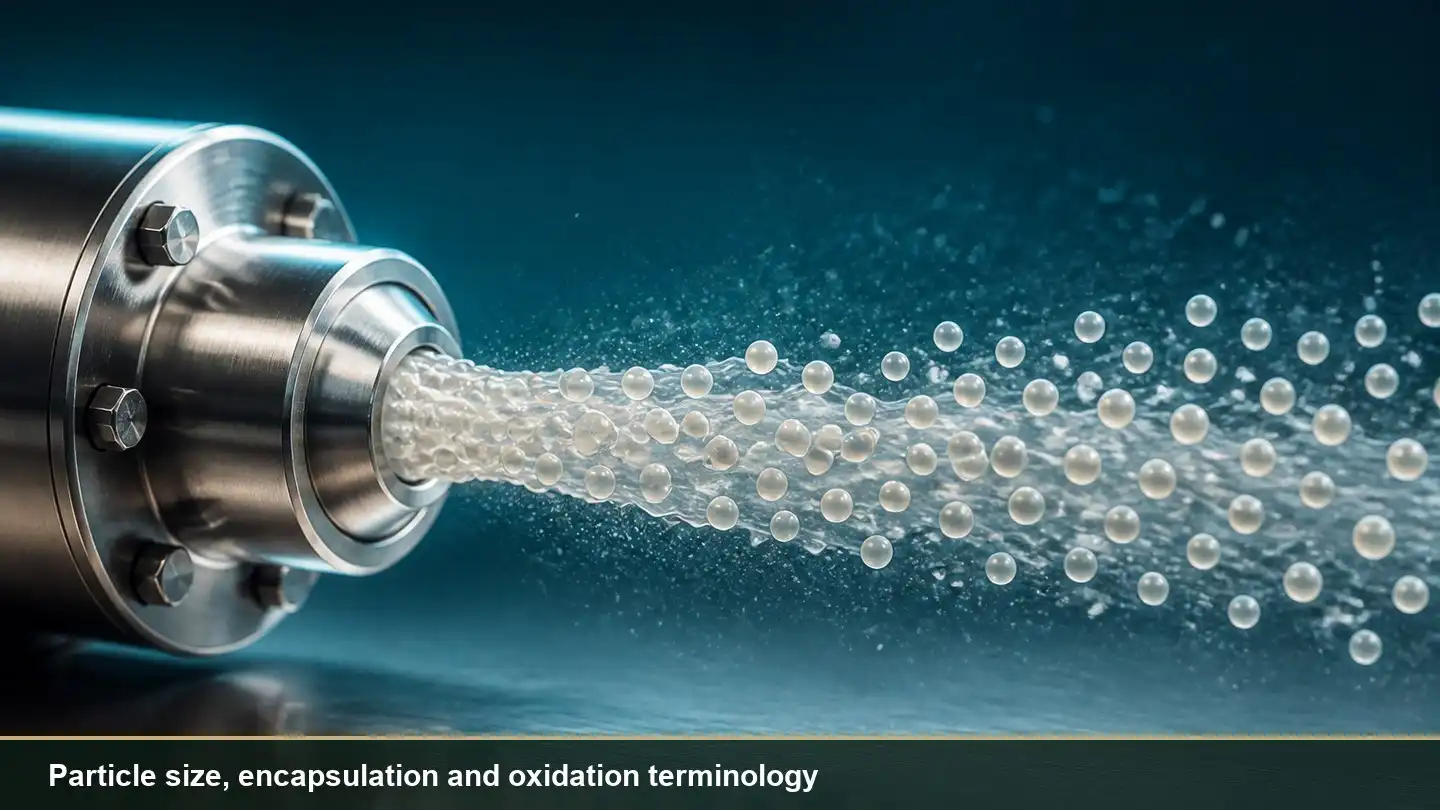
A phrase such as "uniform particle size distribution" is qualitative. It is reassuring but says nothing about mean diameter, distribution width or a second population. Ask for the underlying report: the Z-average, the polydispersity index, and the percentile table if laser diffraction was run as well.
| Term | Typical reporting unit | What it describes | Why a formulator checks it |
|---|---|---|---|
| Z-average | nm | Intensity-weighted mean hydrodynamic diameter from DLS | Reference point for behaviour in the redispersed state |
| Polydispersity index (PDI) | dimensionless, 0 to 1 | Width of the distribution rather than its centre | A tidy mean with a poor PDI usually means mixed populations |
| D10 / D50 / D90 | µm | Percentiles from a laser-diffraction measurement | Sizes agglomerates that DLS tends to blur |
| Encapsulation efficiency (EE) | % of total oil | Share of active held inside the bilayer rather than on the surface | Determines how much of the declared concentration is enclosed |
| Surface (free) oil | % of total oil | Active adsorbed to the outside of the particles | Drives powder stickiness and early oxidative change |
| Payload / loading | % by weight | Active mass relative to total powder mass | Used to back-calculate the inclusion rate in a blend |
Encapsulation Terminology: Efficiency, Surface Oil and Payload
Encapsulation efficiency is the field most often quoted and least often defined. Ask which numerator the laboratory used: free oil measured in the wash, oil recovered after breaking the vesicles, or the difference between total and extracted oil. The three routes give different numbers on the same batch. Ask also whether EE was measured on the wet dispersion before drying or on the reconstituted powder, because a drying step can rupture part of the population.
The EmerWell omega-3 grade is specified at an encapsulation efficiency above 85%. That figure is only meaningful together with its concentration basis, so read it as a pair with the payload range. Where a specification is thin on definitions, evaluating the purity of a liposomal omega-3 powder before buying sets out the questions that close the gaps.
Oxidation Indicators: POV, Anisidine Value and TOTOX
Long-chain omega-3 fatty acids oxidise in two stages, and each stage is measured differently. Hydroperoxides form first and are quantified as the peroxide value (POV), usually by iodometric titration. Those hydroperoxides later decompose into aldehydes, which POV does not capture; the p-anisidine value (AV) covers that fraction. Combining the two gives a TOTOX value that describes the oxidation history of the oil rather than a single moment.
EmerWell specifies its liposomal omega-3 powder at a peroxide value below 2 meq/kg. That is a release limit, not a shelf-life guarantee: it describes the batch on the day it was tested , not after months in a warehouse. Packaging and encapsulation each influence oxidative and sensory stability, as reported in work published in Food Science & Nutrition. For how these mechanisms behave in practice, see stability challenges in liposomal omega-3 powder formulations.
| Indicator | What it measures | Common reporting unit | Practical reading |
|---|---|---|---|
| Peroxide value (POV) | Primary oxidation products (hydroperoxides) | meq O2/kg | A snapshot of the batch at release; rises with air, light and heat |
| p-Anisidine value (AV) | Secondary oxidation products (aldehydes) | dimensionless index | Detects the stage that POV has already stopped reporting |
| TOTOX | Combined primary and secondary burden | index (2 × POV + AV) | Useful for comparing the same oil across lots and time points |
| Free fatty acids (FFA) | Hydrolytic breakdown of the triglyceride backbone | % expressed as oleic acid | Points to moisture or enzyme activity rather than oxygen alone |
| Moisture and water activity | Residual water retained in the powder | % by weight, and activity units | Trace moisture drives both hydrolytic and oxidative pathways in storage |
Reading a Peroxide Value in Context
A POV limit means little unless you know how the sample was handled. Values shift with the interval between sampling and analysis, with headspace oxygen, with light exposure and with the extraction solvent used, so two laboratories can legitimately report figures that differ by an amount QA has to decide about. Three questions bring the number back into context: was POV measured on the bulk powder, the redispersed suspension or the extracted oil; what were the transport conditions before analysis; and is there accelerated or real-time data showing how POV moved across the intended shelf life? A supplier who answers all three is describing a controlled process.
How the Test Method Shapes the Number Reported
Every figure on a specification is method-dependent. HPLC quantifies fatty-acid content but reports mass rather than location: it cannot say whether the EPA and DHA sit inside the bilayer. DLS reports hydrodynamic size and is sensitive to dilution. TEM confirms structure on a small field of view, which is weak for statistics. The EmerWell omega-3 grade names HPLC, DLS, TEM and iodometric titration, and reports particle size by DLS.
| Method | What it reports | Notes on interpretation |
|---|---|---|
| HPLC | EPA and DHA content, fatty-acid profile, tocopherol levels | Reports mass, not location; read alongside encapsulation data |
| DLS | Z-average, PDI and size distribution in liquid | Depends on dilution and dispersant; request the dispersion protocol |
| TEM | Particle morphology, lamellarity, layer structure | Imaging evidence, qualitative rather than statistical |
| Iodometric titration | Peroxide value | Solvent system and reaction time affect the reported figure |
| Laser diffraction | D10, D50 and D90 of a powder or dispersion | Better for agglomerate sizing than for individual vesicles |
Specification Fields That Most Often Need Clarification
Certain fields invite interpretation, and they are worth confirming in writing before a purchase order rather than after a failed trial:
- Concentration basis. Is the declared percentage expressed on total powder weight or on the oil phase? Without its basis, a figure can look twice as strong as it is.
- Particle size. Ask for the numerical distribution behind a descriptive statement, plus the protocol used to obtain it.
- Encapsulation efficiency. Confirm the definition, the extraction route, and whether the sample was tested dry or wet.
- Peroxide value. Note the method and the units, then ask whether the figure is a limit or an actual batch result.
- Microbiology. A total plate count limit should come with the test scope: which groups of organisms, over what incubation.
- Heavy metals. Confirm which elements were tested and the limit of quantification, not only the lead figure.
- Dispersibility. Turn a claim of a stable suspension in cold liquids into numbers by asking for the redispersion test conditions.
- Certification scope. Ask for certificate holder, site coverage and expiry date on each document. The EmerWell omega-3 grade is listed with cGMP, ISO 9001:2015, ISO 22000, HACCP, Kosher and Halal certification, and each batch carries a certificate of analysis.
How mature grades differ on these points is set out in key features of a high-quality liposomal omega-3 powder.
Documentation to Request Alongside a Specification
A specification states what a grade is intended to deliver; these documents let QA verify that the material delivered it, and they are normally available before a first order:
- A batch certificate of analysis with measured values, not only limits, and the method named for each result.
- The current specification revision with an issue date, so changes between lots can be traced.
- Safety and handling information, including the storage conditions used in the supplier's stability programme.
- Copies of the certificates above, showing holder and validity, with any scope statement that bounds them.
- A composition statement detailed enough to support your ingredient declaration and allergen review.
- Stability data covering your transport and storage envelope, including packaging format and headspace control.
Requesting Specifications, COAs and Samples
EmerWell supplies liposomal omega-3 powder as a water-dispersible raw material for supplement and functional-food manufacturers, with a deliberately short specification table: appearance, concentration, particle size by DLS, encapsulation efficiency, solubility, lead content, total plate count and peroxide value. If you are scoping a grade, ask for three things at once — the current specification, a recent batch COA with actual results, and a sample for bench trials. Technical support covers redispersion testing, interpretation of particle-size data, and review of stability results against your intended packaging. Begin from the liposomal omega-3 powder product page, or send your questions to info@emerwell-bio.com. Commercial terms are confirmed case by case in writing.
References
- Liposomal Encapsulation in Food Systems: A Review of Formulation, Processing, and Applications. Food Science & Nutrition, 2025. https://pmc.ncbi.nlm.nih.gov/articles/PMC12321603/
- Effect of packaging and encapsulation on the oxidative and sensory stability of omega-3 supplements. Food Science & Nutrition, 2023. https://pmc.ncbi.nlm.nih.gov/articles/PMC10003024/
- Comparison of physicochemical properties and oxidative stability of microencapsulated perilla oil powder prepared by freeze-drying and spray-drying. Food Science and Biotechnology, 2023. https://pmc.ncbi.nlm.nih.gov/articles/PMC10541381/
- ISO 22412:2025, Particle size analysis — Dynamic light scattering (DLS). International Organization for Standardization. https://www.iso.org/standard/85505.html
- U.S. eCFR, 21 CFR Part 111 — Current Good Manufacturing Practice in Manufacturing, Packaging, Labeling, or Holding Operations for Dietary Supplements. https://www.ecfr.gov/current/title-21/chapter-I/subchapter-B/part-111
This article discusses ingredient and manufacturing terminology for business readers. It is not medical or dietary advice, and no statement here should be read as a claim about any finished product.
Online Message