

Sep 21, 2026
Regular NMN vs Liposomal NMN: Key Differences Explained
Regular NMN versus liposomal NMN is a materials question before it is a marketing one. For procurement and R&D, the regular NMN vs liposomal NMN comparison comes down to three things: the physical form of the powder, how that powder behaves in your process, and the documents that prove both. EmerWell publishes a grade-level specification for liposomal NMN powder that makes one column concrete; the other column depends on the crystalline material you benchmark against. What follows is an engineering comparison, closing with a decision table for specification review.
The Two Materials, Described as Materials
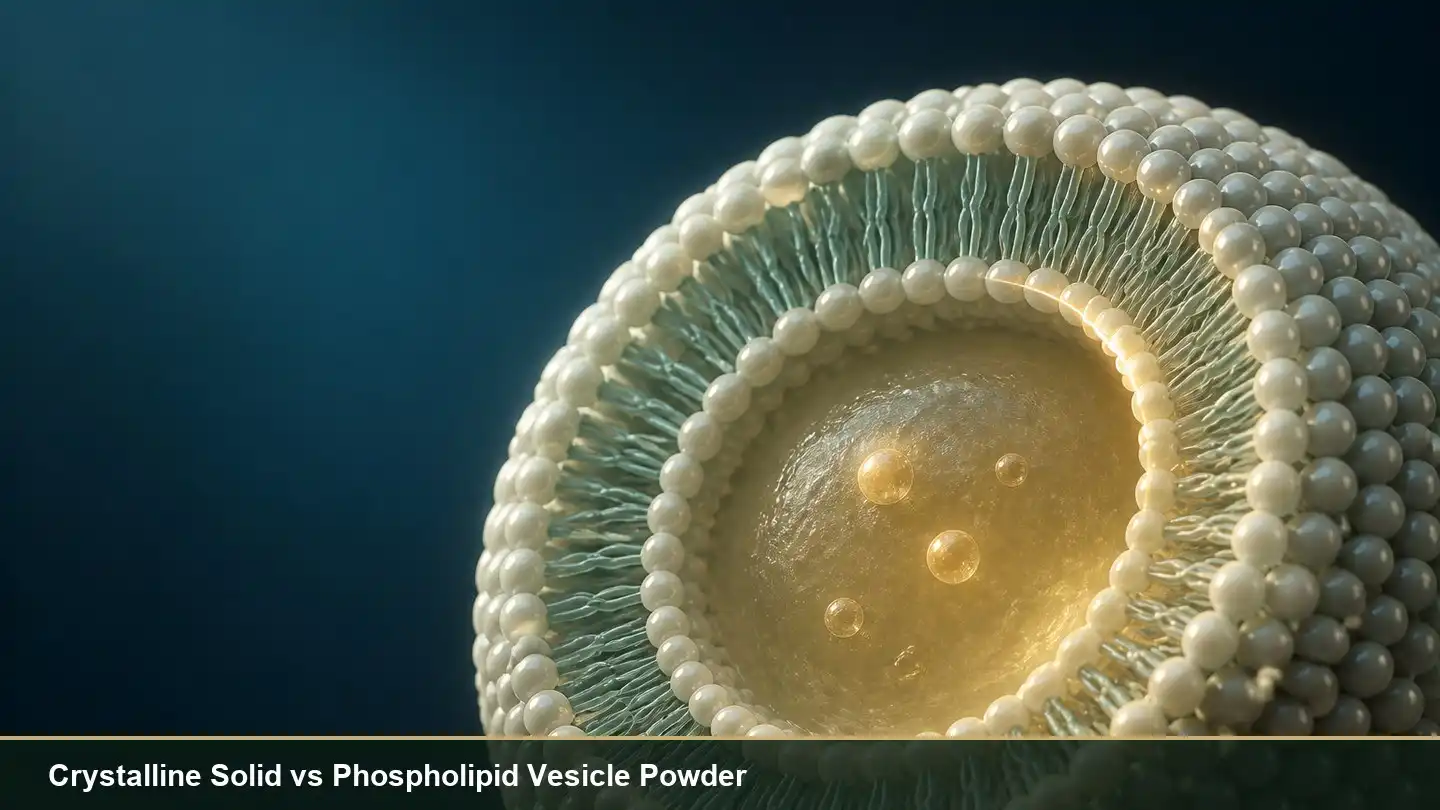
Both are powders sold as nicotinamide mononucleotide, and that is where the similarity ends. Crystalline NMN is a single-phase solid. Liposomal NMN powder is a two-phase system in which phospholipid vesicles sit inside a dried carrier matrix. Nearly every difference below follows from that structure rather than from the label on the pack.
Crystalline NMN: one phase, one headline number
Here the active is the particle, so assay and purity dominate the specification and particle size is a milling outcome rather than a design target. Flowability and moisture uptake depend on crystal habit and storage history, so two materials with equal assays can still behave differently on your line.
Liposomal NMN powder: two phases, two numbers that must both be reported
A liposomal specification has to describe the active and the carrier together: how much NMN is present, and how much of it sits inside a bilayer. EmerWell lists NMN content of 10% to 70% (customizable, from 99% purity raw material) alongside encapsulation efficiency of 85% to 95%, with an appearance of white to off-white free-flowing fine powder. A content figure on its own says nothing about the vesicle population.
| Attribute | Regular NMN (crystalline) | Liposomal NMN powder |
|---|---|---|
| Physical form | Single-phase crystalline solid | Dried powder; vesicles dispersed in a carrier matrix |
| Primary identity number | Assay and purity on a dry basis | NMN content plus encapsulation efficiency |
| Content range as specified | Set by the crystallisation and milling supplier | 10% - 70% (customizable; 99% purity raw material) |
| Particle metric | Milled distribution, usually by laser diffraction | Hydrodynamic vesicle size by DLS; uniform distribution as listed |
| Dispersion behaviour | Readily soluble; wetting and clumping must be managed | Instant cold-water dispersibility; forms a stable, translucent nano-emulsion |
| Encapsulation efficiency | Not applicable; there is no carrier phase | 85% - 95% as listed for this grade |
| Testing methods listed | Supplier-defined assay and impurity methods | HPLC (purity), DLS (particle size), NMR (encapsulation) |
Particle Size, Distribution and Dispersibility
Particle size means different things on the two routes, and mismatched definitions stall more specification reviews than any other single point.
What DLS reports, and why the method has to be named
For a liposomal powder the meaningful figure is the hydrodynamic diameter of the vesicles after reconstitution, and dynamic light scattering is the standardised route to size and size distribution for submicrometre particles (ISO 22412:2025). This grade is listed with a uniform particle size distribution by DLS and an analytical trio of HPLC, DLS and NMR for purity, size and encapsulation. Crystalline material is normally read by laser diffraction, so record the method beside the number.
Polydispersity is the quiet specification
The polydispersity index describes how wide the size population is and affects how a lipidic nanocarrier behaves (reference 5). Ask for the raw DLS report rather than a summary, and set an upper limit in your specification.
Cold-water dispersibility in practice
This grade is specified as instant cold-water dispersible, forming a stable, translucent nano-emulsion. Crystalline NMN is highly soluble, yet a soluble solid can still clump when wetted in bulk. Reproduce the test on your own equipment before accepting either claim.
Processing Compatibility Along the Line
Process tolerance is where the routes diverge most visibly. Crystalline material is chemically simple and physically uncooperative in some steps; a vesicle-based powder handles well but dislikes operations that disrupt a bilayer. A walkthrough of how liposomal NMN powder is manufactured is useful background before mapping the material onto your line.
Dry blending, tableting and capsule filling
Crystalline NMN blends predictably and tolerates compression, at the cost of taste and moisture management. A liposomal grade arrives free-flowing with a described neutral base, which suits chewables, stick packs and filled capsules. The question is not which compresses better, but whether your sieving, granulation or compression step generates shear and heat your supplier's stability data actually covers.
Liquid and ready-to-drink formats
Crystalline NMN dissolves into a beverage base, but a dissolved active offers no particle population to specify. A liposomal powder is designed to reconstitute into a suspended colloidal system, which introduces order of addition, base pH, mixing shear and suspension homogeneity as process variables. Validate them on your own line and write the parameters into the batch record.
Drying route and its fingerprints
Drying is where encapsulation performance is quietly lost. Work comparing freeze-dried and spray-dried encapsulated powders (reference 4) shows measurable fingerprints on encapsulation and oxidative stability, and the review in reference 3 makes the same point at formulation level. Ask for data from your route rather than for a generic stability statement.
| Unit operation | Crystalline NMN | Liposomal NMN powder | What to verify with the supplier |
|---|---|---|---|
| Dry blending | Predictable; segregation is possible | Free-flowing; the carrier fraction must stay uniform | Blend uniformity data for your diluent system |
| Sieving and milling | Routine; controls the size distribution | Shear may disturb the vesicle population | Tested through a milling step? |
| Tableting and capsule filling | Confirm per grade | Depends on excipients and inclusion level | Compression trial data or a pilot-scale reference |
| Liquid and RTD preparation | Dissolves; no particle metric to hold | Reconstitutes into a suspended system | pH window, order of addition, shear limits |
| Drying and finishing | Not applicable in most lines | The route affects encapsulation and oxidative stability | Data generated on the same drying route |
Stability, Moisture and Packaging
This grade is listed at 24+ months in powdered form under proper storage, with storage conditions of a cool, dry place and nitrogen-flushed multi-layer aluminium foil bags.
What a duration has to be tied to
A shelf-life figure is only meaningful alongside its pack format, storage conditions and test method. Figures for powders and for liquid carriers describe different systems and are not interchangeable. Check that the container and closure in the report match what you will buy.
Packaging is part of the specification
The product page lists 1 kg sample packs, 25 kg standard packs and custom sizes, with nitrogen flushing and a multi-layer foil barrier. With crystalline material, moisture protection is largely the whole story; with a liposomal powder you are also protecting a physical structure, so headspace, seal integrity and how often a pack is opened all matter. If packs are decanted in your facility, see these notes on keeping potency through storage and repacking.
Documentation and Acceptance Criteria
The two routes need different paper, and the difference is easy to write into a purchase specification. A buyer's guide to reading a liposomal NMN powder COA line by line covers the detail; in short, a certificate for a vesicle-based grade has to report more lines than one for a crystalline grade.
Three documents that must agree
A certificate of analysis, a specification sheet and a stability report form the minimum set. On the crystalline route the certificate is largely assay and impurity data; on the liposomal route it must also carry content, encapsulation efficiency, a size result with its method, and the microbiological and heavy-metal lines. This grade lists Pb < 0.1 ppm and total plate count < 1,000 cfu/g; the limits you accept come from your own risk assessment, but they must be identical across the set.
The procurement decision table
Priorities map to a route, and to the evidence worth requesting before a trial.
| If your priority is | The route that usually fits | Evidence to request before a trial |
|---|---|---|
| Lowest material complexity and the shortest specification | Regular crystalline NMN | Assay and impurity certificate, particle distribution, moisture data |
| A defined particle population and a carrier phase to specify | Liposomal NMN powder | Encapsulation efficiency by method, raw DLS report with polydispersity |
| Cold-water dispersion into a stick pack or beverage mix | Liposomal NMN powder | Dispersion trial at your solids loading; pH window of the base |
| Compression into a tablet with conventional excipients | Regular crystalline NMN, or a liposomal grade with trial data | Compression and blend uniformity data for your formulation |
| Batch-to-batch consistency on repeat orders | Either route, provided the specification is written tightly | Three consecutive certificates plus a sampling plan |
| Documentation depth for regulated markets | Liposomal NMN powder | Certificate, specification sheet, stability report, allergen statements |
Which Finished Format Fits Which Route
Format decisions usually settle the route rather than the other way round. When placing the liposomal grade beside other delivery formats, a comparison of liposomal powder with other NMN formats is a reasonable starting point, and a guide to choosing a grade that fits your formula covers excipient and process fit in depth. In practice:
- Capsules and tablets - crystalline material is the default; a liposomal grade fits where flowability, taste and compression data support it.
- Stick packs and drink mixes - dispersion behaviour decides, and a grade specified for cold-water dispersion removes a processing step.
- Ready-to-drink and liquid concentrates - a suspended colloidal system is a different product from a solution, with its own homogeneity controls.
- Chewables and gummies - taste masking and thermal exposure in the process need evidence rather than assumptions.
- Premix and custom blends - compatibility with the other actives belongs in the technical discussion before the specification is frozen.
What to Ask on a First Call
Use the same question set on both routes so that the answers line up.
- Which method produced the size result, DLS or laser diffraction, and can we see the raw report?
- For a liposomal grade, what encapsulation efficiency was measured, by which method, and on which batch?
- Was the stability data generated in the pack format and storage condition we intend to buy?
- Which unit operations has the material already been run through, and under what conditions?
- What does the certificate of analysis carry, line by line, and who ran third-party testing?
- Which certifications does the supplying site hold, and what is the scope and expiry of each?
- How is the material packed, and what happens to the pack after it is opened?
- What documentation accompanies a sample, so a trial produces usable data?
How to Run a Fair Comparison on Your Own Bench
A comparison run at the supplier's site will flatter the supplier's product, so put both materials through one protocol:
- Fix a common basis so that each portion contains the same quantity of active.
- Run the dispersion test on your own equipment and record the conditions.
- Measure particle metrics on one instrument, name the method and keep the raw output.
- Hold retained samples under your intended storage condition and re-test on a pre-set schedule.
- Release only against documents that arrive with a commercial batch, not a trial certificate.
Request Samples and Technical Documentation
EmerWell supports procurement and formulation teams with samples, specification sheets and batch documentation for the liposomal NMN powder range, including certificates of analysis, particle size reports and stability data, plus technical guidance on dispersion and process fit. Send your target format and process constraints to info@emerwell-bio.com and the team will align the documentation set with your specification review; commercial terms, pack formats and pilot volumes are confirmed in writing.
This article is written for ingredient buyers, formulators and manufacturers. It describes material properties, processing behaviour and documentation practice for bulk ingredients and is not medical advice on any finished product.
References
- U.S. eCFR - 21 CFR Part 111, dietary supplement current good manufacturing practice: https://www.ecfr.gov/current/title-21/chapter-I/subchapter-B/part-111
- ISO 22412:2025 - Particle size analysis, dynamic light scattering (DLS): https://www.iso.org/standard/85505.html
- Rahim M.A. et al., Liposomal Encapsulation in Food Systems, Food Science & Nutrition: https://pmc.ncbi.nlm.nih.gov/articles/PMC12321603/
- Freeze-drying versus spray-drying of microencapsulated perilla oil powder, Food Science and Biotechnology: https://pmc.ncbi.nlm.nih.gov/articles/PMC10541381/
- Impact of Particle Size and Polydispersity Index on Lipidic Nanocarrier Systems, Pharmaceutics: https://pmc.ncbi.nlm.nih.gov/articles/PMC6027495/
Online Message