

Nov 18, 2026
Liposomal Omega-3 Powder Manufacturing: Key Quality Control Steps
An omega-3 line is harder to control than a dry-powder line for one structural reason: the active is an oil, and oil oxidises continuously from the moment it is exposed to air. Every unit operation between intake and packing either slows that reaction or accelerates it. A liposomal omega-3 powder programme therefore lives or dies on the discipline applied at seven control points, and the certificate of analysis is only the last of them. This article sets out those points in sequence, with the measurement that belongs at each one.
Why the Control Strategy Differs From a Dry Powder Line
In a botanical or vitamin powder the dominant degradation routes are moisture and heat, and both are addressed by a drying specification and a moisture barrier. In an omega-3 powder the dominant route is oxidation, which is catalysed by heat, driven by oxygen and accelerated by light and by trace metals. That changes where the controls have to sit. Moisture control still matters, because water activity affects the bilayer and the microbial profile, but it is no longer the primary variable.
The second difference is that oxidation is measurable at every stage, cheaply. Peroxide value can be run on the incoming oil, on the emulsion before drying and on the finished powder. When those three numbers are recorded in sequence, a drift becomes visible before a batch fails, which is what makes the control strategy practical rather than theoretical.
Specification Baseline
The figures below describe the grade as supplied. They are the acceptance values a buyer should see before a purchase order is raised.
| Parameter | Specification | What it controls |
|---|---|---|
| Concentration | 10%–25%, with 10% DHA and 5% EPA as a common standard | The serving arithmetic and the loading band available to the formulator |
| Encapsulation efficiency | > 85% | How much of the oil sits inside the bilayer rather than on the particle surface |
| Peroxide value | < 2 meq/kg | The oxidative state of the finished powder at release |
| Appearance | Off-white to light yellow, free-flowing | A baseline for colour trending across shelf life |
| Dispersibility | Disperses in cold liquids without oil separation | Whether the grade suits a beverage or stick pack |
| Lead | < 0.5 ppm | A metal ceiling appropriate to an oxidation-sensitive matrix |
| Total plate count | < 1,000 cfu/g | Microbial headroom for formats without a preservation step |
| Testing methods | HPLC for assay, DLS for particle size, TEM for morphology, iodometric titration for peroxide value | Whether the reported figures can be reproduced by a third party |
Two of these deserve comment before the control points are discussed. A peroxide value below 2 meq/kg at release is a meaningful limit only if the same method is used at intake and at release; iodometric titration results are not comparable with those from an alternative colorimetric method, and a specification that does not name the method is not enforceable. The encapsulation figure has the same property: it is only useful when the separation technique is stated.
Control Point One: Oil Intake
The line cannot produce a low-peroxide powder from a high-peroxide oil. Intake is therefore the first and most consequential control, and it should include three checks: peroxide value and anisidine value on the delivered lot, the fatty acid profile confirming the declared EPA and DHA ratio, and the contaminant panel covering heavy metals, dioxins and polychlorinated biphenyls where the destination market requires it. A supplier that quotes a finished-product specification without being able to show intake data is presenting an outcome without its cause.
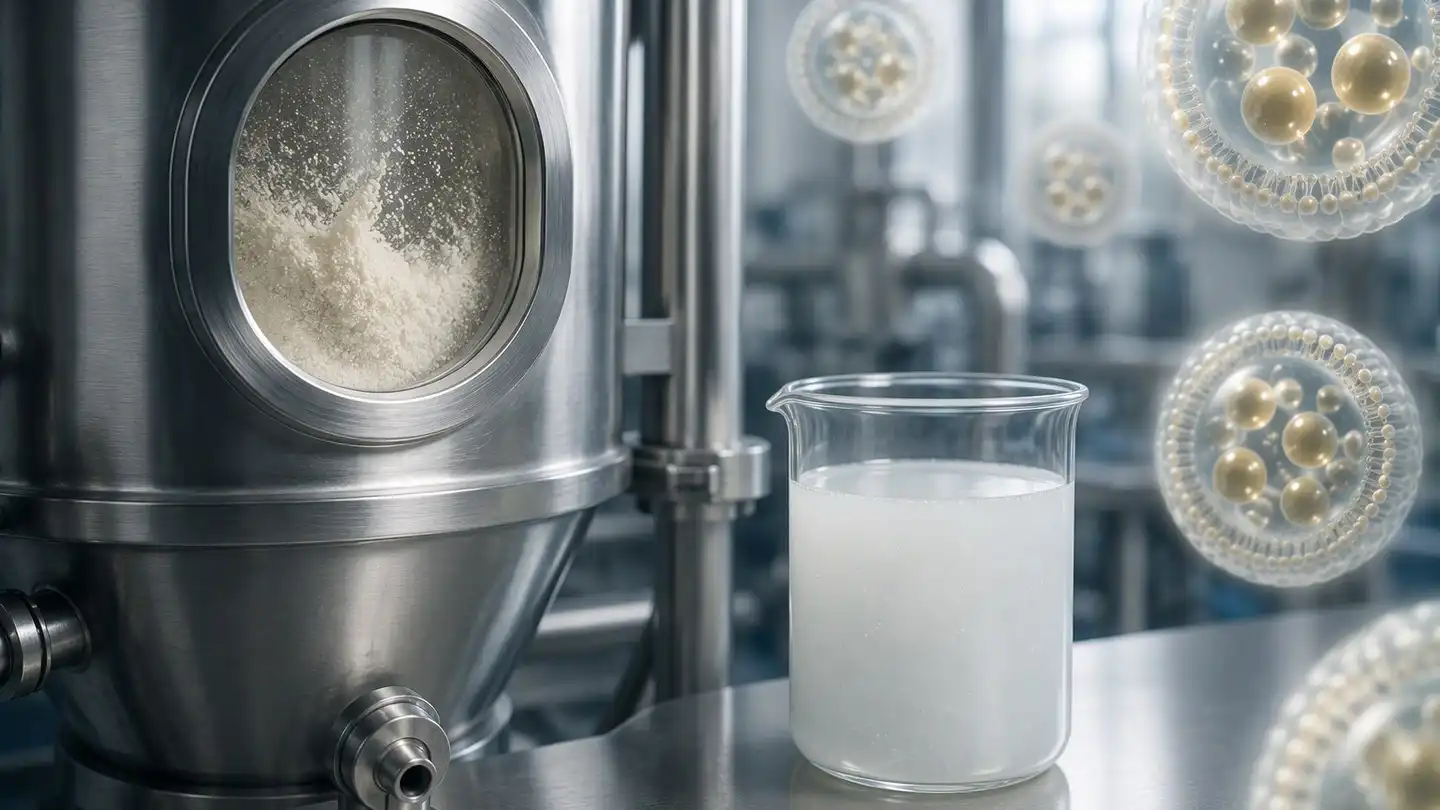
The practical discipline is to reject at intake rather than to compensate downstream. An oil at the upper end of its acceptance range will oxidise further during emulsification and drying, and the finished powder will sit close to the release limit with no margin for shelf life. Buying to the middle of the intake range costs a little more per kilogram and buys a great deal of stability margin.
Control Point Two: Emulsifier and Aqueous Phase
The phospholipid is not an inert carrier in this system; it is the structure that protects the oil. Its source, its purity and its dispersion behaviour all affect the encapsulation efficiency that the finished powder can reach. Two variables matter most: the phospholipid-to-oil ratio, which sets how much bilayer is available per unit of oil, and the hydration procedure, which determines whether the bilayer forms as a continuous lamellar phase or as fragments.
Trace metals belong here as well. Copper and iron catalyse lipid oxidation at concentrations far below any heavy-metals limit that would fail a specification, and they arrive through the aqueous phase, through process water and through unpassivated contact surfaces. Where a project is oxidation-sensitive, the water used in the aqueous phase should be specified and monitored rather than assumed acceptable because it is potable.
Control Point Three: Homogenisation
Homogenisation sets the particle size distribution, and the distribution sets both the encapsulation efficiency and the dispersion behaviour. The controllable variables are pressure, the number of passes and the temperature of the emulsion at the valve. Pressure that is too low leaves large droplets and a broad distribution; pressure that is too high generates heat and can strip the phospholipid from the interface, which shows up as a fall in encapsulation rather than as a change in particle size.
Temperature control at the valve is the variable most often left implicit. A single pass at high pressure can raise the emulsion temperature by several degrees, and repeated passes compound it. Where the oil is already close to its oxidation threshold, that heat is the difference between passing and failing release. A line that logs valve temperature per pass has a defensible process; one that does not is relying on the operator's judgement.
Control Point Four: Drying
Spray drying converts the emulsion into a powder and, in doing so, exposes the oil to the highest temperatures it will see in the whole process. Inlet temperature, outlet temperature, feed rate and atomisation pressure interact: a high inlet with a fast feed produces a wet particle and a low outlet temperature, while a high inlet with a slow feed produces a dry particle that may have been heat-damaged. The outlet temperature is the better proxy for particle history, because it reflects the evaporative cooling that the droplet actually experienced.
The drying step is also where encapsulation is most likely to be lost. As water leaves the particle, the bilayer is compressed, and a formulation that was stable in emulsion can crack at the surface. That failure is not visible in the appearance and not visible in the particle size; it appears as a lower encapsulation efficiency measured after drying and as a higher peroxide value at release, because oil that has reached the surface is fully exposed.
Control Point Five: Oxidative Markers Across Stages
Recording the same marker at each stage is what turns a specification into a control system. The table below sets out what to measure and what a drift at that point implies.
| Stage | Marker | What a rise at this point points to |
|---|---|---|
| Oil intake | Peroxide value, anisidine value | Supplier-side handling or storage before delivery |
| Post-emulsification | Peroxide value, particle size | Shear damage, metal traces, or oxygen ingress in the emulsion tank |
| Post-drying | Peroxide value, encapsulation efficiency | Thermal stress at the nozzle, or bilayer cracking during dehydration |
| Bulk storage | Peroxide value, moisture, colour | Packaging barrier failure or warehouse temperature excursion |
| Finished pack | Peroxide value, colour, sensory | Light exposure or oxygen transmission through the pack structure |
A single rising number is uninformative on its own; a rise that appears at one stage and not before it localises the cause. That is the whole argument for staged measurement, and it is the reason a supplier that can only report release values is limited in what it can diagnose.
Control Point Six: Microbiology and Contaminant Screening
An oil-in-water emulsion is a favourable medium for microbial growth before it is dried, and the drying step does not sterilise it. Total plate count below 1,000 cfu/g at release is the usual commercial limit, but the more useful control is the hygiene of the aqueous phase and the hold time of the emulsion before drying. An emulsion held for several hours at ambient temperature will show a higher plate count than one dried within the hour, even when both meet the release limit.
Where the destination market is infant nutrition, the screening extends further: the contaminant panel is broader, the heavy-metal limits are tighter and the documentation requirement is heavier than for the adult supplement market. A supplier that claims to meet those standards should be able to show the screening regime and the batch-level results, not only a certificate that names the standard.
Control Point Seven: Packaging and Atmosphere
The final control point is the one most often filed under logistics. A powder with a peroxide value below 2 meq/kg at release will not stay there in a pack that transmits oxygen. Nitrogen flushing and a multi-layer aluminium foil structure are the standard answer, and both should be stated as specification items with measurable parameters rather than described as protective.
The buyer-side implication is that the pack used in the supplier's stability programme should be the pack the brand intends to use commercially. Where the supplier tested in foil and the brand packs in a metallised stand-up pouch, the stability data does not transfer and the shelf life claim is unsupported. The site's analysis of stability challenges in liposomal omega-3 formulations covers the interaction between pack structure and oxidative drift in more detail.
Reading the Process Rather Than the Certificate
Most of what distinguishes one omega-3 supplier from another is invisible on a certificate of analysis, because two powders can meet the same release specification with very different margins. The difference shows up in the process: whether intake is controlled, whether valve temperature is logged, whether encapsulation is measured after drying as well as before, and whether the pack used in stability work is the commercial pack.
A buyer who asks about those four items is asking questions that cannot be answered by a trading intermediary, which is precisely why they are useful. The supporting reading for that conversation is the site's account of how liposomal omega-3 powder is made, its description of the science behind the formulation, and its checklist for evaluating purity before buying.
What a Batch Record Should Show
If a supplier is willing to share a redacted batch record, the document answers more questions than any certificate. Four entries carry most of the information. The intake entry should show the peroxide and anisidine values of the oil lot actually consumed, with the supplier lot number. The emulsion entry should show the phospholipid-to-oil ratio, the aqueous phase preparation time and the hold time before drying. The homogenisation entry should show pressure, pass count and the emulsion temperature at each pass. The drying entry should show inlet and outlet temperature, feed rate and atomisation pressure, together with the encapsulation result measured after drying rather than before. A record containing those entries demonstrates that the process is controlled rather than merely described. A record that shows only start and end values, with no intermediate measurements, tells the buyer that the process is monitored at the output and managed by operator experience in between, which is a materially different proposition.
Next Step
For a process review, contact the technical team at info@emerwell-bio.com with the target concentration, the intended format and the storage conditions the finished product will face. Samples of the standard grade are available for trial work, and the liposomal omega-3 powder specification sheet provides the baseline figures referenced above, including the concentration band and the peroxide value limit.
This article is intended for ingredient buyers, formulators and quality professionals. It describes manufacturing control points, analytical practice and documentation boundaries. It does not address the use of any finished product by an individual, and statements about finished products remain the responsibility of the brand that markets them.
References
- U.S. Food and Drug Administration. Current Good Manufacturing Practice in Manufacturing, Packaging, Labeling, or Holding Operations for Dietary Supplements, 21 CFR Part 111. ecfr.gov
- U.S. Food and Drug Administration. Search for FDA Guidance Documents. fda.gov
- FAO/WHO. Codex Alimentarius Commission. fao.org
- European Food Safety Authority. Food Additives. efsa.europa.eu
Online Message