Sep 20, 2026
Liposomal Omega-3 Powder for Functional Foods: Formulation Considerations
Formulators rarely reject liposomal omega-3 powder on the strength of the ingredient data alone. Projects stall because the matrix, the process or the shelf life asks for something the specification sheet never described. Starting from a water-dispersible, oxidation-resistant powder is sensible, and the published specification for liposomal omega-3 powder is a reasonable baseline, but the harder question is how that powder behaves once it is blended into a bar, a stick pack, a filled wafer or a gummy base.
Why Functional Food Matrices Change the Formulation Brief
In a beverage, the powder is hydrated once and the system stays closed. In a solid or semi-solid matrix, the same powder becomes one dry or semi-dry phase among several, competing for water with sugars, proteins, fibres and humectants. Water activity, shear, temperature and headspace differ from matrix to matrix, and each acts on the phospholipid bilayer carrying the EPA and DHA. The beverage case is well documented - how liposomal omega-3 powder is used in beverage formulation - and it is a useful contrast, because a pressed bar or a gummy base imposes constraints a drink never does.
This article stays on the formulator's side of the table: matrix fit, sensory control, oxidation, process exposure, inclusion rate and documentation.
Reading the Specification in Matrix Terms
A specification is a set of numbers; a formulation is a set of interactions. The table below restates the published specification for this ingredient in terms of what each value changes at the bench.
| Parameter | Published specification | What it changes in a formulation |
|---|---|---|
| Appearance | Off-white to light yellow, fine, free-flowing powder | Blends and fills without caking; suits dry mixing and tableting |
| Concentrations | 10% - 25% (standard: DHA 10%, EPA 5%) | Convert the declared target into the mass of powder a serving must carry |
| Particle size (DLS) | Uniform particle size distribution | Even distribution in dry blends and repeatable dosing across batches |
| Encapsulation efficiency | Above 85% | Share of EPA and DHA held inside the bilayer rather than sitting on the surface |
| Solubility and dispersibility | Water-dispersible; stable suspension in cold liquids | Opens fillings, gels and reconstituted systems, not only dry blends |
| Peroxide value (POV) | Below 2 meq/kg | Primary oxidation marker at release, tested by iodometric titration |
| Heavy metals | Pb below 0.5 ppm | Sets how far the ingredient can be pushed into sensitive categories |
| Microbiology | Total plate count below 1,000 cfu/g | Bioburden baseline for ambient storage and distribution |
| Certifications | cGMP, ISO 9001:2015, ISO 22000, HACCP, Kosher, Halal | Determines which markets and on-pack statements are open to the brand |
Read the table as a release baseline rather than the whole story, and confirm that the certificate of analysis for your batch reports every parameter using methods that align with your own sample preparation.
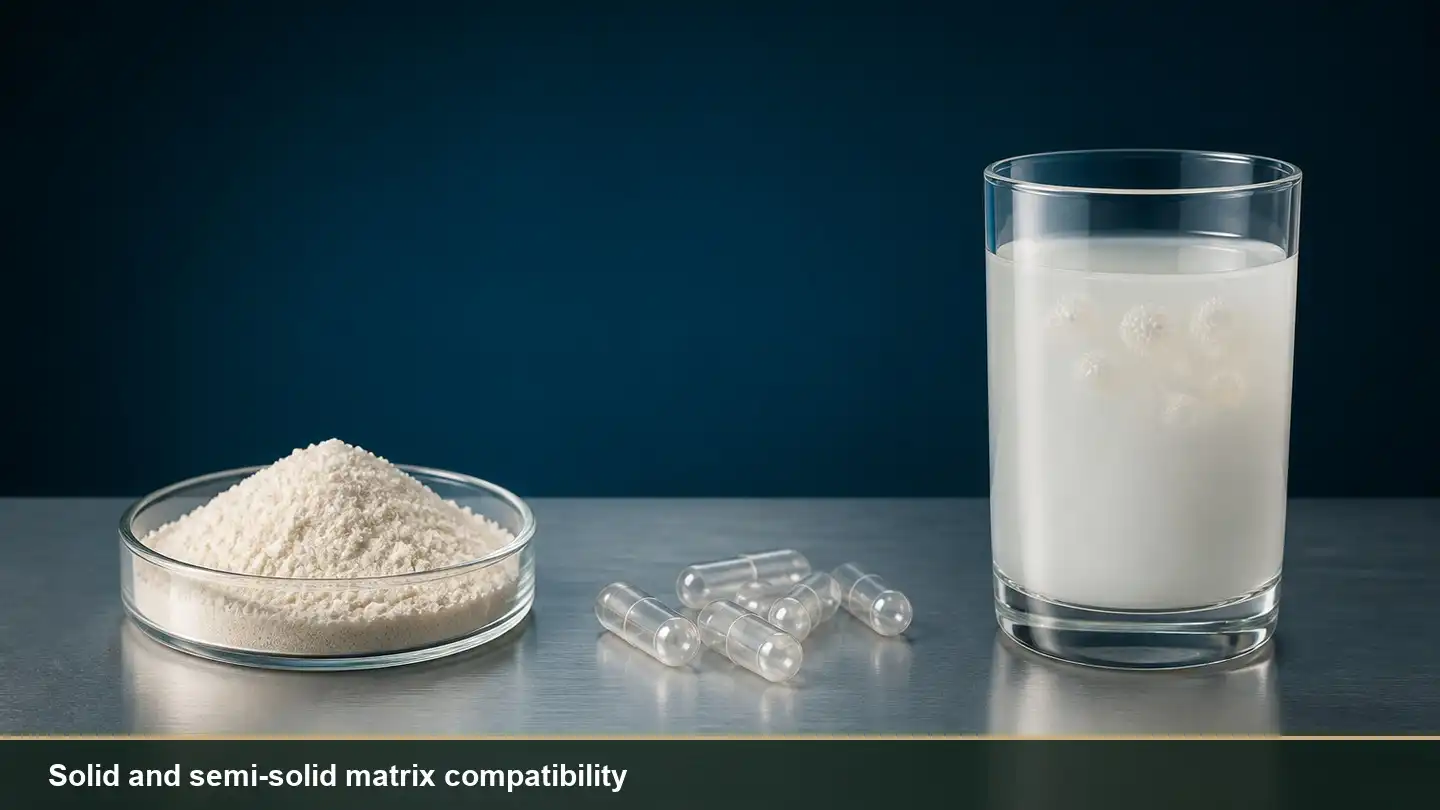
Solid and Semi-Solid Matrix Compatibility
Every functional food matrix hydrates, heats and compresses the powder differently, so grouping applications by their dominant stress makes the compatibility question answerable; the underlying bilayer physics is described in the science behind liposomal omega-3 powder formulation.

Dry blends, stick packs and sachets
Dry systems are the least demanding, provided moisture is controlled. A free-flowing powder with a uniform particle size distribution disperses evenly through a premix, which keeps the active load consistent from scoop to scoop. The practical risks are segregation during transport and moisture ingress through the pack, so set a tight water activity limit and avoid long conveying runs that separate fine and coarse fractions.
Bars, fillings and baked systems
Semi-solid systems are harder because they combine water, heat and pressure. In a filled wafer or a nut-butter layer, the powder sits in a continuous fat phase with limited free water, which is favourable for stability but unforgiving for texture if the powder is added late and poorly dispersed. In baked goods the ingredient should enter the line as late as possible: doughs and batters expose the bilayer to heat, moisture and mechanical work. Confirm the label target against what survives the process rather than what was weighed into the mixer.
Gummies, chewables and semi-solid bases
Gummy bases add a hot syrup, a gelling agent and an acid system to the list. Temperature at the point of addition drives both oxidation and structural stress, so the powder is normally introduced after the syrup has cooled to the lowest workable temperature. Dispersion has to be checked in a laboratory batch before scale-up, because gel networks can trap agglomerates that read as grittiness in the finished chew.
Sensory Control in Powder Blends, Bars and Gummies
Sensory performance decides whether a functional food is bought again. The published profile - off-white to light yellow, fine and free-flowing - is neutral enough to disappear into most matrices, and encapsulation keeps the oily core away from taste receptors. Where sensory problems do appear, they usually trace back to incomplete encapsulation or to oxidation after release. The recurring complaints and their controls are collected in taste and stability issues reported with liposomal omega-3 powders and in the table below.
| Sensory risk | Where it shows up | Practical control |
|---|---|---|
| Fishy or stale notes | Dry blends and filled wafers, where the powder meets the palate first | Complete encapsulation, plus a flavour system that carries the aroma load |
| Off-odour on opening | Headspace of pouches, jars and multi-serve packs | Nitrogen flushing, vacuum sealing and foil laminate construction |
| Grittiness | Semi-solid fillings and gummy chew | Verify dispersion at process temperature before scaling up |
| Colour drift | Light-yellow powder in pale, translucent bases | Opaque or tinted matrices; light-barrier packaging |
| Texture softening | Bars and filled wafers over shelf life | Start from low water activity and re-test texture after accelerated storage |
Panel testing early is cheaper than reformulating late: taste the blend, the filling and the finished article at release and again after accelerated storage.
Oxidative Stability Across Processing and Storage
What to measure, and when
The peroxide value is the working release marker here, published below 2 meq/kg, and it is read by iodometric titration. Secondary oxidation products matter too, and a trained panel often detects them before a laboratory value moves, so ask for primary and secondary data together.
Light, heat, headspace and time
Oxidation is a function of oxygen, light, heat and time, so every control either removes one of those inputs or shortens exposure. Nitrogen flushing and vacuum sealing in multi-layer aluminium foil pouches address oxygen and light at the packaging stage; keeping the powder out of hot unit operations addresses heat; first-in-first-out rotation addresses time. The wider picture, including how matrix and storage conditions interact, is covered in stability challenges in liposomal omega-3 powder formulations.
Process Steps That Can Disturb the Encapsulated Structure
Encapsulation efficiency is measured on the powder as delivered, not after your line has finished with it. The bilayer is a physical structure, so heat, shear or pressure can move surface oil out of the core. The table below maps common unit operations to their likely effect and to the control that keeps the risk manageable; the upstream sequence itself is described in how liposomal omega-3 powder is produced.
| Unit operation | Typical exposure | Effect on encapsulated structure | Control |
|---|---|---|---|
| Dry blending and premix | Low shear, minimal heat | Minor, if moisture is held down | Set a water activity limit and a maximum blending time |
| High-shear mixing | Shear plus local temperature rise | Bilayer distortion and rising surface oil | Define shear limits and monitor product temperature |
| Extrusion and forming | Pressure and friction heat | Compaction can rupture vesicles | Add the powder late, after dense phases have formed |
| Baking and drying | Moisture and sustained heat | Loss of bilayer integrity; oxidation accelerates | Keep the ingredient out of the oven wherever the format allows |
| Compression and tableting | High pressure on a thin bed | Surface oil release, sticking and capping risk | Run a small compressibility trial before committing |
| Packaging and headspace | Oxygen and light over months | Slow oxidation across shelf life | Nitrogen flush plus foil laminate, stored cool and dark |
Where a process cannot be changed, validate the exposure: run one batch through the full line and test the finished article for peroxide value, surface oil and sensory agreement with the release specification.
Estimating Inclusion Rate and Carrying Capacity
Inclusion rate follows from the label, not from the ingredient. Your regulatory team sets the amount of EPA and DHA the product will declare per serving; the concentration range of this powder, 10% to 25% with a standard DHA 10% and EPA 5% blend, converts that target into the mass of powder the formula has to carry. From there the constraints are physical: a gummy accepts only so much powder before the texture changes, a sachet has a fixed fill weight, and a bar has a sensory ceiling.
Build any overage on your own process loss data, then confirm it with a finished-product assay. Where the required load exceeds what the matrix can carry, the usual answers are to adjust serving size, split the amount across two formats, or accept a lower declared figure.
Batch Documentation, Labels and the Regulatory File
In the United States, dietary supplement ingredients sit inside the current good manufacturing practice framework of 21 CFR Part 111, which places record-keeping duties on the finished-product operation as well as on the ingredient supplier. Two files matter for a functional food launch.
The supplier file
- Certificate of analysis for each batch, matching the parameters in the specification table.
- Specification sheet with the method named for every value, including particle size and peroxide value.
- Certification evidence for cGMP, ISO 9001:2015, ISO 22000, HACCP, Kosher and Halal, with holder, scope and validity.
- Stability data covering the packaging format you will actually buy.
- Allergen, country-of-origin and market-support documents for your destination.
The label file
On-pack wording is your regulatory team's decision and depends on the market. What the supplier should hand over is the factual basis: declared active content, overage policy, and confirmation of which certificates cover the site that made the batch. Keep that evidence current: a lapsed certificate invalidates a statement that was accurate at launch.
Common Failure Modes and How to Catch Them Early
Most problems that reach a stability chamber trace back to four causes.
- Encapsulation loss after processing - surface oil rises and taste fades; test the finished article, not the premix.
- Moisture gain in storage - powder clumps and dispersibility drops; check pouch seals and water activity limits.
- Segregation in dry blends - assays drift between the top and bottom of the batch; audit conveying and mixing order.
- Texture change in semi-solid systems - bars soften or gummies stiffen; re-test texture after accelerated storage.
Requesting Specifications, COAs and Samples
EmerWell supplies liposomal omega-3 powder as a raw material for supplement and functional food manufacturers. If you are scoping a project, start from the liposomal omega-3 powder product page, then write to info@emerwell-bio.com with your matrix, your declared target and your packaging format. We can share the specification sheet, a representative certificate of analysis and sample quantities, and our technical team can review process exposure and documentation questions before you commit to a formulation. Commercial terms, order quantities and dispatch arrangements are confirmed case by case in writing.
References
- Liposomal Encapsulation in Food Systems: A Review of Formulation, Processing, and Applications. Food Science and Nutrition. 2025;13(8):e70587. https://pmc.ncbi.nlm.nih.gov/articles/PMC12321603/
- Effect of packaging and encapsulation on the oxidative and sensory stability of omega-3 supplements. Food Science and Nutrition. 2023;11(3):1426-1440. https://pmc.ncbi.nlm.nih.gov/articles/PMC10003024/
- Comparison of physicochemical properties and oxidative stability of microencapsulated perilla oil powder prepared by freeze-drying and spray-drying. Food Science and Biotechnology. 2023;32(13):1831-1839. https://pmc.ncbi.nlm.nih.gov/articles/PMC10541381/
- ISO 22412:2025, Particle size analysis - Dynamic light scattering (DLS). International Organization for Standardization. https://www.iso.org/standard/85505.html
- U.S. eCFR, 21 CFR Part 111 - Current Good Manufacturing Practice in Manufacturing, Packaging, Labeling, or Holding Operations for Dietary Supplements. https://www.ecfr.gov/current/title-21/chapter-I/subchapter-B/part-111
This article is written for B2B ingredient evaluation and formulation planning. EmerWell is a liposomal ingredient manufacturer; the content is not medical advice and does not set out finished-product instructions or health claims.
Online Message
YOU MAY LIKE
High quality furniture manufacturer