

Nov 23, 2026
What Should You Know About Phospholipids in Liposomal NMN Supplements?
Ask a formulator what determines the quality of a liposomal NMN powder and the answer will usually start with the NMN. It should start with the phospholipid. The active sets the declared amount; the lipid sets whether that amount is carried in a structure at all, how large the structure is, how much of it survives drying, and how the powder behaves when it is reconstituted.
The Phospholipid Is the Delivery System
A liposome is a bilayer vesicle, and the bilayer is made of phospholipid. Without it there is no compartment to encapsulate anything, which means the lipid is not an inactive ingredient in any meaningful sense. It is the component that performs the delivery function, and it is the component most often under-specified in a purchase order.
That has a practical consequence for buyers. Two powders can both be described as liposomal NMN, both declare the same NMN content, and still behave differently in a capsule or a stick pack because the phospholipid differs in composition, in purity and in oxidative history. The specification for the active does not capture any of that. The lipid specification does.
What the Word Phospholipid Covers
Commercial lecithin is a mixture, not a single substance. The components matter because they behave differently at an interface, and the ratio between them changes the properties of the finished vesicle.
| Component | Role in a bilayer | Why a buyer should care |
|---|---|---|
| Phosphatidylcholine | Principal structural lipid; forms the bilayer backbone | Higher proportion generally gives a more coherent, more reproducible vesicle |
| Phosphatidylethanolamine | Supports curvature and packing | Influences particle size and the tendency to aggregate |
| Phosphatidylinositol and phosphatidic acid | Charged species at the surface | Contribute surface charge, which affects colloidal stability |
| Neutral triglycerides and sterols | Non-bilayer material carried along | Dilute the bilayer and can weaken the barrier |
A specification written only as "lecithin" says nothing about which of those rows predominates. This is why a serious technical sheet names the phospholipid source and, where available, the phosphatidylcholine fraction rather than the generic class.
How Lipid Composition Moves Encapsulation Efficiency
Encapsulation efficiency is the parameter that describes how much of the active ended up inside a vesicle rather than in the surrounding aqueous phase. On the reference specification for this grade it sits in the 85% to 95% range. What produces a result at the top of that range rather than the bottom is a combination of process and lipid composition, and the two cannot be separated after the fact.
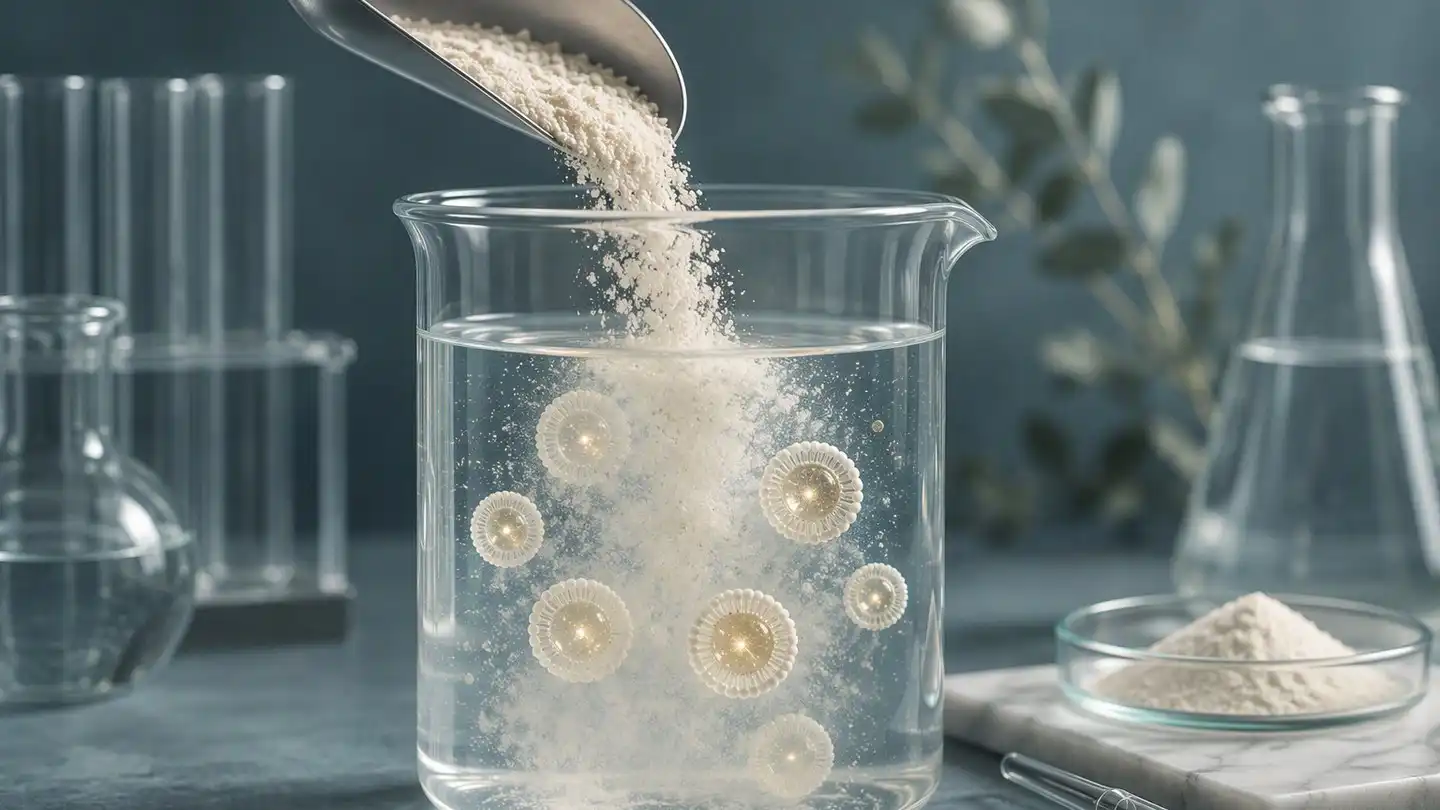

A bilayer formed from a coherent phospholipid fraction packs more predictably, which means the vesicle population is more uniform and the aqueous core is better defined. A bilayer diluted with non-bilayer material packs less predictably, the population widens, and the proportion of active that remains outside the structure rises. The process can compensate to a degree — more energy, more passes, tighter temperature control — but it cannot convert a poorly specified lipid into a well-behaved one.
This is the reason a supplier's encapsulation figure should always be read alongside the lipid specification. An efficiency number quoted without a phospholipid description is a result without a cause, and it is not reproducible from one lot to the next.
Source, Allergen and the Vegan Question
The three common sources are soy, sunflower and egg, and the differences that matter commercially are origin, allergen status and supply reliability rather than performance alone. Soy raises a labelling question in markets where soy is a declared allergen. Sunflower avoids that question and has become the default for brands with a clean-label position. Egg-derived phospholipid is a specialised choice with its own allergen profile.
For a brand carrying a vegan claim, the lipid source has to be documented, not assumed. Plant-derived lecithin satisfies the claim; the capsule shell often does not, and that is where the audit usually fails. The choice of grade for a formula should therefore record both the lipid origin and the shell material in the same document, with a statement attached to each.
Non-GMO status follows the same pattern. It is a chain-of-custody statement about the lipid, not a property of the finished powder that can be inferred from the active. A supplier who can produce the statement for the lecithin lot and the carrier together is doing the work that the claim requires.
Lipid Oxidation and the Off-Note Problem
Phospholipids oxidise, and oxidation is the failure mode that surfaces as a sensory complaint rather than an assay failure. The mechanism is straightforward: unsaturated acyl chains react with oxygen, primary oxidation products form, and those products break down into smaller volatile compounds that carry distinct notes. In a powder, the reaction is slow but not stopped, which is why packaging and storage conditions belong in the specification.
Two measurements describe the state of the lipid. Peroxide value quantifies primary oxidation products and is measured by iodometric titration; it is the number that moves first. A secondary measurement of the volatile fraction describes what a consumer would notice, and it moves later. A supplier who reports only one of the two is describing half the picture.
For the buyer, the practical response is to specify a peroxide limit at release and to ask how the powder is protected during storage and transport. Nitrogen flushing, foil lamination and moisture control are process decisions with measurable consequences, and they are the reason storage conditions belong in a technical agreement rather than a shipping note.
The Three Numbers to Put in the Agreement
Most phospholipid disputes are avoidable with three numbers and one statement. The table below is the short version of a technical agreement.
| Item | What to specify | What it avoids |
|---|---|---|
| Phosphatidylcholine fraction | The minimum proportion in the lipid, with the assay method named | Silent substitution with a lower-grade lecithin between lots |
| Peroxide value | A limit at release, measured by iodometric titration | Off-notes appearing in a finished batch after packing |
| Particle size distribution | The distribution, not only the mean, measured by dynamic light scattering | A widening population that passes release but fails on stability |
| Origin statement | Lipid source with allergen and non-GMO status | A label claim that cannot be documented after launch |
The first row is the one buyers most often leave out. Naming the lipid source is not the same as specifying its composition, and a source change at the supplier's end can move both encapsulation efficiency and particle size without any line on the certificate looking different.
What This Means for Your Format
The lipid specification propagates into format decisions in ways that are easy to overlook. A powder with a wide particle size distribution settles and segregates in a sachet, so the declared amount per stick becomes variable. A powder with a high surface charge disperses well in water but can foam. A powder with a higher non-bilayer fraction flows well but releases its active less consistently under compression.
None of these is visible from an NMN content percentage, and all of them are visible in a pilot run. That is the argument for a sample large enough to fill a small batch rather than a gram-scale quantity: the questions that matter at the filling line cannot be answered from a spoon.
Red Flags in a Lipid Specification
A sheet that lists lecithin with no composition, an encapsulation figure with no acceptance range, a particle size reported only as a mean, or a certificate with no peroxide value. Any one of those is a question to ask. Several together suggest the delivery system is being described rather than controlled.
How the Vesicle Forms, and Why the Lipid Sets the Ceiling
Every liposomal powder passes through the same three stages: a lipid phase is prepared, an aqueous phase containing the active is brought into contact with it, and energy is applied until vesicles form. The stages differ in equipment and in the order of operations, but the physics does not change. What changes is how forgiving each stage is, and that forgiveness comes almost entirely from the lipid.
In a film-rehydration route, the lipid is dissolved in a solvent, dried to a thin film, and then hydrated with the aqueous phase. Hydration is the critical step: a coherent film hydrates evenly and produces a relatively narrow population, while a film containing non-bilayer material hydrates unevenly and produces a wide one. In a high-pressure homogenisation route, the coarse dispersion is forced through a narrow gap, and the resulting size depends on how readily the bilayer deforms. A lipid with a well-defined acyl chain profile deforms predictably; a heterogeneous one does not.
The consequence for a buyer is that process parameters cannot be optimised independently of the lipid specification. A supplier who tightens homogenisation pressure to compensate for a weaker lipid will produce a smaller mean particle size, but not necessarily a narrower distribution, and the stability of the resulting powder may be worse than the number suggests. This is the mechanism behind a pattern that confuses buyers: two powders with similar reported particle sizes behaving differently after three months on stability.
When a supplier describes the process, it is worth asking which lipid parameter the process was validated against. An answer that names the phosphatidylcholine fraction and the peroxide limit indicates the process was designed around the material. An answer that describes only pressure and temperature indicates the process was designed around the equipment.
Reading a Certificate Against the Lipid Specification
A certificate of analysis is a release document for the powder. Read against the lipid specification, each line says something about how the delivery system was built.
| COA line | What it implies about the lipid |
|---|---|
| Assay of the active | Confirms the declared amount; says nothing about where that amount sits |
| Encapsulation efficiency | Describes how much of the active is inside the vesicle, and therefore how well the lipid performed |
| Particle size distribution | Describes the population the process produced from that lipid |
| Peroxide value | Describes the oxidative history of the lipid at release |
| Residual moisture | Describes how much water remains available to drive hydrolysis during storage |
| Heavy metals and microbiological counts | Confirm the lot clears the limits on the specification |
The third and fourth lines together are the closest thing to a fingerprint of the delivery system. A narrow distribution paired with a low peroxide value describes a process that was run on good material. A narrow distribution paired with a high peroxide value describes a process that produced the right structure from material already on its way to degradation, and that powder will behave differently in six months.
There is a subtler flag worth naming: a specification that is precise about the active and vague about everything else. A sheet quoting the NMN content to a decimal place while describing the lipid as lecithin tells you where the supplier's attention sits. It is not a defect in the product, but it is a reliable indicator of where documentation requests will be slow, and of which questions will be answered from memory rather than from a file. Buyers running a qualification programme should weigh that as heavily as any single number, because a grade is only as controllable as the specification behind it.
Ask for the Lipid Specification, Not Just the Active
EmerWell supplies liposomal NMN powder with a specification that covers NMN content, encapsulation efficiency, particle size, heavy metals and microbiological limits, and with the lipid composition and origin documented alongside it. Buyers can request a lot COA, a particle size distribution and a sample for pilot-scale trial work, together with the process description that explains how the vesicle is formed and dried.
If you are specifying a liposomal NMN grade and want the lipid parameters written into the agreement, send your format and target serving to info@emerwell-bio.com, or review the liposomal NMN powder specification directly. We will confirm which parameters the grade holds and which ones your process will need to control.
References
1. U.S. Food and Drug Administration. Current Good Manufacturing Practice in Manufacturing, Packaging, Labeling, or Holding Operations for Dietary Supplements (21 CFR Part 111). ecfr.gov
2. U.S. Food and Drug Administration. Guidance documents for the food and dietary supplement industry. fda.gov
3. FAO/WHO Codex Alimentarius Commission. Food labelling and food additive provisions. fao.org
4. European Food Safety Authority. Food additives and nutrient sources added to food. efsa.europa.eu
Disclaimer: This article provides technical information on ingredient specification for business-to-business sourcing. It is not medical advice and makes no statement about the suitability of any product for a health condition. Finished-product claims remain the responsibility of the brand placing them on the market.
Online Message