May 6, 2026
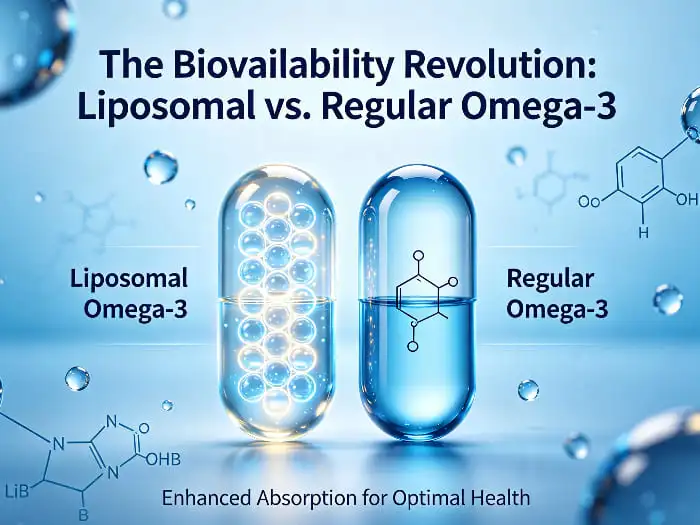
The Bioavailability Revolution: Liposomal vs. Regular Omega-3
As a specialist in nutrient delivery, we recognize that the true value of a supplement lies not in the dose administered, but in its intestinal absorption efficiency. Taking traditional fish oil is like trying to water a plant by throwing a bucket of water at it; much is wasted. Taking liposomal omega-3 is like using a precision drip-irrigation system; it delivers the nutrients directly to the roots in a steady, controlled way that the body can actually use.
The Absorption Barrier in Traditional Fish Oil
The clinical utility of omega-3 fatty acids (EPA and DHA) for cardiovascular and cognitive health is well-documented, yet their efficacy is frequently hindered by poor aqueous solubility and variable absorption. Traditional supplements, particularly in ethyl ester (EE) or unmodified triacylglycerol (TAG) forms, rely heavily on the presence of a high-fat meal to trigger bile secretion and pancreatic lipase activity. Research indicates that the digestion of EEs is 10 to 50 times slower than TAGs, often leading to inconsistent blood levels.
The Liposomal & Lipid-Based Advantage
To overcome these hurdles, researchers have developed advanced lipid-based delivery systems, including liposomes and self-micro emulsifying drug delivery systems (SMEDS). Liposomes are microscopic vesicles consisting of phospholipid bilayers that entrap the omega-3 oil.
This technology offers three primary benefits for B2B formulations:
- Nano-Size Efficiency: By reducing particle size to the 100–300 nm range, these systems create a massive surface area-to-volume ratio, allowing digestive enzymes to interact with the oil far more efficiently.
- Bypassing Digestive Hurdles: Advanced systems present the oil in a pre-dispersed state that facilitates immediate micelle formation in the small intestine, significantly reducing dependency on meal timing.
- Oxidative Shielding & Sensory Appeal: Omega-3s are highly susceptible to oxidation ("rancidity"). The phospholipid bilayer acts as a physical barrier, protecting fragile PUFAs from light and oxygen while effectively masking the "fishy" aftertaste—a critical factor for consumer compliance.
A 13.2-Fold Bioavailability Jump
Preclinical pharmacokinetic studies highlight the dramatic impact of these systems. In research conducted by Ahmad et al., an optimized lipid-based delivery system utilized food-grade lecithin to stabilize oil droplets. The results showed that EPA bioavailability increased by 13.2-fold and DHA by 4.7-fold compared to conventional fish oil. Lecithin was identified as the key factor in reducing particle size and stabilizing the oil phase within a robust phospholipid matrix.
Conclusion: Strategic Sourcing for 2026
In the evolution of nutrition, the focus has shifted from the milligrams administered to the milligrams absorbed. Liposomal delivery transforms omega-3 from a meal-dependent, fragile oil into a highly bioavailable, stable nutrient system suitable for high-end functional foods and nutraceuticals.
Are you looking to upgrade your product line with high-performance Omega-3? As your technical partner, we provide stable, standardized liposomal solutions designed to meet the most rigorous formulation challenges.
- [Request a Technical Data Sheet]
- [Order Samples for Stability Testing]
- [Consult with our R&D Team]
For technical support and formulation consultation, contact our professional team: info@emerwell-bio.com
About the Author
Le Li, Ph.D. is an Industrial Pharmaceutical Scientist specializing in advanced drug delivery systems. At EmerWell, she leads the development of innovative liposomal formulations designed to solve core challenges in nutrient stability and intestinal absorption.
References
- Ahmad, I. et al. Appl. Food Res. 2025, 5, 100745.
- Shah, S et al. Adv. Drug Delivery Rev. 2020, 154-155, 102–122.
- Venugopalan, V. K et al. Foods 2021, 10 (7), 1566.
- Has, C. et al. J. Liposome Res. 2019, DOI: 10.1080/08982104.2019.1668010.
- Khadke, S. et al. Expert Opin. Drug Deliv. 2020, 72 (10), 1328–1340.
- Komaiko, J. et al. Food Chem. 2016, 203, 331–339.
- Alijani, S. et al. Prog. Lipid Res. 2025, 97, 101318.
- Sedaghat Doost, A. et al. Trends Food Sci. Technol. 2020, 99, 474–486.
- Xu, Z. et al. Food Chem. 2016, DOI: 10.1016/j.foodchem.2016.01.073.
Online Message
YOU MAY LIKE
High quality furniture manufacturer

_1776234266736.webp)