

Nov 11, 2026
EmerWell Closes SupplySide West 2026 With Particle Data on the Table
EmerWell Bio LLC closed three days at SupplySide West 2026 with a booth organized around one question: can the encapsulation be measured? Across 28–30 October at Mandalay Bay Convention Center in Las Vegas, Booth 7751, formulators reviewed dynamic light scattering (DLS) and transmission electron microscopy (TEM) characterization for the EncapsWell™ liposomal range at the table, next to the batch records behind each grade — and the San Diego scientists who generated the data were the same people answering questions about it.
That structure changed the shape of the conversations. Fewer visitors opened with price per kilogram. More of them opened a laptop, pulled up a formula in development, and asked what would happen to particle size, payload, and shelf stability if their active were moved into a phospholipid bilayer. The recap below is organized around what those visitors asked, because the questions were more informative than any traffic count.
| Show | SupplySide West 2026 |
| Dates | 28–30 October 2026 |
| Venue | Mandalay Bay Convention Center, Las Vegas, NV, USA |
| Booth | 7751 |
| Format | Technical review sessions at the booth, three show days |
A Booth Built for Review, Not Handouts
The booth was laid out for seated technical review rather than a counter transaction: a screen cycling through particle size distributions and TEM images, printed specification sheets for six liposomal grades, and enough table space for a formulator to put a laptop down and walk through a live formula.
That layout mattered because the visitors arrived prepared. Many came in pairs — a formulation lead and a procurement contact — and the conversation split along that line almost immediately. The formulation side wanted the method: which instrument, which dilution, which media, how polydispersity was calculated, and whether the reported figure was a mean over the batch or a single sampling point. The procurement side wanted the commercial consequences of those numbers: which spec is guaranteed in the CoA, what the acceptable deviation is batch to batch, and what happens to a purchase order if a later lot lands at the edge of the range.
Sitting behind both sets of questions was a single technical definition that the team returned to repeatedly. A liposomal powder is not an ingredient blended with phospholipids. The active has to sit inside a bilayer, and that architecture is what produces the difference in absorption. A blend can be sold under the same word, and buyers have learned to ask which one they are being quoted.
The Four Questions That Repeated Across Three Days
1. Is the active actually encapsulated?
This was the first question in most sessions, and usually the one that decided the rest of the meeting. Visitors had seen "liposomal" labels attached to products where the active was simply dry-blended with lecithin, and they wanted the distinction demonstrated rather than asserted. The answer at the booth was structural: TEM images showing bilayer vesicles, DLS distributions consistent with an encapsulated population, and an explanation of how the payload is loaded rather than coated.
2. What is the particle size, and how was it measured?
EncapsWell™ materials are engineered to a particle size below 400 nm with a polydispersity index below 0.5, verified by DLS and TEM. The follow-up was always methodological — whether the sample was diluted in water or in a food matrix, whether the measurement was taken before or after spray drying, and how the number compares with what a customer's own lab would report. Formulators who already run DLS in-house wanted the raw distributions, not a summary line, so they could compare against their own baselines.
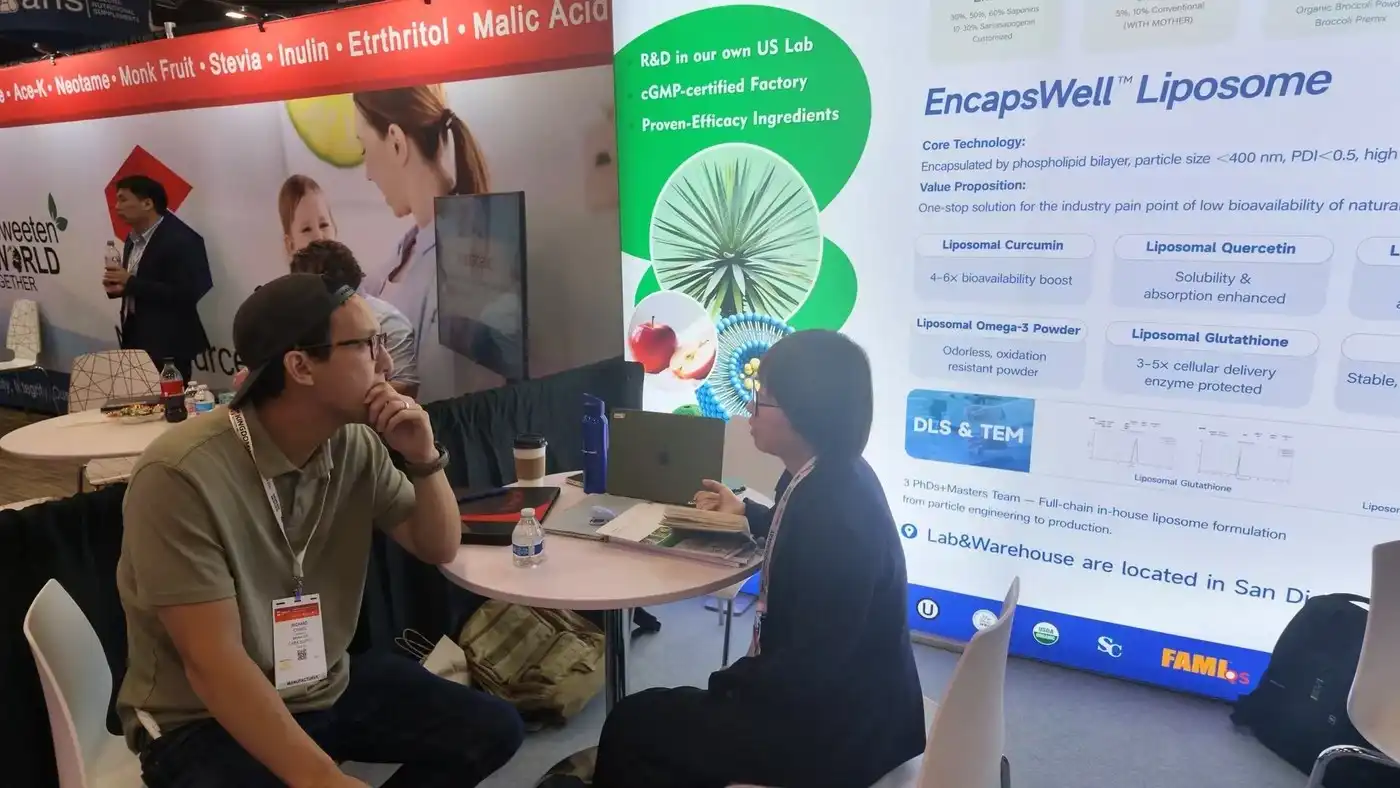

Particle size and PDI reviewed screen by screen at Booth 7751, with the scientist who generated the data answering the method questions.
3. Does the distribution hold at commercial scale?
Pilot-scale success is the easy part. The question that separated serious buyers from browsers was reproducibility: what the batch-to-batch variance looks like after a year of production, and how that variance is documented. A liposomal claim that drifts between lots becomes a labeling problem, a stability-testing problem, and eventually a customer complaint — so the team walked through how specifications are locked and released rather than promising a single impressive measurement.
4. Can the same route be applied to a non-catalog active?
The last question was the one that generated follow-up work. Buyers arrived with actives that were poorly water-soluble, unstable in a powder blend, bitter at the required dose, or simply not absorbed well enough to justify their position on a label. Each of those is a different formulation problem with a different encapsulation answer, and the booth conversation was the start of a project brief rather than a quotation.
Which Actives Buyers Brought to the Table
Interest clustered where the technical case is strongest. Liposomal omega-3 powder came up constantly, usually framed around the two failures of conventional fish oil powders — odor and oxidation — and whether a liposomal powder format resolves both without a heavy coating system. Liposomal curcumin powder questions were about the size of the bioavailability claim a brand can defend, and what documentation sits behind a 4–6× figure.
Liposomal glutathione powder drew formulators working on cellular delivery and enzyme protection, where the value proposition is 3–5× delivery and the constraint is keeping the tripeptide intact through processing. NAD and NMN questions were about membrane permeability and how a stable powder format fits an anti-aging position that regulators are watching closely. Quercetin interest centered on solubility and absorption enhancement, and resveratrol on stability against degradation.
Beyond the six headline grades, visitors asked about liposomal vitamin C, vitamin D3, B12, vitamin E, and liposomal versions of botanical extracts already in their catalogs — milk thistle, acerola, CoQ10. The pattern was consistent: brands are not shopping for a liposomal catalog. They are trying to fix one specific active that underperforms in its current format.
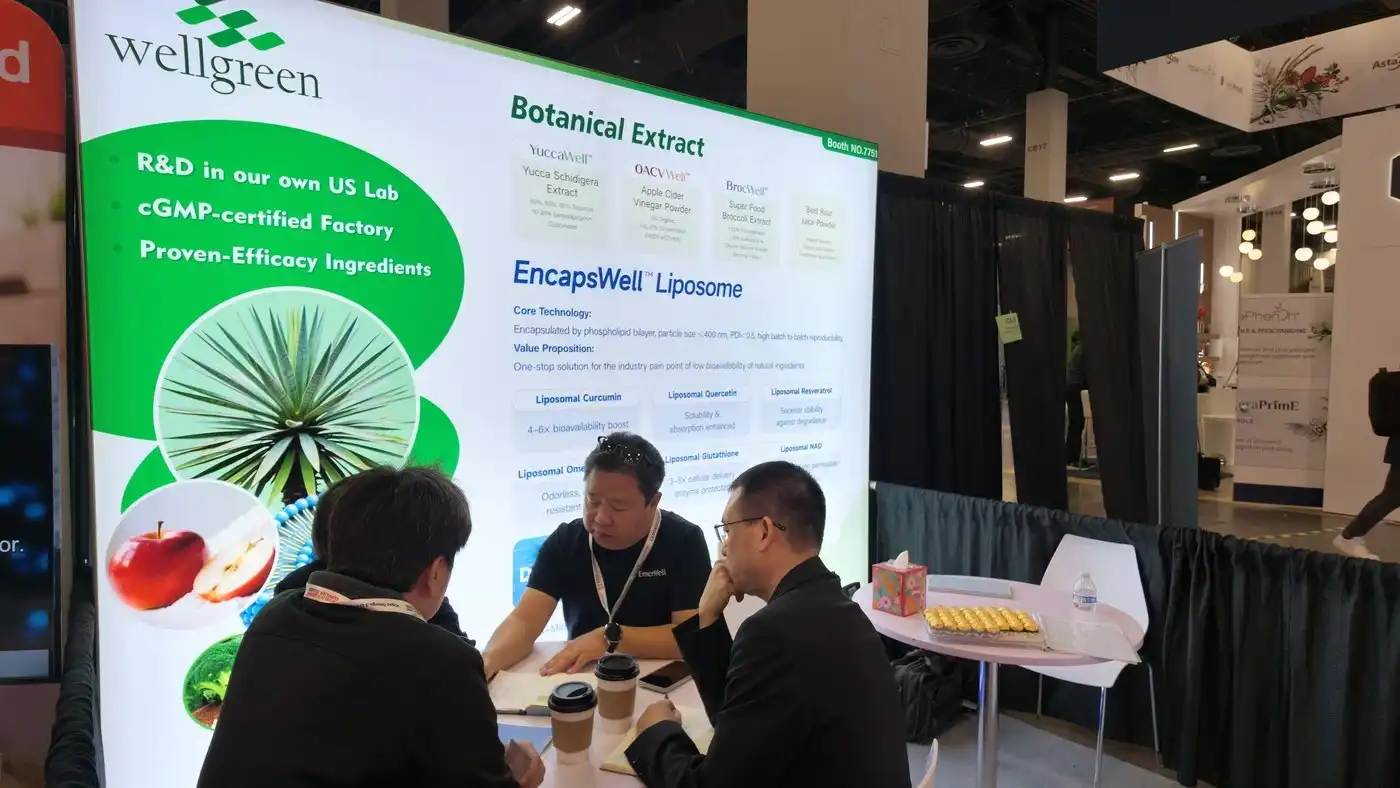
The booth ran as a series of seated technical reviews rather than a sample counter, with specification sheets and CoA data on the table.
Why San Diego Kept Coming Up in the Conversation
The U.S. footprint turned out to be a technical argument as much as a logistics one. EmerWell operates an independent laboratory and warehouse at 6342 Ferris Square in San Diego, staffed by a research team of three PhDs and master's-level scientists covering liposome development from particle engineering through production.
For a North American brand, that changes the follow-up sequence. A question raised at the booth does not have to survive an overnight delay to reach the person who can answer it. Samples ship domestically, so an application trial can start in days rather than in weeks. And the technical contact after the show is the scientist who designed the formulation, not an account manager relaying a message.
Several visitors raised the point directly: they had been burned by a supplier whose U.S. representative could quote a spec sheet but could not explain a DLS result. The San Diego team being on the floor for all three days was, for those buyers, the difference between a sample request and a project.
From Booth Conversation to Project Brief: What Happens Next
The follow-up path for conversations started at Booth 7751 is deliberately short, because most of the information needed to move forward was already exchanged at the table.
- Technical review. The active, target dose per serving, current format, and the failure being fixed are matched against an encapsulation route. Where the route is not viable, that is stated at this stage rather than after a sample order.
- Sample and documentation. A sample ships from San Diego with the characterization data and CoA for the lot, so the customer's own lab can reproduce the measurement.
- Application trial. Stability, taste, dose loading, and process compatibility are tested in the customer's actual matrix — beverage, gummy, capsule, or powder blend — because particle behavior in a model system is not the same as behavior in a finished product.
- Specification lock and scale-up. Once the trial passes, the specification is fixed and transferred into production. Because R&D and manufacturing sit inside the same organization, the spec that passed in development is the spec that runs at commercial scale.
- OEM/ODM supply. Standard grades and custom formulations are supplied under cGMP conditions, with customer-specified actives available beyond the catalog.
For teams that met the group at the show, the fastest next step is a short technical note rather than a formal inquiry: the active, the dose, the format, the target particle size if one exists, and the launch window. That is enough to confirm feasibility and, where relevant, to send the right characterization data first.
FAQ
Can we still request samples after the show? Yes. Sample requests from the show are being processed in the order they were received, and U.S. and Canadian buyers are served from the San Diego warehouse. Include the active, target dose, and intended dosage form so the right grade is dispatched.
Will EmerWell share the raw particle data discussed at the booth? Yes. DLS distributions and TEM images for the displayed grades are available with the sample documentation, so a customer's own laboratory can compare results on the same method.
Is the 400 nm and PDI 0.5 figure a specification or a typical value? It is the engineering target for the platform, and the released specification for each grade is confirmed in its CoA. Buyers who need a tighter window for a specific application should raise it during the technical review, since feasibility depends on the active.
Can EmerWell formulate a liposomal version of an active that is not in the catalog? Yes. Custom work covers concept development, particle engineering, stability assessment, and production scale-up, and is quoted per project after the technical review rather than from a standard price list.
Where is the product manufactured and characterized? Liposomal development and characterization take place at the San Diego laboratory, with production under cGMP conditions. The U.S. team that characterized the materials at the show remains the technical contact after it.
About EmerWell Bio LLC
EmerWell Bio LLC is a San Diego–based supplier of liposomal delivery technologies for the nutraceutical, functional food, and personal care industries, and the U.S. subsidiary of Wellgreen Technology Co., Ltd. Through the proprietary EncapsWell™ platform, the company provides liposomal ingredient supply and end-to-end formulation services — from R&D design through large-scale OEM production — supported by an independent laboratory, warehouse, and a research team of three PhDs and master's-level scientists at 6342 Ferris Square, San Diego, CA 92121.
The EncapsWell™ range covers liposomal curcumin, quercetin, resveratrol, omega-3 powder, glutathione, and NAD, alongside additional grades including NMN, vitamin C, vitamin D3, B12, vitamin E, B5, and B6, with OEM/ODM supply and custom formulation for actives outside the catalog.
EmerWell works with U.S. and international brands, and its California operation supports North American customers with domestic sampling, stock, and technical support in the customer's own time zone. Technical documentation, characterization data, and samples are available on request from the San Diego team.
Contact: info@emerwell-bio.com · +1 619 877 5461
LinkedIn: linkedin.com/company/emerwell
Online Message