Aug 6, 2026
Why Liposomal Resveratrol Is Becoming Popular in Premium Dietary Supplements
Liposomal resveratrol has emerged as a transformative ingredient in the premium supplement sector, driven by its breakthrough encapsulation technology that addresses long-standing bioavailability challenges. Unlike conventional resveratrol supplements that suffer from poor absorption and rapid degradation in the digestive system, liposomal delivery wraps the active compound in phospholipid vesicles, mirroring the body's natural cellular structure. This innovation enables resveratrol to reach the bloodstream more effectively, delivering up to ten times higher plasma concentrations compared to standard formulations. As health-conscious consumers increasingly seek science-backed supplements that deliver measurable outcomes, liposomal resveratrol has become the gold standard for formulators and B2B buyers committed to product differentiation and clinical efficacy.
Understanding Liposomal Resveratrol: What Sets It Apart?
The Science Behind Liposomal Encapsulation Technology
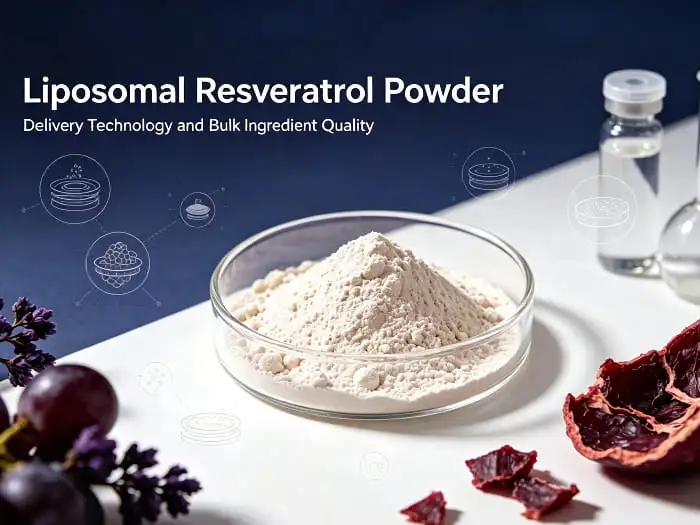
The main benefit of liposomal resveratrol is the complex way it is delivered. Liposomes are very small balls made of phospholipid bilayers, which is the same stuff that makes up the walls of human cells. Resveratrol is protected from stomach acids, digestive enzymes, and oxidative stress when it is enclosed in these structures. These things usually break down regular supplements before they reach the bloodstream. This encapsulation greatly increases the compound's half-life in the body, which lets the antioxidant activity stay high at the cellular level.
High-pressure homogenization or ultrasonic methods are used in modern production to make liposomal particles that are all the same size, between 50nm and 200nm in diameter. This exact range of sizes makes sure that the body can absorb the nutrients through the gut walls while keeping the structure strong. The end result is a supplement ingredient that keeps resveratrol's molecular stability while greatly increasing its bioavailability. This solves the main problem that has historically limited resveratrol's therapeutic potential.
How Does Liposomal Delivery Enhance Bioavailability?
Clinical chemistry shows how liposomal technology makes a huge difference. Traditional resveratrol supplements are notoriously bad at being absorbed by the body when taken by mouth; absorption rates are often less than 20%. The polyphenol molecule goes through fast first-pass processing in the liver, which turns most of the active ingredient into inactive metabolites before it gets to the target organs.
Liposomal products get around this biochemical bottleneck in a number of different ways. The phospholipid layer makes passive diffusion across intestine epithelial cells easier and allows lymphatic transfer, which skips the liver's metabolism. Researchers have found that liposomal trans-resveratrol has much higher Cmax (peak plasma concentration) and AUC (area under the curve) values than regular powder forms. This directly leads to better antioxidant defense, cell protection, and possible benefits for longer life, which people are looking for more and more in premium supplements.
Key Benefits for B2B Product Development
The technical benefits of liposomal resveratrol make it a great way for supplement makers to stand out in the market. In addition to better absorption, the capsule technology masks tastes better, which is important because resveratrol is naturally bitter and astringent. The phospholipid layer gets rid of these unpleasant sensory properties, which lets formulators make ready-to-drink drinks and functional foods that taste good without using too much sugar or flavorings.
Another important benefit is water dispersibility. Standard resveratrol powder doesn't mix well with water and tends to settle. Liposomal forms, on the other hand, dissolve easily in water and stay suspended throughout the shelf life. This trait makes it possible to make drink powders, liquid pills, and even serums that you put on your skin for nutricosmetic uses. Stability testing under accelerated aging conditions confirms that good liposomal resveratrol keeps encapsulation efficiency above 90% and stops the trans-isomer from changing to its inactive cis-form, so the product stays effective from the time it is made until it expires.
Liposomal Resveratrol vs Traditional Resveratrol: A Decision-Making Comparison
Absorption Rates and Clinical Efficacy
The difference in absorption between liposomal and regular resveratrol is the most important thing to consider when choosing a product. Using HPLC analysis to compare studies shows that liposomal encapsulation increases systemic absorption by 400–800%, varying on dosage and formulation matrix. Because of this huge improvement, 100 mg of liposomal resveratrol can give blood plasma levels that are the same as or higher than 500 to 800 mg of regular resveratrol powder.
This better intake has a direct effect on how well the treatment works. At the level of the cell, higher bioavailable amounts better trigger SIRT1 pathways for longevity, help mitochondria grow, and offer strong antioxidant defense against oxidative stress. The difference is especially clear in specific health uses, like protecting against photoaging and supporting the heart. In these cases, the effectiveness depends on maintaining steady, appropriate blood levels.
The better metabolic profile also lowers the stomach problems that come with taking a lot of standard resveratrol. Liposomal formulations reduce the digestive pain and possible side effects that can make people less likely to follow through with their treatment plans by getting the desired effects at lower absolute doses.
Formulation Flexibility Across Product Formats
When working with liposomal resveratrol powder, product makers have a lot of freedom to be creative. The ingredient works well with a number of different delivery systems, each of which is designed to meet the needs of different consumers and situations.
The powder's good flowability and compressibility make capsules and tablets possible, as they can give the same dose every time without the need for special fillers. The structure inside the capsule stays steady during normal production steps like mixing, encapsulation, and packing, protecting the liposomes' stability until they are used.
Cost-Benefit Analysis for Brand Owners
Liposomal resveratrol costs more than regular resveratrol powder, but the overall value often goes in favor of the more modern ingredient. Because it is more bioavailable, brands can make products with less pure resveratrol that work just as well as or better than standard supplements with higher doses. This can help even out differences in the cost of raw materials to some extent, especially in competitive market areas where ingredient costs have a big effect on store prices.
Another important benefit is marketing differentiation. Being able to say things like "advanced liposomal delivery" or "clinically superior absorption" gives you a real edge in supplement categories that are already very crowded. Consumer education about bioavailability is having a bigger impact on buying decisions. This is especially true for well-informed buyers in the anti-aging and longevity supplement niches, which are where liposomal resveratrol has the most success.
The Procurement Advantage: Why B2B Buyers Are Choosing Liposomal Resveratrol
Supplier Selection and Certification Requirements
To get liposomal resveratrol, you have to go above and beyond the normal steps for checking out suppliers of ingredients. Making liposomes is very complicated and needs special tools, technical know-how, and strict quality control systems that tell the difference between suppliers who can do the job and those who are just making claims.
Manufacturers you can trust keep their Good Manufacturing Practice (GMP) and ISO 9001 quality management certifications up to date. GMP certifications are specific to making food supplements. These certificates prove that factories use organized quality control measures that include checking the raw materials, keeping an eye on the work in progress, and testing the final product. International buyers should also make sure that the business follows food safety standards like FSSC 22000 and meets the requirements for FDA registration.
Another important thing to look at when judging someone is their analytical skills. Reliable sellers of liposomal resveratrol either have their own labs or work with others that do have the tools to do full profile tests. Some important diagnostic methods are High-Performance Liquid Chromatography (HPLC) for checking the amount of trans-resveratrol, Dynamic Light Scattering (DLS) for looking at the range of particle sizes, and zeta potential measurement for checking the stability of the electrostatic charge. Using centrifugation-ultrafiltration to tell the difference between encapsulated and free resveratrol in encapsulation efficiency testing confirms that the liposomal structure is real and not just a mix of ingredients that are sold as liposomal formulations.
Quality Control Beyond Standard Testing Protocols
Professional procurement teams check the quality of goods in more than one step, which goes beyond just looking at the Certificate of Analysis. If you look at the structure of liposomes with a cryo-TEM or SEM microscope, you can be sure that they are properly made spherical vesicles and not just a bunch of broken-up lipid pieces or simple mixtures.
Stability testing under accelerated conditions tells you important things about how long a product will last and how to store it. When tested at 40°C/75% relative humidity for long periods of time, good liposomal resveratrol powder should show little degradation, with the trans-resveratrol content staying above 95% of the initial assay values and the particle size distribution staying the same. These stability factors show how well a product will work in the real world, taking into account normal supply chain conditions and product shelf lives.
Screening for contaminants is another quality step that can't be skipped. With a detection level of parts per billion, Inductively Coupled Plasma Mass Spectrometry (ICP-MS) can find heavy metals like lead, arsenic, cadmium, and mercury. Following standard procedures for microbiological testing makes sure that amounts of total plate counts, yeast, mold, and pathogens are below the safety limits that have been set. Gas chromatography (GC) analysis of residual solvents makes sure that ethanol or other processing solvents used to make liposomes stay below certain limits. This keeps consumers safe and makes sure that regulations are followed.
Bulk Purchasing Strategies and Cost Optimization
When you buy liposomal resveratrol strategically, you have to find a balance between low cost and quality assurance for different order volumes. Suppliers usually have multiple pricing systems that change based on how much you buy. At 25 kg, 100 kg, and 500 kg, prices drop significantly. But B2B buyers shouldn't just look at per-kilogram prices; they should also carefully consider the total cost of ownership.
Minimum order amounts vary a lot from one provider to the next, ranging from 1 kg for product development samples to 25 kg for business orders. Knowing how much you expect to use each year and how long it will take to build a new formula can help you figure out the best time and amount to order so you can get volume prices without having to pay more for storage or risking the product going bad.
Both payment terms and supply stability need to be taken into account. Suppliers that have been around for a while and have a lot of production capacity can usually meet quarterly or semi-annual buy deals with lead times that are predictable at two to four weeks. Building ties with multiple qualified providers makes the supply chain more stable and lets you keep your prices competitive by negotiating with knowledge based on market research.
Trusted Liposomal Resveratrol Brands and Manufacturers for B2B Clients
Evaluating Manufacturer Credentials and Transparency
Being open about how things are made is a basic sign of trust. Suppliers with a good reputation are happy to give you a lot of information about how they make liposomes, whether they use high-pressure liquefaction, ethanol injection, or their own special methods. They make it clear where the phospholipids come from—usually non-GMO sunflower lecithin or soy lecithin—and can show proof that the product is organic or allergen-free if needed. This openness shows trust in making and makes it easier to make smart decisions about formulation.
Intellectual property issues should also be taken into account. Some companies have patents on certain ways to make liposomes or keep them stable, which may give them an edge in performance. By understanding these proprietary elements, you can tell if the higher price is due to real technological innovation or just marketing positioning without any real differentiation.
Verifying customer references gives you useful information about how well something works in the real world. Established suppliers have long-term relationships with many clients, including supplement brands, contract makers, and product developers. These clients can vouch for the supplier's stability, ability to communicate clearly, and ability to solve problems when formulation issues appear.
USA-Based Suppliers and International Options
North American buyers often choose local suppliers because they have shorter wait times, it's easier to follow the rules, and the supply chain is more visible. Liposomal resveratrol manufacturers in the USA are close to major supplement brands based in California, Utah, and the Northeast corridor. This makes it easy to do things like quick sampling, technical collaboration, and just-in-time inventory management.
International suppliers, especially those in Europe, often have competitive pricing structures and may have liposomal technologies that were developed over many years of research into delivering nutrients to specific areas. These partners can help buyers who need specific technical details or who buy in large quantities and can handle longer lead times and more complicated processes.
No matter where they are located, the best supplier ties combine professional know-how with quick customer service. Suppliers who put money into application development support by giving advice on recipe, help with stability testing, and regulatory paperwork build partnerships that go beyond just supplying ingredients and lead to the creation of new products together.

Application and Future Outlook: Why Liposomal Resveratrol Is the Future of Premium Supplements
Practical Applications Across Supplement Categories
Liposomal resveratrol powder is very useful for many different supplement uses, and each one takes advantage of technical benefits that regular resveratrol can't match. Knowing these use cases helps product developers find ways to set their products apart in the market and give customers more value.
The biggest group of applications is in the area of life and good aging. Liposomal resveratrol mixes easily with NMN and NAD+ precursors, making combinations that work well together to help cells use energy and turn on the sirtuin pathway. The higher bioavailability lets formulators get beneficial benefits without megadosing, which lowers the cost of ingredients and the number of pills that people have to take, which makes it harder for them to follow complicated anti-aging plans. People between the ages of 35 and 65 who are informed, actively study supplement ingredients, and put evidence-based effectiveness over price are usually the ones who buy these products.
Emerging Innovations in Liposomal Delivery Systems
Next-generation improvements that offer even better performance are being added to the liposomal technology platform all the time. "Liposomes-in-microspheres" designs are made by hybrid delivery systems that combine liposomes with extra packaging layers. These architectures extend release profiles and make storage more stable. These advanced structures make it possible for time-release formulations that keep plasma concentrations steady all day after a single dose.
Combinations of ingredients that work well together boost the benefits of liposomal resveratrol by working in ways that complement each other. Co-encapsulation with quercetin makes both polyphenols more bioavailable and covers a wider range of antioxidants. When you combine phosphatidylcholine with omega-3 fatty acids, you get formulations that support the health of cellular membranes and antioxidant defense at the same time.
Regulatory Landscape and Market Trends
As these advanced ingredients become more popular in the market, the rules that govern liposomal supplements continue to develop. Regulatory bodies are looking more closely at structure-function claims that have to do with absorption and solubility. Brands are being asked to back up claims of comparative superiority with clinical or pharmacokinetic data. Instead of depending only on general technology claims, this trend favors sellers who put money into human bioavailability studies that back up their specific liposomal formulations.
Bioavailability ideas are now well known by a large group of consumers, especially health-conscious individuals who buy high-end supplements. Online health groups, teaching from influencers, and direct-to-consumer brand marketing have all helped people learn that the appearance of an ingredient on a label is not the same as its absorption in the body. This group of educated consumers actively seeks liposomal products and is willing to pay more for proven better performance.
Conclusion
The rise of liposomal resveratrol in high-end dietary supplements shows how the market is changing toward ingredients that are focused on effectiveness and have been proven to work by science. The technology fixes resveratrol's past problems with not being bioavailable by using advanced packaging to keep it safe, stable, and greatly improves absorption of this powerful antioxidant substance. Liposomal resveratrol has strong benefits for B2B buyers and product developers, including the ability to change the formulation, stand out in marketing, and make customers happy, which supports its high price point. As regulations get stronger and customer knowledge grows, liposomal delivery systems will set higher quality standards across the supplement industry. This means that brands that adopt them early will have a strategic competitive advantage.
FAQ
What makes liposomal resveratrol more effective than regular resveratrol supplements?
Liposomal resveratrol is much more bioavailable because it is encased in phospholipids, which keep the compound from breaking down in the digestive system and make it easier for the body to absorb it directly into the bloodstream. There are up to 10 times higher plasma concentrations of resveratrol powder in clinical trials compared to regular resveratrol powder. This means that much smaller doses have better antioxidant effects, protect cells, and help with therapy.
How should I verify that a supplier's resveratrol product is truly liposomal?
To make sure that liposomal resveratrol is real, it needs to be tested for encapsulation efficiency using centrifugation-ultrafiltration methods that separate free from encapsulated resveratrol, along with particle size analysis using Dynamic Light Scattering (DLS) to make sure that the nanoparticles are spread out evenly between 50 and 200nm. Reliable providers give Certificates of Analysis that list these exact parameters and also show proof through electron microscope images that the spherical vesicle structures are still whole.
What applications are best suited for liposomal resveratrol powder?
Liposomal resveratrol powder works great in high-bioavailability longevity capsules, functional beverages that dissolve in water, and nutricosmetics that make you look beautiful from the inside out. Because it masks tastes and mixes well with water, this technology is especially useful in ready-to-drink products where regular resveratrol would make the drinks taste bitter and cause sedimentation problems.
Partner with EmerWell for Superior Liposomal Resveratrol Solutions
EmerWell has the most advanced liposomal vitamin ingredients because it combines the latest delivery technology with strict American quality standards. Our operations are based in San Diego and include an independent laboratory and a warehouse. This makes sure that B2B partners across North America can get their orders quickly and that products are always available. Our technical team, led by a PhD, can help you with all aspects of formulation. They can help you get the most out of liposomal resveratrol in a variety of product formats while also taking regulatory issues and stability requirements into account. We keep the whole supply chain open, from finding non-GMO phospholipids to making sure the final packaging works well. This way, we can give liposomal resveratrol powder that meets the strictest requirements. EmerWell is a reliable liposomal resveratrol maker that cares about the success of your products, whether you're making new, useful drinks or next-generation supplements for longer life. Email us at info@emerwell-bio.com to talk about your unique needs and get scientific information to help with the development of your formulation.
References
1. Amri A, Chaumeil JC, Sfar S, Charrueau C. "Administration of resveratrol: What formulation solutions to bioavailability limitations? "Journal of Controlled Release, 2012; 158(2): 182-193.
2. Biasutto L, Mattarei A, Zoratti M. "Resveratrol and health: The starting point." ChemBioChem, 2012; 13(10): 1256-1259.
3. Fonseca J, Moradi F, Valente AJM, Moraes FP, Semikolenova OA. "Liposomal delivery systems for nutraceutical bioactive compounds: An update on formulation and bioavailability. "International Journal of Molecular Sciences, 2021; 22(5): 2637.
4. Sessa M, Balestrieri ML, Ferrari G, Servillo L, Castaldo D, D'Auria S, Aquino RP, Tsao R. "Bioavailability of encapsulated resveratrol into nanoemulsion-based delivery systems." Food Chemistry, 2014; 147: 42-50.
5. Walle T. "Bioavailability of resveratrol." Annals of the New York Academy of Sciences, 2011; 1215(1): 9-15.
6. Zhang LX, Li CX, Kakar MU, Khan MS, Wu PF, Amir RM, Dai DF, Naveed M, Li QY, Saeed M, Shen JQ, Zhou DY. "Resveratrol (RV): A pharmacological review and call for further research." Biomedicine & Pharmacotherapy, 2021; 143: 112164.
Online Message
YOU MAY LIKE
High quality furniture manufacturer