May 29, 2026
Which One is Better: Regular NMN or Liposomal NMN?
Liposomal forms of NMN are definitely better than regular NMN. Liposomal NMN powder is 4–8 times more bioavailable than forms that aren't sealed because it protects the active ingredient during rough digestion. With this advanced transport technology, NAD+ precursors get to target cells more quickly. This makes the product work better and makes customers happier, which is very important for high-end anti-aging products.
Understanding NMN and Liposomal NMN
Nicotinamide Mononucleotide (NMN) is an important part of nutrients for long life because it directly makes NAD+, a coenzyme that is needed for DNA repair, cellular energy production, and mitochondrial function. Nutraceutical companies often use crystalline NMN powder that is ≥99% pure in pills and tablets. People like NMN that hasn't been changed, but stomach acid quickly breaks it down into nicotinamide before it gets to the bowels. NMN is taken up by cells through SLC12A8 transporters, which stop absorption even after the stomach has broken down the food.
What Makes Liposomal NMN Different?
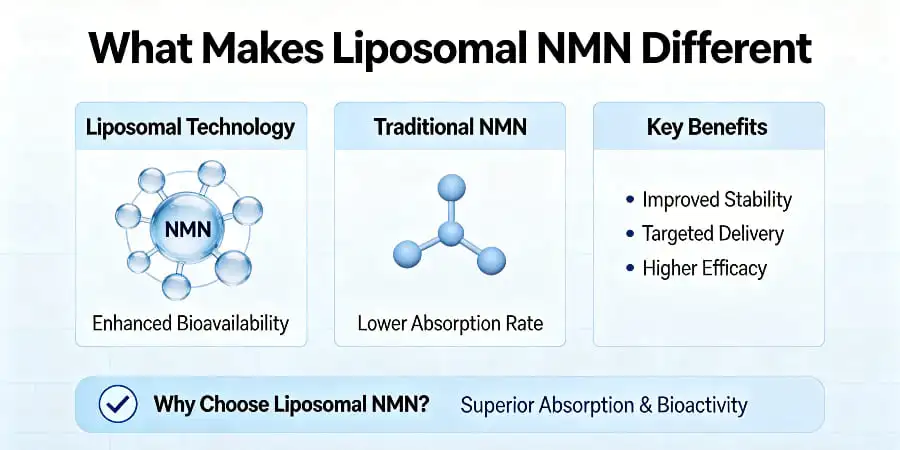
Liposomal NMN powder is a step forward in science. NMN molecules are enclosed in phospholipid bilayers that look like the membranes of human cells using advanced packaging technologies such as high-pressure homogenisation or thin-film hydration. This barrier keeps things from breaking down in an acidic gut and lets membranes fuse or endocytosis happen so cells can absorb things directly. When you freeze-dry liquid liposomal solutions, you get a shelf-stable, free-flowing powder that keeps its shape and can be made in a variety of ways. Procurement managers should know that this new idea solves NMN's solubility problems right away, which makes it perfect for high-end product lines.
The B2B Relevance
It's important for B2B leaders to understand these basic differences. Product makers who want to stand out from the competition need ingredients that can be tested. Regulatory experts need models that are stable. When deciding between normal and enclosed forms, procurement teams must compare cost structures and data on how well the products work. They must also think about how transport technology affects customer results and brand positioning in complex supplement markets.
Key Differences Between Regular NMN and Liposomal NMN
Bioavailability measures, dosage schedules, and safety factors all play a role in how products are made and where they are positioned in the market.
Bioavailability and Cellular Uptake
Studies have shown that liposomal delivery methods make NMN 4–8 times more absorbable than powder that isn't enclosed. Bypassing the enzymes that break down standard NMN, this huge gain is made. Standard versions use SLC12A8 transporters for gut absorption, which creates systemic bottlenecks. The liposomal type, on the other hand, lets cells enter directly. For B2B clients, smaller effective amounts, better product economics, and higher success claims that appeal to health-conscious customers looking for anti-aging benefits are all good things.
Dosage Optimization
Regular NMN products recommend 250–500 mg daily doses, usually twice a day, to keep NAD+ levels stable. This is to make up for absorption losses. Liposomal versions have similar absorption at 125–250 mg once a day. Product development teams can make concentrated formulas for pills and useful drinks. This can lower the cost of raw materials per serve and make it easier for end users to follow the instructions. Liposomal NMN stays steady even when you eat, which makes it easier for people to use. Standard NMN works better when you don't have anything in your stomach, so it doesn't affect your digestion.
Safety and Stability Profiles
Both types have a good track record of safety, with no side effects that are clinically important. When it comes to weather stress, liposomal NMN powder is better than regular NMN, which stays stable in cold, dry places. Phospholipid coating stops reactive breakdown, which extends the shelf life and effectiveness across all distribution routes. This is important for buying things from other countries. Third-party testing shows that liposomal NMN powder that is made properly meets strict heavy metal, microbial safety, and active ingredient concentration standards. This gives important B2B buyers peace of mind.
Liposomal NMN vs Other NMN Formats: Market Comparison
To find your way around the different ways to give NAD+ precursors, you need to know how each one caters to different customer groups and tastes.
Delivery System Analysis
Standard NMN pills are the most popular because they are easy to make and people are used to them. These pills are easy to use and don't cost a lot of money because each dose has 125–500 mg of solid NMN. For better absorption, sublingual pills don't go through the digestive system. However, their effectiveness relies on the quality of the product and how well the user follows the directions for administration.
The final coenzyme is made by liposomal NAD+ products, but not its predecessor. NAD+ molecules are much bigger than NMN molecules, which makes it hard for them to get into cells, even when they are encapsulated. Because of this, taking extra NAD+ is a unique option.
Nicotinamide riboside (NR) is the main NAD+ precursor that NMN has to compete with. It takes longer for NR to change into NAD+ because it needs to be modified to make NMN first. Because it was first sold in Western countries a long time ago and has strong scientific support, NR is a real choice for companies that want to attract customers who are looking for proof.
Cost-Benefit Considerations
Liposomal NMN powder is 30–60% more expensive than regular versions when bought in bulk. This price is because the stable packaging method needs complicated production, specialised tools, and intellectual property. Bioavailability costs money, and B2B buyers have to decide if the value is worth it. The difference in performance supports a higher selling price, protecting margins for brands aiming at wealthy customers, offering longer lasting effects, or being clinically proven to work. Standard NMN for entry-level goods could be useful for mass-market companies whose customers care about price.
Market Segment Fit
Liposomal mixtures are perfect for healthy beverage companies because they can be mixed with water and have a bland flavour. NMN that isn't encased is bitter, which makes it hard to hide its taste. However, lipid wrapping lowers unpleasant sensory qualities. Beauty-from-within businesses like the idea about how skin health can be seen through improved absorption. Contract makers don't have to change their tools to add powder to pills, capsules, packs, or ready-to-drink drinks.
Procurement Insights for B2B Clients
To get a lot of liposomal NMN powder, you have to carefully evaluate suppliers, negotiate prices, and plan your transportation so that the product stays pure from production to sale.
Supplier Selection Criteria
Quality assurance starts with checking all of the certificates. Food safety standards like cGMP, ISO 22000, FSSC 22000, and HACCP should be met by good producers. Certificates of Analysis (CoA) for each batch are properly certified by independent labs to show the product's purity, heavy metal, microbial, and active ingredient concentration. Halal and kosher certifications let you reach certain groups of people, while non-GMO and veggie certifications let you reach more markets.
Equally important is production transparency. Suppliers should offer raw material traceability documents proving ethical procurement of non-GMO phospholipids from sunflower or soy lecithin. Ask for ICH-compliant stable testing data to make sure the product works throughout its shelf life. Check the production capabilities to make sure it can be expanded. Some suppliers may be able to help growing brands without making them commit to a lot of inventory if they have specialised liposomal production lines and open MOQ deals.
Pricing and Negotiation Strategies
The market price of liposomal NMN powder varies from $180 to $320 per kilogram, based on the size of the order, how well the powder is encapsulated, and the approval standards. Tier discounts are popular in big buy deals. At 50 kg, you can save 10-15%, and at 200 kg or more, you can save even more. Annual supply contracts with buying patterns every three months help guarantee better prices while keeping inventory flexible.
Value-added services can help make things easier. To speed up product launches, suppliers offer white-label packaging, making up unique flavours, and pre-mixes. These services may cost more than in-house skills, but they are often cheaper for new brands that don't have a lot of R&D resources.
Logistics and Quality Maintenance
To stay structured, liposomal NMN powder needs to be stored in a controlled way. The temperature should be less than 25°C (77°F), and the humidity should be less than 60%. Powder liposomes are more solid than liquid liposomes, but heat or water can damage the phospholipid membrane, which makes the packaging less effective. For foreign shipping to warm places, temperature-controlled crates should be used, and arrival times should be between 2 and 4 weeks. Local US sellers with nearby storage cut down on wait times and stocking costs, which lets the market respond quickly.
Making the Right Decision: Which NMN Form Suits Your Business?
To pick the best NMN style, you need to make sure that the technical factors match your company's goals, your target audience, and your strategies for competing with others.
Decision Framework for Different Business Models
Liposomal formulas should be used by high-end health companies that target people aged 35 to 65. This group wants new ways to fight ageing, values science progress, and is willing to pay more for better results. Improving solubility creates a unique selling point that allows for prices that keep profits high even as ingredient costs rise.
For mass-market supplement names that focus on ease of access and quantities, standard NMN may work well. The lower cost structure makes it easier to compete on price at the store level, get into new markets, and make products. These companies may say that their products support NAD+ and extend life, but they know that their customers value value over accessibility.
Functional food and drink companies use liposome technology to come up with new goods. Because they taste better, dissolve better in water, and last longer in liquids, encapsulated forms are almost required for drinkable types. When you think about how much it costs to reformulate and hide the flavours in regular NMN, the small extra makes sense.
Case Study: OEM Partnership Success
A medium-sized nutrition company released a high-end line for longer life with a liposomal NMN powder source. Time-to-market went from 16 months to 10 weeks when the company chose an OEM/ODM source that could make flavours, press tablets, and package bottles. It was made a daily pill with 150 mg of liposomal NMN, resveratrol, and pterostilbene. Within six months of its release, the SKU gained 12% of the top online anti-aging market. Customers said it gave them energy after two weeks because it was bioavailable. Higher return buy rates than 40% showed that better transport technologies made customers happier and more loyal to the brand.
Future Market Trends
As the study of ageing becomes more popular, the field of NAD+ optimisation changes quickly. In new tests, NMN is being mixed with drugs that slow down ageing, drugs that help mitochondria, and drugs that change epigenetics. In addition to NMN, liposomal transport technologies are putting together chemicals that work well together to make products that fight ageing in a number of different biological ways. Next-generation anti-aging drugs will probably have dual-encapsulation, sustained-release, and personalised dose formulas. The procurement teams should keep an eye on them.
Conclusion
Conventional and liposomal NMN are different in how bioavailable they are, how flexible their formulations can be, and how they are positioned in the market. Standard NMN works well for mass-market uses, but liposomal NMN powder makes it easier for the body to absorb, dose, and keep the product stable. B2B decision-makers have to weigh the 30–60% cost increase against better performance that lets them charge more, make more accurate claims about effectiveness, and make customers happier. Longevity and beauty-from-within brands can use encapsulated products to give them the science edge they need to do well in competitive markets. Spending money on buying leads to things that are ready for the market and work as promised if you choose providers with a lot of certifications, clear manufacturing methods, and open OEM/ODM capabilities.
FAQ
Liposomal NMN: Does it work better than powder?
According to clinical studies and comparisons, liposomal NMN powder is 4–8 times more bioavailable than forms that are not enclosed. Phospholipid bilayers keep active ingredients from being broken down by stomach acid and let cells absorb them directly. Because it works at lower amounts and regenerates NAD+ more quickly, it can be used in high-end products that want to show measurable anti-aging effects.
What amount of medicine should B2B formulas suggest?
To make up for the loss of absorption, normal NMN products say to take 250 to 500 mg every day. Liposomal versions work at 125–250 mg because they are more bioavailable. When making product specs, you should think about what the people you want to buy will want. For example, high-end brands may stress how convenient it is to take a smaller dose, while mass-market items may keep higher doses for perceived value, no matter how they are delivered.
How can I be sure that the provider is real and of good quality?
Ask for cGMP certification, third-party laboratory COAs for each batch, data from stable tests, and papers that show how raw materials can be tracked. Suppliers you can trust will welcome site checks and provide these papers. Before making big purchases, you should ask for independent proof samples. Suppliers who focus on price are less trusted than those who focus on flexibility in MOQ, clear communication, and expert support.
Partner with EmerWell for Superior Liposomal NMN Powder Supply
EmerWell has pharmaceutical-grade EncapsWellTM liposomal NMN powder for businesses that want performance that has been proven by science. Our R&D team in San Diego and cGMP-certified production facilities make goods with at least 99% NMN content, as well as ISO 22000, HACCP, Non-GMO, and Vegan certifications. You can also choose from different formulations for pills, tablets, and drinks. Our OEM/ODM services speed up the process of getting your idea to market, whether you need 10 kg for product development or multiple tonnes for business supply. Work with a trustworthy liposomal NMN powder maker to get storage space in the US, fast samples, and technical advice that is special to your recipe. Email info@emerwell-bio.com for exact price, safety data, or an advice on how to make your product idea a market leader.
References
Mills, K. F., Yoshida, S., Stein, L. R., et al. (2016). Long-Term Administration of Nicotinamide Mononucleotide Mitigates Age-Associated Physiological Decline in Mice. Cell Metabolism, 24(6), 795-806.
Shade, C. W. (2016). Liposomes as Advanced Delivery Systems for Nutraceuticals. Integrative Medicine: A Clinician's Journal, 15(1), 33-36.
Poddar, S. K., Sifat, A. E., Haque, S., et al. (2019). Nicotinamide Mononucleotide: Exploration of Diverse Therapeutic Applications of a Potential Molecule. Biomolecules, 9(1), 34.
Akbarzadeh, A., Rezaei-Sadabady, R., Davaran, S., et al. (2013). Liposome: Classification, Preparation, and Applications. Nanoscale Research Letters, 8(1), 102.
Yoshino, J., Baur, J. A., & Imai, S. I. (2018). NAD+ Intermediates: The Biology and Therapeutic Potential of NMN and NR. Cell Metabolism, 27(3), 513-528.
Hong, W., Mo, F., Zhang, Z., et al. (2020). Nicotinamide Mononucleotide: A Promising Molecule for Therapy of Diverse Diseases by Targeting NAD+ Metabolism. Frontiers in Cell and Developmental Biology, 8, 246.
Online Message
YOU MAY LIKE
High quality furniture manufacturer