Sep 15, 2026
What Should Buyers Consider When Choosing Liposomal Glutathione Powder?
When sourcing liposomal glutathione powder for B2B applications, buyers must evaluate encapsulation efficiency, purity standards, regulatory certifications, and supplier reliability. Unlike standard glutathione, the liposomal form encapsulates the active tripeptide within phospholipid bilayers, significantly enhancing oral bioavailability and protecting the ingredient from digestive degradation. For product developers, OEM manufacturers, and procurement managers navigating a crowded market, understanding what differentiates a high-performance ingredient from a mediocre one is essential to building products that deliver measurable results and earn consumer trust.
Understanding Liposomal Glutathione Powder: Benefits and Mechanism
How Liposomal Delivery Solves the Bioavailability Problem?
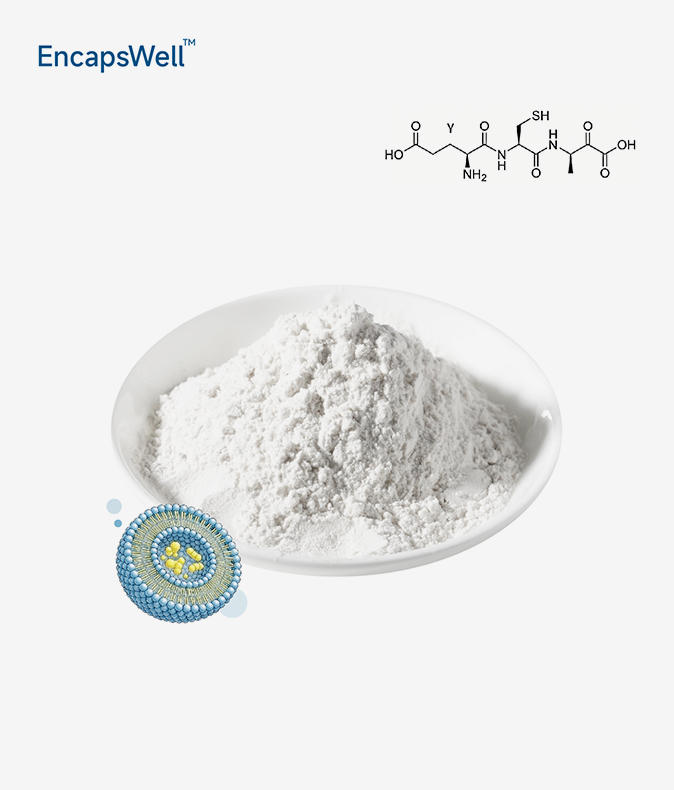
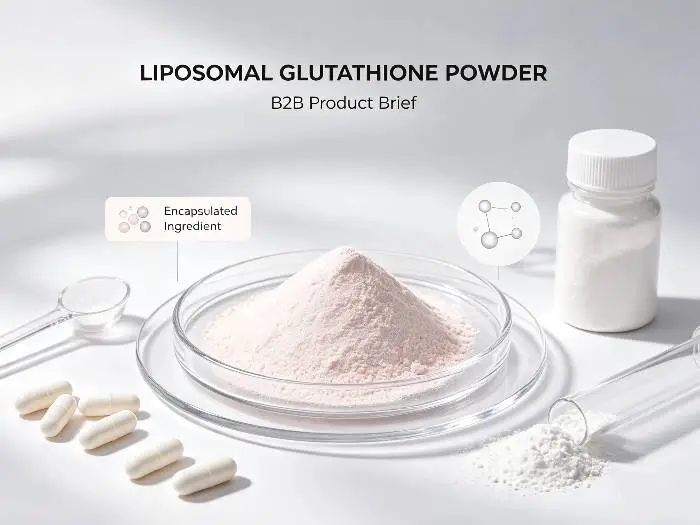
Standard oral glutathione has a well-known problem: gamma-glutamyltransferase enzymes and acidic stomach conditions break it down before it can be used effectively. This problem can be fixed with liposome technology, which puts lessened L-glutathione inside phospholipid bubbles that look like the walls of human cells. These particles keep the active ingredient safe as it goes through the digestive system and make it easier for cells to take it in directly through lipid fusion. EmerWell's liposomal glutathione powder, which is made using their own EncapsWell™ platform, is up to 13 times more effectively absorbed than regular glutathione powder. This is a clinically important difference for formulations that need to show they work.
In addition to absorption, the powder shape has clear business benefits. The particle size (D50) is usually between 100 and 250nm, and the encapsulation efficiency is over 90%, so the potency stays the same from batch to batch. It's much easier to use in functional drinks, sachets, and capsule blends because it doesn't smell as sulfurous as glutathione that hasn't been encapsulated. These technical factors directly lead to better-performing end goods for companies that make nutraceuticals and nutricosmetics.
Key Factors to Evaluate When Selecting Liposomal Glutathione Powder
Purity, Certifications, and Independent Testing
Documentation should come first when making decisions about purchases. A reliable supplier will give you Certificates of Analysis (COA), Technical Data Sheets (TDS), and Safety Data Sheets (SDS) that have been checked by a third-party lab. Buyers should demand glutathione content of at least 95%, effectiveness proven by HPLC, heavy metal screening within FDA/EPA limits, and checks for microbial contamination.
Certifications are an organized way to check something. The liposomal glutathione powder from EmerWell is certified as non-GMO, vegan, HACCP, cGMP, HALAL, KOSHER, NOP, EOS, and ISO9001. This level of compliance is important because different end markets have different rules. For example, DSHEA rules apply to dietary supplements in the US, while Novel Food rules apply in the EU and ASEAN. Your regulatory team will have a lot less paperwork to do if you work with a supplier who keeps this certification portfolio up to date.
Dosage Form Compatibility and Formulation Flexibility
Not every format for a product works with every delivery line. When judging dosage form suitability, these are the most important things to keep in mind:
- Powder and sachet formats for healthy drinks and ready-to-mix mixes give you the most options. Although low-shear mixing is advised during production to maintain vesicle integrity, liposomal glutathione powder can be rehydrated into a stable liquid solution.
- Hard and soft capsule formats are preferred for high-dose supplement protocols where precise dosing is critical. Encapsulated forms also help mask any residual flavor notes.
- Tablet formats need extra testing for binder and compression compatibility, which a technically skilled supplier should be able to do with formulation data.
- Liquid-ready formulations are more and more needed for beauty shot drinks and clinical nutrition drinks because the pH level must stay stable in a variety of circumstances.
EmerWell works with all five dosage formats, making it easy to match the ingredient to your production line without having to make changes to the formula. These choices take away a big problem for OEM/ODM clients who want to work with a single source for ingredients.
Market Comparison: Brands, Pricing, and Procurement Options
Evaluating Supplier Reputation and Total Cost of Ownership
There are a number of well-known ingredient names in the liposomal glutathione powder market. Setria is famous for its branded reduced glutathione, which has clinical data to back it up. Quicksilver Scientific has positioned itself in the liquid liposomal segment. Pure Encapsulations gets high-quality ingredients for the practitioner market. Each one is aimed at a different group of people, and buyers have to weigh the value of the name against the performance of the raw materials and the ease of the supply chain.
Pricing in this category is influenced by encapsulation technology sophistication, raw material sourcing, batch scale, and certification overhead. Bulk purchasing at volume typically unlocks tiered pricing, but buyers should figure out the total cost of ownership rather than unit cost alone—factoring in stability data reliability, reformulation risk, and regulatory support value.
EmerWell's MOQs are flexible, ranging from 10 kg for pilot runs to 2,000 kg per month for full business production. This range works for both new brands trying out a new recipe and established brands expanding an existing line. Help with regulatory paperwork, like getting approvals for specific markets, is part of the relationship and not a different service.
How to Match Liposomal Glutathione Powder to Your Business Needs?
Aligning Ingredient Specifications With End-Market Demands
Liposomal glutathione powder is used in different fields for different reasons. Nutraceutical companies that are making anti-aging capsules focus on high encapsulation efficiency and stability for 24 months. Functional beverage makers need active ingredients that are pH-stable, water-dispersible, and won't give off bad flavors. Beauty-from-within brands need systemic bioavailability data to back up claims that their products can inhibit tyrosinase, which is linked to glowing skin. Formulators in clinical nutrition who work with oxidative stress programs need long-term data on bloodstream levels.
EmerWell's OEM/ODM service structure addresses this segmentation directly. Custom solutions include changing the particle size, hiding the taste, and co-encapsulating with complementary actives like vitamin C. This mix has been shown to support intracellular glutathione recycling even more. Buyers of private labels who need to get their products to market quickly can get white-label help with marking and packing that is in line with regulations.
Risk management should be given the same amount of weight as sources. Quality is guaranteed at every stage of production, from suppliers of raw materials who have been checked for ethics to documentation of the finished batch. Zero solvent remains in the end product and energy-efficient nano-encapsulation methods show a way of making products that meets the needs of the clean-label market.
Best Practices for Using Liposomal Glutathione in Product Formulations
Dosage, Synergistic Ingredients, and Labeling Compliance
To use liposomal glutathione powder effectively in finished goods, you need to pay attention to a number of manufacturing factors. Typical levels of inclusion depend on the use. For example, supplement pills usually aim for 250–500 mg per dose, while functional drinks may use smaller amounts because they are more bioavailable. As the quality of the particles can change from seller to supplier, formulators should use stability data that is specific to the grade of ingredients they buy.
Antioxidant research has shown that N-acetyl cysteine (NAC) can work well with other ingredients to make them more effective. NAC helps the body make its own glutathione by acting as a cysteine precursor. When combined with liposomal glutathione powder that is already made, it creates two ways to raise levels inside cells. This mix is becoming more popular in both the clinical nutrition and premium supplement markets.
Labeling compliance under DSHEA requires accurate structure/function claims, ingredient disclosure, and allergen statements. Suppliers who provide full documentation—including a COA reflecting actual batch analysis—make this process considerably less burdensome for regulatory teams.
Conclusion
Sourcing the right liposomal glutathione powder requires buyers to look beyond price and examine encapsulation quality, certification breadth, dosage form compatibility, and supplier technical depth. The ingredient's 13× absorption advantage over standard glutathione is only useful if the production controls are strong enough to make sure it's always delivered on a large scale. Matching the ingredient requirements to the needs of the end-market is what makes the difference between a successful product launch and an expensive reformulation. This is true whether the product is a high-end capsule supplement, a beauty drink, or a clinical nutrition recipe. When buyers put performance data that has been checked and seller openness at the top of their list of priorities, supply chains become more stable and final goods become stronger.
FAQ
Is liposomal glutathione powder safe for all consumer segments?
When used at the suggested levels, liposomal glutathione powder is usually well tolerated by healthy adults. Part of its safety comes from the fact that it uses non-GMO phospholipids, which are safe messengers and are usually made from sunflowers. Buyers should look at the safety information their provider gives them and talk to regulatory experts before going after groups like pregnant women or people who are taking certain medicines.
How does liposomal glutathione compare to standard glutathione in bioavailability?
Liposomal glutathione powder can avoid being broken down by gut enzymes and exposed to stomach acid because the phospholipid bilayer protects its structure. Third-party testing of encapsulation efficiency showed that EmerWell's formulation allows up to 13 times more absorption than unencapsulated glutathione powder.
What should buyers know before negotiating bulk pricing?
When buying ingredients for a business, bulk discounts are common. However, buyers should make sure that the price includes delivery of paperwork, guaranties of stability for each batch, and freedom in when they can reorder. If you know the supplier's maximum capacity and lead times, you can avoid supply problems as your brand grows.
How can I verify that a powder is genuinely liposomal?
Ask your provider for Transmission Electron Microscopy (TEM) images and Dynamic Light Scattering (DLS) studies on particle size distribution. These show that there are spherical lipid bilayer structures in the 100–250nm range, which are what a real liposomal product looks like.
Partner With EmerWell for Premium Liposomal Glutathione Powder Supply
EmerWell, headquartered in San Diego, California, brings a PhD-led R&D team, an in-house US laboratory, and local warehousing to every client partnership. As a dedicated liposomal glutathione powder supplier, we combine the EncapsWell™ platform with full OEM/ODM support, certifications spanning cGMP, HALAL, KOSHER, Non-GMO, and Vegan, and MOQs scaled to your stage of growth. Reach our team directly at info@emerwell-bio.com or visit emerwelllabs.com to request a sample or begin your formulation consultation.
References
1. Richie, J.P. et al. — European Journal of Nutrition, 2015
2. Sinha, R. et al. — European Journal of Nutrition, 2018
3. Allen, J. & Bradley, R.D. — Journal of Alternative and Complementary Medicine, 2011
4. Nkrumah-Elie, Y.M. et al. — Nutrients, 2020
5. Schmitt, B. et al. — Redox Biology, 2015
6. Teskey, G. et al. — Journal of Nutritional Biochemistry, 2018
Online Message
YOU MAY LIKE
High quality furniture manufacturer