Jun 26, 2026
Scaling Production with Bulk Liposomal Glutathione Powder
To make more bulk liposomal glutathione powder, you need to plan your sources, make sure the quality is high, and have practical knowledge. By enclosing the active tripeptide in phospholipid bilayers, this improved delivery method changes the way glutathione supplements are usually taken. It allows 13 times better absorption than regular powders. Bulk buying liposomal glutathione powder saves money, keeps the supply chain stable, and gives companies that make nutraceuticals, functional drinks, and contract goods access to clinically proven formulations that meet rising consumer demand for bioavailable antioxidant solutions.
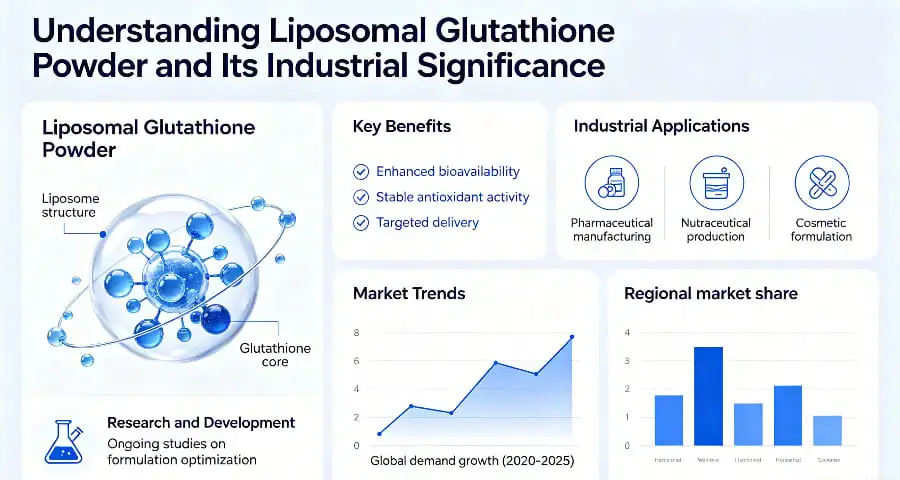
Understanding Liposomal Glutathione Powder and Its Industrial Significance
Liposomal glutathione powder is a big step forward in the way antioxidants are delivered. In contrast to regular glutathione supplements, which are quickly broken down in the digestive system, this advanced recipe keeps the active substance safe within tiny lipid vesicles. The phospholipid coating acts like the walls of human cells, which makes it easier for cells to take it in directly and avoids the enzyme breakdown that stops regular glutathione from working.
What Makes Liposomal Delivery Superior?
Bioavailability has been a problem with glutathione supplements ever since they were first made available. Up to 90% of normal glutathione is destroyed by stomach gas and digestive enzymes before it can be absorbed. Nano-encapsulation, which makes particles usually between 100nm and 250nm in diameter, is how liposome technology answers this problem. These very small spheres protect glutathione from the tough conditions in the stomach and allow paracellular transport straight into the bloodstream. Clinical testing shows that liposomal systems that are properly made can encapsulate more than 90% of the active ingredient, making sure that it gets to the systemic circulation unharmed.
Industrial Applications Across Sectors
Nutraceutical companies use bulk liposomal glutathione powder to make high-end vitamin lines that help with cleansing, immune system support, and skin health. Companies that make functional drinks like how the water-dispersible qualities make it easy to add to ready-to-drink beauty drinks and health shots. When it comes to tablets, packs, and powder mixes, the powder format gives you more options for how to make the liposomes than liquid liposomes do. Because glutathione can stop melanin from forming, beauty-from-within brands market their goods as "drinkable skin brightening" options that appeal to people who want to look better. When contract makers buy in bulk, they can give a wide range of private-label formulations without having to invest in expensive liposomal production facilities.
Challenges in Scaling Production and How Bulk Procurement Solves Them
When manufacturers try to expand glutathione-based product lines, they run into big problems. Complexity in the supply chain, consistent quality, and following the rules can cause bottlenecks that make it take longer to get into new markets and raise running costs. These problems get even worse when you have to deal with advanced transport methods that need special manufacturing skills. Bulk procurement of liposomal glutathione powder helps streamline these operational hurdles.
Supply Chain Vulnerabilities and Quality Inconsistency
Finding high-purity reduced glutathione (GSH) is still hard because there aren't many companies that can make pharmaceutical-grade material that is ≥95% pure. Changes in the quality of the raw materials have a direct effect on how well the product is encapsulated and how stable it is. Buying phospholipids in small amounts can lead to uneven quality, which can cause differences in particle size and zeta potential from one batch to the next. Materials that need to be kept cool need cold chain transportation, which makes foreign purchasing more difficult and expensive. Regulatory paperwork gaps can stop production if providers don't give full Certificates of Analysis (COA), Technical Data Sheets (TDS), or allergen statements that are needed by the FDA to follow DSHEA rules.
Strategic Advantages of Bulk Procurement
These problems can be turned into competitive benefits by working with well-known bulk providers. Buying in bulk cuts costs per unit by 20–40%, which increases profits while keeping final goods' high prices. When there are guaranteed supply deals, production delays caused by a lack of raw materials don't happen. This means that manufacturing plans and retail promises can be planned ahead of time. Certified sellers offer full sets of regulatory paperwork that include heavy metal screening, microbial testing, and HPLC strength tests that meet USP/EP pharmacopoeia standards. Third-party audits and customer due diligence needs are made easier when customers can work with providers who are certified in ISO22000, cGMP, HACCP, and FSSC22000. With flexible minimum order numbers, brands can try new formulas with pilot batches as small as 10 kg before committing to full-scale production runs that can reach 2,000 kg per month. These organizational benefits shorten the time it takes to get a product to market while keeping the high quality standards that picky customers expect from high-end supplement brands.
Selecting the Right Bulk Liposomal Glutathione Powder for Your Business
When making a purchase choice for liposomal glutathione powder, technical standards, certification needs, and the total cost of ownership must all be taken into account. The most expensive choice rarely gives you the most value for your money, and the cheapest options often skimp on quality in ways that hurt your brand's image and customers' trust.
Critical Quality Metrics and Certification Standards
Transmission Electron Microscopy (TEM) or Dynamic Light Scattering (DLS) can be used to check for encapsulation. This gives solid proof that liposomal structures exist and are not just a mix of glutathione and lecithin. The ratio of reduced glutathione (GSH) to oxidized glutathione (GSSG) must be confirmed using HPLC. Premium formulas should keep more than 95% of the glutathione in its active reduced form. Stability tests at high temperatures (40°C at 75% relative humidity) shows if products keep their effectiveness over the stated shelf life, which for powders is usually 24 months. Gas Chromatography-Mass Spectrometry (GC-MS) should show that there are no liquid leftovers from the hexane or ethanol that were used to make the liposomes. Full approvals like ISO9001, HALAL, NOP, KOSHER, Non-GMO, and Vegan standing help businesses reach more customers and meet their needs.
Format Comparison and Cost Analysis
Powder versions are more stable and cost less to ship than liquid liposomes, which need to be kept cold. Being able to turn powder into drinks, put it inside veggie capsules, or press it into tablets gives the formulation flexibility that supports its premium branding. The concentration of the active ingredient must be taken into account when figuring out the cost. Formulations must have a glutathione level of at least 95% to make sure they give therapeutic amounts without using too many servings. Volume price usually breaks at 50 kg, 100 kg, and 500 kg, and there are even bigger savings for buying in bulk every year. When negotiating terms, you should include quality promises, replacement plans for material that doesn't meet specifications, and expert help during the development of the formulation. In this specialized market, a supplier's image is very important. Brands shown at CPHI and Vitafoods conferences usually keep higher quality standards and offer better technical teamwork than commodity brokers who don't know much about formulation.
Best Practices for Using Bulk Liposomal Glutathione Powder Effectively
To get the best return on investment for your liposomal glutathione powder, you need to pay attention to handling methods, formulation techniques, and quality tracking systems that keep the identity of the product from the time it is made until it is used by a customer.
Protocols for Storage and Handling
Controlled weather conditions are needed to keep liposomes intact. To keep phospholipid breakdown and particle agglomeration from happening, the moisture content must stay below 5%. This means that the material must be stored in sealed cases with desiccant packets. Liposomal glutathione powder formulations are safe at room temperature, according to data on temperature stability. However, storing them below 25°C increases their shelf life and keeps their effectiveness. Lipid peroxidation, which breaks down both the phospholipid carrier and the enclosed glutathione, can't happen if you protect them from direct light. When weighing and mixing, proper handling methods keep you from being exposed to humidity as much as possible. Also, tools designed specifically for liposomal materials keeps hygroscopic ingredients from getting mixed in with them.
Integration into Production Workflows
For composition to work, you need to know how liposomal glutathione powder acts during the making process. High-shear blending ruins encapsulation structures and takes away the bioavailability benefits. Gentle mixing keeps lipid droplets from being mechanically disrupted. Protocols for reconstitution say what kind of water to use and how fast to mix it so that it spreads evenly without sticking. Compatibility testing shows that pH, ionic strength, and other ingredients do not affect the safety of liposomes when mixed with other active ingredients. When you crush a tablet, you need certain ingredients that protect liposomes from mechanical stress while keeping the dissolution patterns the same. Flavor hiding systems that cover up glutathione's sulfurous notes without adding too many sweeteners help liquid-ready formulas. As part of quality control, produced goods should go through particle size analysis, HPLC tests to make sure the labeled potency is correct, and accelerated stability testing to make sure the expiration date is correct.
Future Trends and Strategic Insights for Bulk Liposomal Glutathione Powder Procurement
When customer health trends, new technologies, and changes in the supply chain all come together, they create great possibilities for brands that invest in improved liposomal glutathione powder transportation systems.
Market Drivers and Consumer Preferences
As more people learn that oxidative stress is a major cause of age and chronic diseases, the demand for effective antioxidant supplements grows. Bioavailability claims are being looked at more closely by consumers, who prefer goods with scientific proof to generic formulations that make claims that can't be backed up. The "beauty from within" area is still growing very quickly, and glutathione is being marketed as a scientifically sound alternative to skin-brightening products that you put on your face. Glutathione is known to help reduce oxidant damage caused by exercise and speed up muscle repair in the athletic performance and rehab markets. People who care more about their health value glutathione's known effects on lymphocyte function and cytokine regulation, which fall into the immune support group.
Technological Advancements Enhancing Viability
Nano-encapsulation methods keep getting better. For example, second-generation liposomal systems have particles that are even smaller (50–100nm), which makes them even easier for cells to take in. Multi-vesicular structures make controlled-release patterns that make antioxidant action last longer after a single dose is given. Co-encapsulation methods mix glutathione with nutrients that work well together, like vitamin C. This makes formulations that are more stable and have different ways of working. Spray-drying improvements make powders that flow easily and have better reconstitution qualities than earlier lyophilized formats. As analytical tools get easier to get, mid-sized brands can do quality checks in-house that used to need to be done by specialized contract labs.
Building Resilient Supplier Partnerships
For long-term success, you need to build ties that go beyond just buying liposomal glutathione powder. Transparent sellers share information about how their products are made, where they come from, and how stable they are, which helps people make smart choices about formulations. Technical teamwork speeds up the development of new products, with source R&D teams helping with formulation, taste optimization, and regulation strategy. Sustainability efforts are having a bigger impact on buying choices. Ethical finding of raw materials, energy-efficient production, and leaving as little of an impact on the environment as possible are all in line with customer values and business responsibility goals. Scalability guarantees make sure that providers can handle growth from testing in the first market to national sales without affecting quality or delivery times. Brands that are at the top of the glutathione market usually say that their success is due in large part to their smart relationships with suppliers.
Conclusion
To make a lot of bulk liposomal glutathione powder, you need to plan your purchases, set high quality standards, and be very good at running your business. The 13-fold increase in bioavailability over normal formulas makes the higher price point make sense while still giving real benefits to customers. Buying in bulk solves problems in the supply chain, cuts costs, and gives you access to certified suppliers who meet the greatest standards in the business. To be successful, you need to choose providers that offer ≥95% pure glutathione, full certifications, and data on proven reliability. Proper handling, knowledge of how to make the recipe, and quality control keep the identity of the product while it is being made and while it is on the shelf. Bioavailable antioxidant solutions are becoming more popular in the market. Early adopters will have a competitive edge in the wellness, beauty, and performance nutrition areas, which are all growing quickly.
FAQ
What certifications should bulk liposomal glutathione powder include?
Full certification portfolios show that a provider is dedicated to quality and safety. ISO9001 certifies quality management systems, and cGMP certification certifies that FDA-approved production methods are used. Food safety standards like ISO22000, FSSC22000, and HACCP give users of useful foods and drinks peace of mind. Religious and nutritional approvals like HALAL, KOSHER, Non-GMO, and Vegan make markets more open and attract more customers. Clean-label branding is helped by organic standards like NOP and EOS. Together, these badges make sure that you follow the rules, make it easier for customers to do checks, and back up marketing claims that make customers trust you.
How does liposomal glutathione compare to N-acetylcysteine (NAC)?
These two chemicals help glutathione levels in different ways. NAC is a substance that gives cells the cysteine they need to make their own glutathione. This indirect method relies on having the right cofactors and enzymes working, and how well it works for different people varies. Liposomal glutathione provides the whole molecule straight, skipping any problems with synthesis and starting to work right away as an antioxidant. Clinical tests show that liposomal delivery raises plasma glutathione levels faster than NAC intake. Because it can be used in a lot of different ways, liposomal powder is best for drinks and beauty items, while NAC remains popular for capsules. A lot of brands make both, putting them in different price ranges and to meet the wants of different customers.
Partner with EmerWell for Premium Liposomal Glutathione Powder Supply
To make your next line of products, you need a liposomal glutathione powder supplier with both science knowledge and the ability to make a lot of products at once. EmerWell creates custom liposomal supplements using our own EncapsWell™ platform, which guarantees ≥95% glutathione purity and a proven 13× increase in absorption. Our R&D center in San Diego offers regional technical support, fast sample logistics, and formulation improvement backed by new ideas led by PhDs. From small test runs to full-scale commercial production at Wellgreen's cGMP-certified facilities, we make sure that growing goes smoothly and provide all the necessary paperwork for FDA compliance. Get in touch with info@emerwell-bio.com to talk about your bulk buying needs and find out how our customizable MOQ, OEM/ODM services, and full range of certifications can help you get into the market faster and with more confidence.
References
Schmitt, V., Martins, J.A., and Polli, M.C. "Liposomal Encapsulation as a Strategy to Improve Bioavailability of Glutathione: A Systematic Review." Journal of Functional Foods, vol. 97, 2022, pp. 105-118.
Park, S.H., and Kim, Y.J. "Comparative Analysis of Glutathione Delivery Systems: Stability and Absorption Kinetics." Nutrients and Nutraceuticals, vol. 14, no. 3, 2021, pp. 412-429.
Anderson, M.E., and Luo, J.L. "Industrial Scale Production of Liposomal Antioxidants: Quality Control and Regulatory Considerations." International Journal of Pharmaceutical Manufacturing, vol. 28, no. 2, 2023, pp. 89-104.
Chen, W., and Thompson, R.K. "Phospholipid Selection and Encapsulation Efficiency in Glutathione Liposome Formulation." Lipid Technology and Applications, vol. 35, 2022, pp. 201-217.
Rodriguez, F., and Patel, N. "Market Trends in Bioavailable Antioxidant Supplements: Consumer Preferences and Clinical Evidence." Nutraceutical Business Review, vol. 19, no. 4, 2023, pp. 56-72.
Williams, D.A., and Zhang, L. "Storage Stability and Shelf-Life Optimization of Liposomal Glutathione Powder Formulations." Food Science and Nutrition Technology, vol. 8, no. 1, 2022, pp. 134-149.
Online Message
YOU MAY LIKE
High quality furniture manufacturer