May 25, 2026
Liposomal Vitamin C vs Traditional Vitamin C
Liposomal vitamin C powder is a lipid-based delivery system designed to improve the stability and absorption efficiency of ascorbic acid. By encapsulating vitamin C within phospholipid structures, it enables more effective transport across biological membranes compared to conventional formats such as tablets, capsules, or crystalline powders.
For nutraceutical brands, contract manufacturers, and formulation teams, this difference is not just technical—it directly impacts product positioning, dosage strategy, and consumer experience.
Understanding Vitamin C Delivery Systems
What Is Liposomal Encapsulation?
Liposomal encapsulation uses phospholipid bilayers—typically derived from sunflower or soy lecithin—to surround and protect active ingredients. These structures resemble cell membranes, allowing the encapsulated nutrient to interact more efficiently with biological systems.
In powder form, liposomal vitamin C is typically produced through spray-drying or similar technologies, creating a “pro-liposomal” format. Once reconstituted in aqueous environments, it forms functional liposomal structures capable of delivering vitamin C in a more stable and controlled manner.
Limitations of Conventional Vitamin C Forms
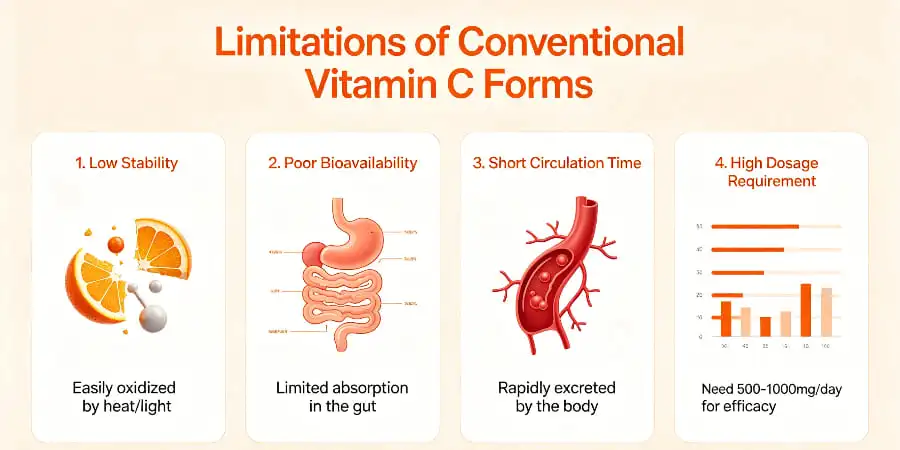
Traditional vitamin C formats rely on active transport mechanisms in the intestine. These transporters can become saturated at moderate to high intake levels, limiting absorption efficiency.
In addition:
- Free ascorbic acid is sensitive to oxidation
- High dosages may lead to gastrointestinal discomfort
- Stability can be compromised in complex formulations (e.g., proteins, minerals, alkaline systems)
These constraints create formulation challenges, especially in high-dose or multi-ingredient products.
Key Differences in Formulation Performance
Improved Absorption Efficiency
Liposomal delivery systems are widely studied for their ability to enhance nutrient uptake. By protecting vitamin C from degradation and facilitating membrane interaction, liposomal formats can achieve more consistent absorption compared to conventional forms.
For formulators, this means:
- Lower effective dosage requirements
- More predictable performance across user groups
- Reduced variability in product efficacy perception
Stability in Complex Formulations
Encapsulation helps protect vitamin C from oxidation during processing, storage, and end use.
This is particularly valuable in:
- Functional beverages
- Effervescent formulations
- Multi-nutrient blends
Unlike free ascorbic acid, liposomal vitamin C is less reactive in formulation systems, reducing issues such as off-flavor development, discoloration, or ingredient interaction.
Improved Tolerance for High-Dose Applications
High-dose conventional vitamin C is often associated with digestive discomfort due to acidity and osmotic effects.
Liposomal systems provide a buffering effect through the lipid layer, making them more suitable for:
- High-potency immune support formulations
- Sensitive consumer groups
- Daily-use premium supplements
Application Opportunities Across Product Categories
Liposomal vitamin C powder is increasingly used in formulations targeting:
- Immune support supplements
- Beauty-from-within products (e.g., collagen support positioning)
- Functional beverages and wellness drinks
- Sports nutrition and recovery formulas
For brands, this enables the development of products aligned with consumer expectations such as improved stability, better tolerance, and perceived higher efficiency.
Importantly, these benefits are not just consumer-facing—they also simplify formulation design and shelf-life management.
Procurement Considerations for B2B Buyers
Key Quality Indicators
When sourcing liposomal vitamin C powder, procurement teams should evaluate:
- Vitamin C content (typically ≥98% for raw material)
- Encapsulation efficiency (relative indicator, not fixed standard)
- Particle size distribution and dispersion behavior
- Stability data (real-time or accelerated)
Reliable suppliers should also provide:
- COA (Certificate of Analysis)
- TDS / SDS documentation
- Batch traceability information
Certifications and Compliance
For global market access, common certifications include:
- cGMP
- ISO 22000 / FSSC 22000
- HACCP
- Non-GMO / Vegan / Kosher / Halal
These certifications are increasingly important for entering regulated markets and meeting brand compliance requirements.
Cost vs. Performance Evaluation
While liposomal vitamin C powder typically carries a higher raw material cost than standard ascorbic acid, the overall formulation efficiency can offset this difference.
Factors to consider include:
- Reduced dosage requirements
- Improved product differentiation
- Lower risk of formulation instability
- Premium product positioning
For many brands, the value lies in performance consistency rather than raw ingredient cost alone.
Why Liposomal Vitamin C Is Becoming a Premium Strategy
The nutraceutical market is shifting from “ingredient-based” competition to “delivery system-based” differentiation.
Consumers are increasingly aware that:
Not all forms of the same nutrient perform equally
This trend is driving demand for:
- Enhanced bioavailability solutions
- Clean-label delivery systems
- Scientifically supported formulation strategies
Liposomal technology aligns well with these expectations, making it a strategic choice for brands aiming to position themselves in higher-value segments.
Practical Formulation Insights
Dosage Strategy
Typical formulation ranges depend on application:
- Daily maintenance products: moderate inclusion levels
- High-potency formulations: higher inclusion with improved tolerance
- Beauty-focused products: often combined with collagen, hyaluronic acid, or antioxidants
Because absorption efficiency is improved, formulators often optimize dosage based on performance targets rather than traditional high-dose approaches.
Compatibility in Multi-Ingredient Systems
Liposomal vitamin C integrates well with:
- Collagen peptides
- Hyaluronic acid
- Plant extracts
- Mineral systems
Encapsulation helps reduce undesirable interactions, improving both stability and sensory performance in finished products.
Storage and Handling
Liposomal vitamin C powder is typically stable under standard storage conditions when properly packaged.
Best practices include:
- Moisture protection
- Controlled temperature (room temperature acceptable)
- Light protection
Compared to liquid liposomal systems, powder formats offer significant advantages in logistics and shelf-life management.
FAQ
What is liposomal vitamin C powder?
It is a phospholipid-based delivery system that improves the stability and absorption efficiency of vitamin C compared to conventional forms.
Is liposomal vitamin C better than regular vitamin C?
Liposomal forms are designed to enhance delivery efficiency and stability, making them suitable for advanced formulations, especially in high-dose or complex systems.
Can liposomal vitamin C be used in beverages?
Yes, it is commonly used in functional beverages and powder mixes due to its improved stability and compatibility.
Is liposomal vitamin C suitable for high-dose formulations?
It is often preferred in high-dose applications due to better tolerance and formulation stability.
Partner with EmerWell for Liposomal Vitamin C Solutions
At EmerWell, we develop liposomal delivery systems using the EncapsWell™ platform, designed to support stability, scalability, and formulation flexibility.
Our liposomal vitamin C solutions are suitable for:
- Nutraceutical brands
- Functional beverage manufacturers
- Private label and OEM/ODM projects
With PhD-led R&D and cGMP-compliant manufacturing support, we help partners move efficiently from concept to commercial production.
Contact us to discuss technical specifications, sample evaluation, or custom formulation development: info@emerwell-bio.com
References
Carr, A.C., & Maggini, S. (2017). Vitamin C and immune function. Nutrients, 9(11), 1211.
Davis, J.L., et al. (2016). Liposomal-encapsulated ascorbic acid: Influence on vitamin C bioavailability and capacity to protect against ischemia-reperfusion injury. Nutrition and Metabolic Insights, 9, 25-30.
Hickey, S., Roberts, H.J., & Miller, N.J. (2008). Pharmacokinetics of oral vitamin C. Journal of Nutritional & Environmental Medicine, 17(3), 169-177.
Lykkesfeldt, J., & Tveden-Nyborg, P. (2019). The pharmacokinetics of vitamin C. Nutrients, 11(10), 2412.
Padayatty, S.J., et al. (2004). Vitamin C pharmacokinetics: Implications for oral and intravenous use. Annals of Internal Medicine, 140(7), 533-537.
Piredda, M., et al. (2021). Advances in liposomal drug delivery systems for vitamin supplementation. International Journal of Molecular Sciences, 22(18), 9505.
Online Message
YOU MAY LIKE
High quality furniture manufacturer