May 21, 2026
Liposomal Vitamin C: Superstar Anti-Oxidant
Success in premium nutraceuticals and functional drinks depends on absorption. Liposomal vitamin C powder encapsulates ascorbic acid in phospholipid layers that imitate cell membranes, a breakthrough in nutrient delivery. This sophisticated encapsulating method improves bioavailability by up to 8x compared to ordinary vitamin C powders, addressing issues including gastrointestinal discomfort and fast elimination. This delivery technology improves immune-support and antioxidant formulas for clinically validated brands.
Understanding Liposomal Vitamin C Powder: What Makes It a Superstar Anti-Oxidant?
Biological compatibility distinguishes liposomal vitamin C powder from conventional ascorbic acid. Saturable intestinal transporters (SVCT1 and SVCT2) decrease vitamin C absorption above 200mg to 20%. Liposomal encapsulation eliminates this bottleneck.
The Science Behind Enhanced Bioavailability
Ascorbic acid molecules are protected during digestion by phospholipid bilayers. These uniformly sized vesicles endocytose or fuse with enterocyte membranes in the small intestine. Nutrient integrity and plasma retention are maintained by this process. Clinical studies show that encapsulated vitamin C supports collagen formation and cellular antioxidant defense better than unprotected versions for longer durations.
Three formulation challenges are addressed by the technique. Unabsorbed ascorbic acid in the colon causes osmotic diarrhea in high-dose regimens (1,000-3,000mg). Liposomal carriers solve this with regulated release. Lipid shells prevent gastric acid from degrading free vitamin C before absorption. Longer blood circulation of lipid-bound nutrients slows renal clearance, unlike water-soluble supplements.
Antioxidant and Immune-Support Mechanisms
Phosphatidylcholine, the main lipid in excellent formulations, has additional effects beyond absorption. Nutraceuticals that improve skin barrier function benefit from this phospholipid's membrane healing properties. Research shows that liposomal administration boosts intracellular vitamin C by promoting lymphocyte activity and collagen formation. These results are crucial for immunological resilience, post-workout recovery, and dermatological health brands.
Comparing Liposomal Vitamin C Powder With Other Vitamin C Formats
Format trade-offs must be clarified in procurement. Standard pills and capsules are convenient but have dissolving variability and first-pass metabolism losses. Although liquid liposomal solutions absorb well, they need preservatives, refrigeration, and shorter shelf life.
Why Powder Format Excels in B2B Applications
Liposomal vitamin C powder is bioavailable and practical. The dry condition inhibits oxidation and microbiological development without preservatives, prolonging shelf life beyond 24 months when stored correctly. Reconstituted in drinks or supplement matrices, the powder spontaneously produces liposomes, giving producers flexibility in ready-to-drink immune shots and effervescent sachets.
Stability testing has additional benefit. Free ascorbic acid degrades taste profiles and active compounds in complex formulations with minerals or proteins as a pro-oxidant. Lipid encapsulation protects vitamin C from reactive components, retaining nutritional efficacy and taste throughout product lifecycles. Functional food producers use this trait to manage protein powder and collagen mix ingredient interactions.
Ascorbic acid purity in liposomal vitamin C differs between natural and synthetic sources. While chemically equivalent, synthetic non-GMO maize dextrose produced by fermentation is more consistent for GMP manufacturing. Our EncapsWell™ platform uses ≥99% pure pharmaceutical-grade ascorbic acid and sunflower-derived phosphatidylcholine to prevent soy allergies. HPLC testing shows encapsulation effectiveness above 60%, ensuring most vitamin C reaches consumers safely.
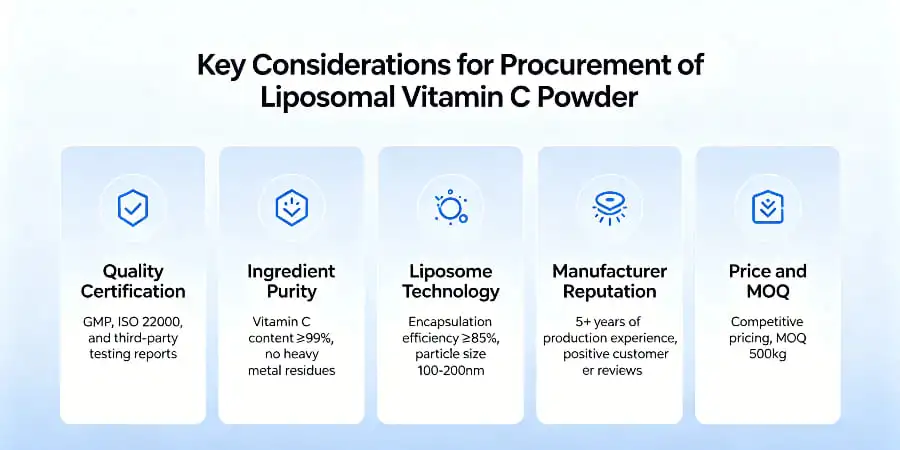
Key Considerations for Procurement of Liposomal Vitamin C Powder
Supplier evaluation goes beyond price. Quality factors distinguish liposomal vitamin C powder technology from inferior lecithin-vitamin C mixtures.
Critical Quality Metrics
Lipid vesicle encapsulation efficiency is the proportion of vitamin C encapsulated. Reputable vendors provide Certificates of Analysis for results exceeding 50% from ultrafiltration or dialysis. Dynamic Light Scattering proves uniform particle size distribution. Batches with optimized size have good absorption potential and stability.
Ascorbic acid (minimum 99% by HPLC) and phospholipid composition are verified for purity. Premium formulations differentiate from commodity alternatives with membrane-compatible administration from high-phosphatidylcholine lecithin (>50% PC). Heavy metal (lead, cadmium, arsenic, mercury) and microbiological tests meet USP criteria, preserving brand reputation and customer safety.
Certifications show manufacturing discipline. Wellgreen's manufacturing is cGMP, ISO 9001/22000, HACCP, and FSSC 22000 certified. Not just badges, they are proven quality systems with batch traceability, environmental controls, and corrective action methods. Halal, Kosher, and Non-GMO Project certification help niche brands enter markets.
Supplier Reliability and Logistics
Annual manufacturing capacity is crucial for brand scaling. Production facilities over 100 metric tons provide supply continuity during demand peaks. Bulk pricing accommodates existing distributors, and flexible minimum order sizes help developing companies. Inventory planning is easier with transparent lead times (2-4 weeks for stock formulas, 6-8 weeks for bespoke blends).
Shipment infrastructure affects product quality. Domestic clients benefit from our San Diego warehouse, which reduces transportation times and temperature fluctuations. Export documentation such as Certificates of Origin, Free Sale Certificates, and stability studies facilitates FDA, EU Novel Food, ANVISA, and Health Canada permits.
How to Use Liposomal Vitamin C Powder Effectively?
Combining dose science with formulation practicality is optimal usage. Clinical literature recommends 500-1,000mg daily dosages divided between morning and evening for immunological support to sustain plasma levels. Recovery solutions for athletes may include 1,000-2,000mg post-workout when oxidative stress rises.
Dosage Optimization for Various Applications
Nutricosmetics benefit from sustained-release liposomal vitamin C powder. Skin elasticity and moisture are improved when 500mg is combined with collagen peptides, which boost collagen hydroxylation reactions. Vitamin C and iron in anemia-support products use ascorbic acid to convert non-heme iron into accessible forms, preventing gastrointestinal discomfort from high-dose iron-vitamin C combos.
Storage and Handling Protocols
Liposomal vitamin C powder reconstitution in slightly acidic conditions (pH 4-6) stabilizes ascorbic acid and promotes liposome production, giving beverage formulators the greatest results. The water-soluble nature makes it easy to mix into RTDs, protein shakes, and effervescent tablets. Neutral taste profiles prevent the strong sourness of unprotected ascorbic acid, which requires substantial flavoring.
Maintaining product integrity throughout the supply chain demands environmental considerations. Unopened containers should be kept cool, dry, and out of direct sunlight below 25°C (77°F). Automated encapsulation lines benefit from humidity management to avoid clumping and maintain powder flow. Reconstituted liquid formulations should be consumed within 24 hours or refrigerated for 72 hours to prevent oxidation.
Bulk handlers should run FIFO inventory rotation and track storage temperatures. Large OEM containers benefit from nitrogen flushing during packaging to improve shelf life by displacing oxygen.
Why Choose EmerWell's EncapsWell™ Liposomal Vitamin C Powder?
Our technique blends biotechnology innovation with industrial precision. With five years of R&D development, our PhD-led team has developed the EncapsWell™ platform for multi-vesicular liposomal systems. Our multi-lamellar architecture generates redundant barriers to retain >95% potency over 24 months, unlike single-layer vesicles that leak.
Customization Capabilities for Brand Differentiation
OEM/ODM services allow extensive customization of liposomal vitamin C powder, pills, hard capsules, soft gels, and liquid-ready concentrates. Add zinc, quercetin, elderberry extract, or N-acetylcysteine to create synergistic immunological compositions tested for stability.
Designing private label packaging from 100g consumer jars to 25kg bulk barrels is possible. Co-branding allows ingredient suppliers to promote EncapsWell™ technology on partner goods, increasing demand. Allergen declarations, Certificates of Analysis, and shelf-life studies from regulatory support teams expedite FDA GRAS notifications or NDI filings.
Sustainability and Compliance Commitments
Modern procurement is ethical. Our phospholipids come from non-GMO sunflower grown through regenerative agricultural partnerships, eliminating soy deforestation. Energy-efficient spray-drying reduces carbon footprints by 30% over freeze-drying. Climate Pledge-certified brands use recyclable HDPE packaging and biodegradable desiccants.
Compliance in 50+ jurisdictions reduces global expansion constraints. FDA compliance for dietary supplements, EU Novel Food approvals, Australian TGA listing, and Brazilian ANVISA registration are supported with comprehensive documentation. Localized technical assistance from our San Diego location ensures North American clients receive fast formulation and batch responses.
Conclusion
Selecting a liposomal vitamin C powder provider goes beyond price—it determines performance and brand trust. Advanced encapsulation technology, verified production techniques, and flexible customization make EmerWell a valuable partner for nutraceutical companies, functional beverage developers, and contract manufacturers. Our clinically validated EncapsWell™ technology enhances bioavailability and simplifies market launch with certifications and regulatory assistance. As customer demand for evidence-based, well-absorbed supplements rises, liposomal delivery technologies become category standards.
FAQ
Is long-term use of liposomal vitamin C safe for daily supplementation?
Chronic vitamin C supplementation at dosages up to 2,000mg daily, substantially below the adult Upper Intake Level, is supported by extensive safety research. Liposomal encapsulation lowers stomach discomfort from high-dose ascorbic acid, making long-term treatments more comfortable. Accelerated stability and toxicological screening ensure no degradation products or lipid peroxidation over shelf life in our formulations
How does cost compare to standard vitamin C for bulk procurement?
Despite 2-3x higher per-kilogram pricing than commodity ascorbic acid, the nutritional value outweighs price differences. The 8× bioavailability advantage allows 500mg liposomal vitamin C powder formulations to achieve effects of 2,000mg+ normal dosages. Premium brands charge higher retail pricing to balance ingredient costs and improve consumer satisfaction via effectiveness.
What minimum order quantities support emerging brands?
We accept 25kg stock formulation orders, allowing businesses to evaluate market reaction without inventory risk. Custom blends need 100kg to justify formulation and stability testing. Progressive pricing applies to 500kg orders, which earn 15% reductions, and 2,000kg+ contracts, which qualify for strategic partnership terms and exclusivity.
Partner With a Trusted Liposomal Vitamin C Powder Manufacturer
EmerWell helps bioavailability-focused companies innovate and scale. Liposomal vitamin C powder from our San Diego R&D Center and Wellgreen's cGMP-certified production facilities provides measurable benefits. Our technical team offers formulation assistance, stability data, and regulatory documentation to help you establish a nutricosmetic line, reformulate supplements, or manufacture functional drinks. US warehouse enables fast sample delivery and reliable supply chains. Contact info@emerwell-bio.com to discuss your project, request Certificates of Analysis, or schedule pilot production. Turn your formulation vision into market-leading products.
References
Davis, J.L., Paris, H.L., Beals, J.W., et al. "Liposomal-encapsulated Ascorbic Acid: Influence on Vitamin C Bioavailability and Capacity to Protect Against Ischemia-Reperfusion Injury." Nutrition and Metabolic Insights, vol. 9, 2016, pp. 25-30.
Gopi, S., Balakrishnan, P. "Evaluation and Clinical Comparison Studies on Liposomal and Non-Liposomal Ascorbic Acid." Journal of Liposome Research, vol. 31, no. 4, 2021, pp. 356-364.
Hickey, S., Roberts, H.J., Miller, N.J. "Pharmacokinetics of Oral Vitamin C." Journal of Nutritional & Environmental Medicine, vol. 17, no. 3, 2008, pp. 169-177.
Lykstad, J., Sharma, S. "Biochemistry, Water Soluble Vitamins." StatPearls Publishing, 2023.
Padayatty, S.J., Sun, A.Y., Chen, Q., et al. "Vitamin C: Intravenous Use by Complementary and Alternative Medicine Practitioners and Adverse Effects." PLoS ONE, vol. 5, no. 7, 2010, e11414.
Carr, A.C., Maggini, S. "Vitamin C and Immune Function." Nutrients, vol. 9, no. 11, 2017, 1211.
Online Message
YOU MAY LIKE
High quality furniture manufacturer