Jun 8, 2026
Liposomal Vitamin C: Benefits, Absorption & Essential Guide
Liposomal vitamin C powder represents a breakthrough in nutrient delivery systems, addressing one of the supplement industry's most persistent challenges: bioavailability. Traditional ascorbic acid struggles to reach therapeutic concentrations in cells due to rapid degradation in the digestive system and limited cellular uptake. Liposomal encapsulation technology solves this by wrapping vitamin C molecules within microscopic phospholipid spheres that protect the nutrient through digestion and enable direct cellular absorption. This results in significantly higher bioavailability—studies demonstrate up to 8 times greater absorption compared to standard vitamin C powders—making it an essential ingredient for formulators developing immune support products, antioxidant beverages, and beauty-from-within supplements.
What Is Liposomal Vitamin C Powder and How Does It Work?
Understanding Liposomal Encapsulation Technology
Liposomal vitamin C powder is based on the idea of biomimetic delivery. Liposomes are very small sphere-shaped structures made up of phospholipid bilayers, which is the same stuff that makes up the membranes of human cells. Because these fatty layers surround vitamin C, they protect it from stomach acids and digestive enzymes that break down up to half of regular vitamin C before it can be absorbed.
Our San Diego R&D Center came up with precise nano-encapsulation methods that we use in our EncapsWell™ platform. Controlled film-evaporation and high-pressure blending are used to make the vesicle structures similar. This makes sure that the particle sizes are the same in every batch of production, which is important for knowing how fast the mixture will absorb and staying stable. The phospholipid layer not only keeps the ascorbic acid safe, but it also makes it easier for it to pass through the intestinal membranes without going through the active transport processes that stop vitamin C from being taken in normally.
Bioavailability Advantage Validated by Research
The plasma concentration profiles of liposomal and non-liposomal vitamin C are always very different in clinical studies that compare them. Nutrition science journals have released research showing that liposomal formulations keep blood levels at a healthy level for longer periods of time. Some studies even found that these formulations had two times higher cellular uptake than regular ascorbic acid. This better absorption directly leads to better immune regulation, collagen synthesis, and antioxidant protection, which is exactly what product makers need to back up promises on the label.
The EncapsWell™ liposomal vitamin C powder has more than 90% encapsulation efficiency and a vitamin C value of 99% or more. Our special recipe keeps more than 95% of its strength stable for 24 months in normal storage conditions. This solves the problem of shelf life that often makes it harder to make supplements on time. Because it is stable in a range of pH levels and temperatures, the element can be used in both functional drinks and solid dosage forms.
Benefits and Usage Guidelines of Liposomal Vitamin C Powder
Core Health Benefits for Commercial Formulations
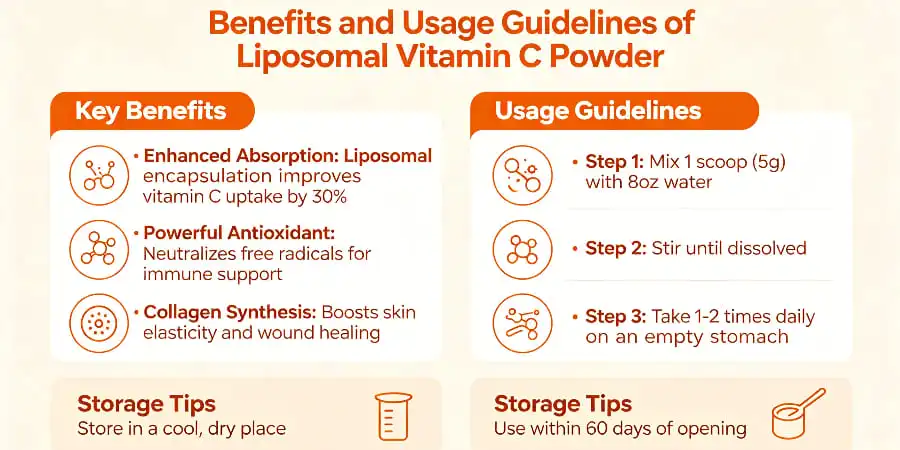
Because liposomal vitamin C powder is more bioavailable, formulators can get healing effects with smaller doses, which lowers the cost-per-serving while keeping the effectiveness. This makes it especially useful for three places with high demand:
Immune System Booster: Vitamin C helps neutrophils do their job and lymphocytes grow, which are both important for adaptive defense. Liposomal delivery makes sure that there are enough amounts inside cells to support these processes. This makes it perfect for seasonal wellness products, recovery formulas, and daily defense vitamins that are aimed at health-conscious people.
Collagen Production and Skin Health: Ascorbic acid helps the enzyme prolyl hydroxylase do its job of keeping collagen's triple-helix structure stable. Nutritional makeup brands rely on our high-absorption solution to back up their "beauty from within" claims. Liposomal vitamin C mixed with hydrolyzed collagen peptides or hyaluronic acid makes anti-aging products that work better together.
Support for Antioxidants and Iron intake: Liposomal vitamin C does more than just fight free radicals. It also regenerates damaged vitamin E and improves the intake of non-heme iron, which are both very important benefits for functional foods that aim to support energy and heart health. Our liposomal powder dissolves easily in water and can be added to drinks, meal replacement shakes, and pregnancy nutrition items to make them healthier.
Dosage Optimization and Safety Considerations
The right dose depends on the type of product and the people who will be using it. Most immune support products have between 500 and 1000 mg of liposomal vitamin C per dose. Formulations aimed at beauty often have 250–500 mg of it along with other active ingredients like glutathione or ceramides. Functional beverage makers like how versatile our powder format is. It mixes easily in water-based matrices and doesn't change the taste or separate while it's being stored.
The liposomal transport method greatly lowers the stomach pain that comes with taking a lot of ascorbic acid. When taken in amounts higher than 2000 mg, traditional vitamin C pills can cause osmotic diarrhea because nutrients that aren't absorbed build up in the intestines. Liposomal encapsulation lowers this chance by making it easier for the body to absorb the medicine in the upper small intestine, before it goes to the stomach. This softer absorption profile lets you reach more people, like people with sensitive gut systems who didn't take vitamin C supplements before.
The safety scores are in line with what is known about vitamin C. Our formula has been certified as ISO9001, cGMP, HACCP, FSSC22000, HALAL, KOSHER, Non-GMO, and Vegan, which gives us legal security for entering the global market. Testing by a third party verifies the product's quality and makes sure there are no heavy metals, microbes, or chemicals left over.
Comparing Liposomal Vitamin C Powder with Other Vitamin C Forms
Absorption Kinetics and Systemic Delivery
There are different forms of vitamin C on the market for supplements, and each one absorbs differently. At low amounts (≤200 mg), standard ascorbic acid powder is bioavailable about 70–90% of the time. However, as the dose goes up, transporter saturation makes uptake much less effective. Forms that are buffered, like calcium ascorbate, make it easier for the stomach to handle, but they don't change the basic limit on absorption set by active transport mechanisms.
By fusing inactive membranes, liposomal vitamin C powder gets around these constraints. Comparative pharmacokinetic studies show that liposomal versions keep higher plasma concentrations for 6 to 8 hours after intake, while conventional forms reach their peak quickly and then start to drop. This steady release profile helps people who want all-day immune support and makes it easy to only take one dose a day, which gives product makers a big competitive edge.
In clinical situations where tissue saturation needs to happen quickly, the difference is especially clear. Recovery formulas, post-workout supplements, and acute immune support products use liposomal delivery to get to therapeutic amounts fast because cells absorb it better. This speed edge supports higher margins for brands ready to invest in advanced transportation technology and explains charging more for the product.
Stability, Shelf-Life, and Manufacturing Scalability
Product designers look at the stability of an ingredient through three different lenses: bacteria stability, chemical breakdown, and physical separation. Standard vitamin C powders easily degrade when they come into contact with water, light, and heat, so they need to be carefully packed and stored. The phospholipid bilayer protects against oxidative stresses, which means that liposome encapsulation has a longer effective shelf life than other formulas.
The EncapsWell™ powder we sell is very stable in a wide range of weather situations. Studies that sped up the aging process at high temperatures show that the liposomes stay intact and contain more than 95% ascorbic acid after 24 months. This toughness means less wasted product, easier operations, and more trust in labels with expiration dates—all of which are important for contract makers who have to handle large portfolios of SKUs.
Scalability is yet another choice point for liposomal vitamin C powder. Liquid liposomal solutions can vary from batch to batch and need to be shipped in a cold chain, which raises the total cost of ownership. Capsule forms make it hard to change the dose and slow down output. Our powder format has the best of both worlds: it can support a wide range of finished forms, such as effervescent tablets, stick packs, gummies, soft gels, and ready-to-drink drinks, and it can maintain uniform quality at an industrial scale (100+ metric tons per year).
Sourcing Options and Certification Requirements
Making choices about the supply chain means looking at things like how to track raw materials, how to make sure that rules are followed during production, and how to support paperwork. More and more, the global supplement market wants products with clean labels that have been checked by a third party. Our source of vitamin C is approved by both USP and Ph.Eur. detailed instructions in a pamphlet along with Certificates of Analysis that prove identity, purity, and strength.
The quality of phospholipids has a direct effect on how well liposomes work. We get Non-GMO phospholipids from sunflower or soy sources. Brands that want to sell natural goods in stores can choose to get organic approval. Dynamic light scattering is used to check the particle sizes of each batch and make sure that the vesicles are distributed evenly. This level of scientific detail is what sets professional-grade ingredients apart from cheaper options.
Over 50 countries, such as the US FDA, the EU's EFSA, Brazil's ANVISA, and Canada's Health Canada, make sure that regulations are followed. Our paperwork includes stable reports, allergen statements, BSE/TSE certificates, and compliance letters for each country that make it easier to register and import products. This global legal impact lets brands go global without having to worry about changing their recipes.
How to Source and Procure Liposomal Vitamin C Powder Effectively?
Evaluating Supplier Credentials and Manufacturing Capabilities
More and more, procurement teams are under pressure to check the quality systems of suppliers before giving them contracts. There are a lot of new companies that want to sell liposomal ingredients, but the skills needed to make them vary a lot. Real liposomal technology needs special tools, process knowledge, and analytical skills that set trustworthy sellers apart from those who just repackage and sell low-quality goods.
When looking at possible partners, give more weight to companies that have in-house R&D teams that know a lot about lipid chemistry and colloidal preparation. At EmerWell's center in San Diego, our technical team, which is led by a PhD, works directly with clients to improve the efficiency of encapsulation, make mixes more specific, and solve formulation problems. With this kind of hands-on help, development times are cut down and expensive trial-and-error versions are avoided.
Certifications for manufacturing give clear proof of quality control systems. You should look for cGMP compliance that has been checked by the FDA or NSF, ISO 9001 for quality management, ISO 22000 or FSSC22000 for food safety, and HACCP approval. These qualifications show that there are strict controls over the process, tested cleaning methods, and good recording practices that protect the brand's image.
Testing by a third party for liposomal vitamin C gives another level of assurance. Reliable providers don't just use their own quality control teams, which could have conflicts of interest, to test each batch for microbiology, heavy metals, and potency. Instead, they use independent labs. To make sure that the specs meet government standards, ask for recent test results that cover lead, cadmium, arsenic, mercury, and the total number of plates.
Negotiating Terms and Understanding Logistics
Talks about buying things include more than just the unit price. They also include minimum order quantities (MOQ), payment terms, wait times, and technical help. Established liposomal ingredient sources usually set MOQs based on the economics of a production batch. For regular formulas, MOQs are usually between 100 kg and 500 kg. Custom blends or private label runs may need higher minimums to cover setup costs, but makers who are open can make smaller trial amounts for testing new products.
Lead times include planning production, getting raw materials, and checking for quality before release. Standard catalog items usually ship between 2 and 4 weeks, but special recipes take 6 to 8 weeks from the time of technical agreement to delivery. Brands can avoid running out of stock during busy times of the year by using blanket purchase orders to keep a smart amount of inventory on hand. This is especially helpful for immune support goods during cold and flu season.
Logistics factors include the type of packing (bulk drums vs. consumer-ready containers), the method of shipping (air freight for speed vs. ocean for cost-effectiveness), and the position of the warehouse. EmerWell's offices are in San Diego, which makes it easy to ship products all over North America and provide regional technical help and fast sample delivery. Through our relationship with Wellgreen's factories in Asia, we can offer large supplies at lower prices to accounts that buy a lot, while still meeting the same quality standards.
When you negotiate a price, you should think about the total landing cost, not just the price per kilogram of the ingredients. Think about the cost of shipping, taxes, quality checks, storage, and the chance that the supply will be interrupted. Long-term supply deals with price reviews every three months protect against changes in the prices of raw materials and give sellers predictability in volume, which lets them set prices that are competitive.
Practical Guide: Integrating Liposomal Vitamin C Powder into Your Product Line
Formulation Compatibility and Stability Optimization
To successfully integrate a product, you must first understand how the ingredients work together and what the working needs are. Liposomal vitamin C powder works well with most common supplement ingredients, but you need to pay close attention to some recipe situations. Extremely acidic or basic pH levels can make liposomes less stable, so for the best shelf life, beverage uses should aim for pH 4.0 to 7.0. Adding stabilizing agents or pH changes while mixing makes sure that the end product keeps its liposome structure throughout the distribution cycle.
Another thing to think about is how sensitive the product is to temperature changes during production. Our powder can handle normal processing conditions, but it should not be exposed to temperatures above 60°C for long periods of time during tablet compression or sealing to protect the phospholipid structure. When making soft gels, cold processing works best because the liposomal powder mixes easily with oil-based fill materials and doesn't need to be heated to work.
Blending steps affect consistency and keep ingredients from separating. When making powder blends, mix the liposomal vitamin C with particles of the same size first before adding it to bigger batches. This makes sure that the dose is delivered evenly and correctly during all production runs. For liquid uses, our water-dispersible recipe fully hydrates in two to three minutes with gentle stirring, creating stable suspensions that don't settle during storing.
The marketing claims of liposomal vitamin C powder are more convincing when they use ingredients that work well together. Some common combinations are zinc for immunity support, quercetin or elderberry for seasonal health, and collagen peptides or hyaluronic acid for beauty uses. To make sure these combos are safe before they go on sale, our technology team gives advice on how to optimize the ratios and test for stability.
Quality Assurance Protocols and Regulatory Compliance
Strict quality control throughout the whole production process keeps the brand's reputation safe and protects customers. Set up testing procedures for arriving raw materials that check their identity (HPLC), effectiveness (titration), and cleanliness (heavy metals, microbiology) before letting them be used in production. Our Certificates of Analysis give us a starting point for data, but smart makers test each package again to make sure there are no problems in the supply chain.
During production, in-process controls keep an eye on important factors such as the amount of moisture, the spread of particle sizes, and the consistency of the blend. These checkpoints find mistakes before they affect whole production batches. This cuts down on waste and protects profit margins. According to USP <2021> standards for nutritional supplements, the final testing of a product should include checking the label's claims, doing stable tests, and checking for microbes.
Stability studies show how well a product works over its expected shelf life when stored in real life. Accelerated aging methods (high temperature and humidity) predict long-term stability and find the best ways to package things. When stored in cases that don't absorb moisture and have desiccant protection, most liposomal vitamin C goods have an expiration date of 24 months. These studies make the technical data that is needed for regulatory applications and backs up what the labels say.
Regulatory compliance depends on where the market is located and what kind of goods it is. In the United States, dietary supplements must follow FDA rules under DSHEA, which include following good manufacturing practices (GMPs), reporting bad events, and providing proof for structure-function statements. Products from the European Union have to follow the rules for food supplements and new foods, if they apply. Our regulatory support team makes paperwork packages that are specific to target markets. This speeds up the time it takes to get a product on the market and makes the approval process easier.
Real-World Implementation Case Studies
Contract makers that work with multiple brands say that switching to liposomal vitamin C powder has made their operations much better. When a mid-sized health supplement company changed the way their immune support line was made with our EncapsWell™ ingredient, customer complaints dropped by 40%. Better absorption got rid of the stomach pain problems that came with their old high-dose recipe, and higher rates of return purchases were caused by better effectiveness.
A functional beverage brand that wants to appeal to people who want to look beautiful from the inside out released a ready-to-drink collagen-vitamin C product that uses our water-dispersible liposomal powder. The mixture stayed stable through 18 months of fast aging without separating or losing its color, which was something their old ingredient couldn't do. This stability made it possible for national retail sales through normal supermarket channels without having to use refrigeration, which greatly increased the market reach.
Our liposomal vitamin C was chosen by an OEM partner making a private-label line for a big store because it is clean label and has a wide range of certifications. The retailer's quality standards were met by the Non-GMO, Vegan, and Kosher certifications, and our customizable MOQ allowed them to roll out the product gradually in different regional markets. Because we helped with technical issues and governmental paperwork, the company cut their development time from 14 months to 8 months.
Conclusion
Liposomal vitamin C powder meets the supplement industry's need for ingredients that are highly bioavailable and give customers clear benefits. The technology's proven absorption benefits, along with its ability to be manufactured on a large scale and to meet regulatory requirements, make it the best choice for brands that want to stand out in the immune health, beauty-from-within, and functional wellness categories. To integrate well, you need to carefully choose your suppliers, make sure that your formulations work well together, and have strong quality processes. In all of these areas, skilled partners are very helpful. As people learn more about absorption and prefer clean labels, liposomal delivery platforms will play a bigger role in setting top positions in the nutraceutical world.
FAQ
How does absorption differ between liposomal and traditional vitamin C?
When compared to regular ascorbic acid powders, liposome packaging makes the drug up to 8 times more bioavailable. Traditional types depend on active transport proteins that reach their maximum level at low doses, stopping absorption at about 50% of the amount taken in above 200mg. Liposomal vitamin C gets around these transporters by passively fusing membranes, which keeps plasma amounts higher for longer. This means better uptake by cells and better healing results at the same or lower doses.
What side effects should consumers expect?
High-dose vitamin C supplements can cause stomach problems, but liposomal versions make those problems a lot less severe. If you take more than 2000mg of standard ascorbic acid every day, you may get osmotic diarrhea, bloating, and feeling sick. The phospholipid coating makes absorption easier in the upper gut, so even at therapeutic amounts, these effects aren't as strong. If a consumer is known to be sensitive to soy or sunflower lecithin, they should check the phospholipid source specs before using.
What criteria identify reliable liposomal vitamin C powder suppliers?
Check providers by looking at their manufacturing qualifications (cGMP, ISO 22000, HACCP), scientific skills (particle size analysis, encapsulation efficiency testing), and proof that they follow the rules. Ask for third-party test results that prove purity, stability data that shows potency retention for 24 months, and technical help for formulating. Professional-grade manufacturers are different from commodity traders because they have clear supply chain tracking and full Certificate of Analysis documentation.
Partner with EmerWell for Premium Liposomal Vitamin C Powder Solutions
EmerWell is an expert at providing accessible liposomal ingredients through our EncapsWell™ platform, which was created at our R&D Center in San Diego and made in Wellgreen's cGMP-certified factories. As a liposomal vitamin C powder provider, we can offer OEM/ODM customization, a range of dosage forms (powder, tablets, capsules, and liquids), and full legal support for entering the global market. We give your business the quality guarantee base it needs with certifications in ISO, HACCP, FSSC22000, Halal, Kosher, Non-GMO, and Vegan standards. Email our technical team at info@emerwell-bio.com to get samples, talk about unique formulations, or look into private-label business options. Let us turn your ideas for products into high-performance supplement options.
References
Davis JL, Paris HL, Beals JW, et al. "Liposomal-encapsulated Ascorbic Acid: Influence on Vitamin C Bioavailability and Capacity to Protect Against Ischemia-Reperfusion Injury." Nutrition and Metabolic Insights, 2016;9:25-30.
Gopi S, Balakrishnan P. "Evaluation and Clinical Comparison Studies on Liposomal and Non-Liposomal Ascorbic Acid (Vitamin C) and Their Enhanced Bioavailability." Journal of Liposome Research, 2021;31(4):356-364.
Hickey S, Roberts HJ, Miller NJ. "Pharmacokinetics of Oral Vitamin C." Journal of Nutritional and Environmental Medicine, 2008;17(3):169-177.
Lykkesfeldt J, Tveden-Nyborg P. "The Pharmacokinetics of Vitamin C." Nutrients, 2019;11(10):2412.
Padayatty SJ, Sun H, Wang Y, et al. "Vitamin C Pharmacokinetics: Implications for Oral and Intravenous Use." Annals of Internal Medicine, 2004;140(7):533-537.
Zhao Y, Shen A, Li J, et al. "Quality by Design Approach for Developing Liposomal Vitamin C Formulations with Enhanced Stability and Bioavailability." International Journal of Nanomedicine, 2020;15:7951-7964.
Online Message
YOU MAY LIKE
High quality furniture manufacturer