May 26, 2026
Liposomal Resveratrol: Benefits, Forms, Dosing, and Side Effects
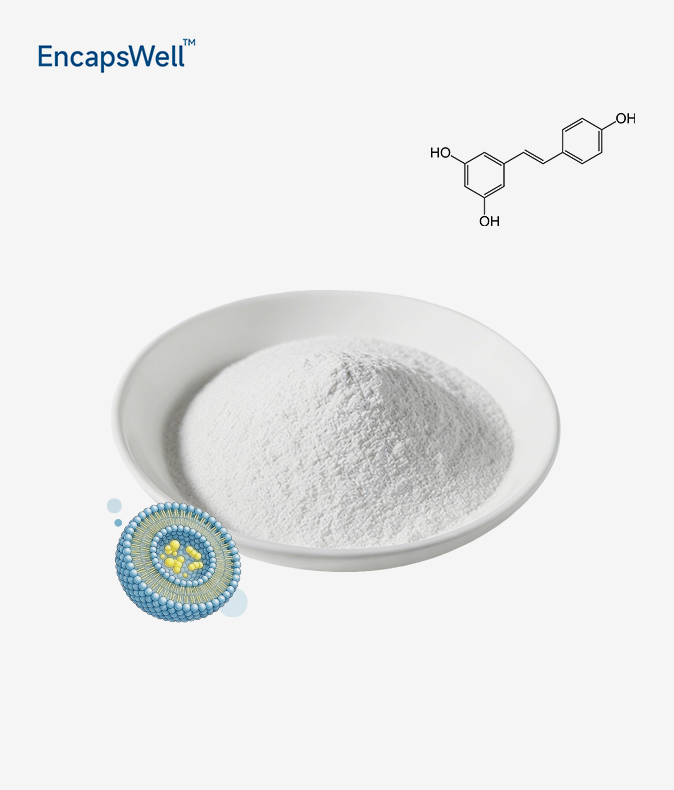
Liposomal resveratrol powder is increasingly becoming a preferred solution for brands looking to overcome the well-known bioavailability limitations of traditional resveratrol. While resveratrol itself has strong scientific recognition in anti-aging, cardiovascular health, and antioxidant applications, its poor absorption and rapid metabolism have long restricted its real-world effectiveness in finished products.
By applying phospholipid-based encapsulation, liposomal resveratrol powder improves delivery efficiency while maintaining the flexibility required for modern nutraceutical development. For B2B buyers, this is not just a technological upgrade—it is a practical tool for improving product performance, formulation versatility, and market positioning.
What Is Liposomal Resveratrol Powder?
Liposomal resveratrol powder is produced by encapsulating trans-resveratrol within phospholipid bilayers and converting the system into a stable, water-dispersible powder through spray-drying or freeze-drying processes. This structure protects the active compound during digestion and supports more efficient absorption compared to conventional resveratrol extracts.
Unlike standard crystalline resveratrol, which has low solubility and is quickly metabolized in the liver, liposomal delivery enables the compound to remain more stable throughout the gastrointestinal process. The result is a formulation that is easier to work with and better aligned with performance-driven product development.
Why Traditional Resveratrol Limits Product Performance
In practical formulation scenarios, standard resveratrol presents several constraints that directly affect product quality and user experience.
First, its poor solubility creates challenges in both capsules and beverage systems. It tends to precipitate in liquid formulations and contributes to astringency, making taste masking more difficult.
Second, rapid metabolism significantly reduces the amount of active resveratrol reaching systemic circulation. Even high-purity extracts cannot fully address this limitation, which often leads brands to increase dosage levels without achieving proportional benefits.
Finally, stability issues in multi-ingredient systems can compromise shelf life, especially in formulations containing proteins, minerals, or other reactive compounds.
These limitations make it difficult for brands to differentiate their products in competitive categories such as longevity supplements or beauty-from-within solutions.
How Liposomal Delivery Improves Resveratrol Utilization
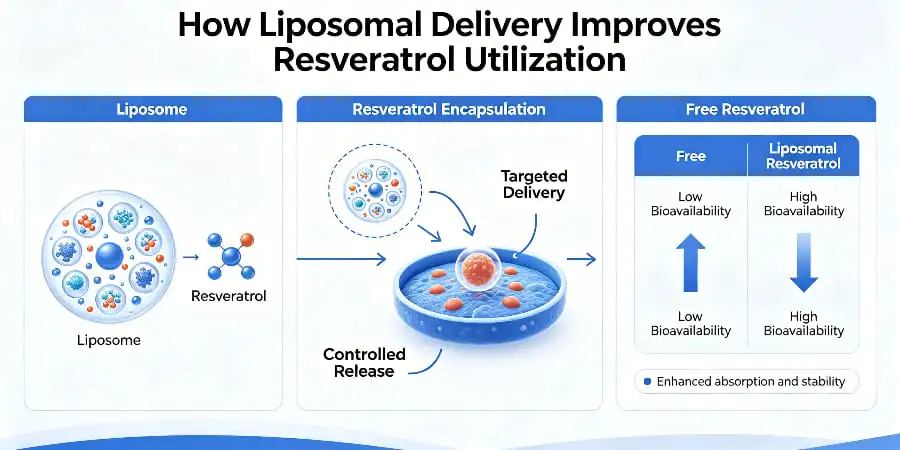
Liposomal technology changes how resveratrol behaves during digestion and absorption. The phospholipid bilayer acts as a protective carrier, helping shield the active compound from degradation while improving its interaction with intestinal membranes.
This delivery system supports alternative absorption pathways and may reduce the impact of first-pass metabolism, allowing more active resveratrol to reach target tissues. For formulators, this translates into more predictable performance and better alignment between formulation design and final product outcomes.
In commercial terms, improved delivery efficiency allows brands to optimize dosage strategies rather than relying on high inclusion levels. This creates opportunities to balance cost, efficacy, and consumer experience more effectively.
Application Flexibility in Modern Product Formats
One of the key advantages of liposomal resveratrol powder is its adaptability across multiple delivery formats. In capsule and tablet formulations, it offers consistent encapsulation performance and compatibility with standard manufacturing processes, making it suitable for anti-aging and daily wellness supplements.
In functional beverages, the water-dispersible nature of the powder helps reduce precipitation issues commonly associated with raw resveratrol. This makes it easier to develop stable formulations for wellness drinks, beauty beverages, and ready-to-mix sachets.
For beauty-from-within applications, liposomal resveratrol integrates more effectively with ingredients such as collagen, vitamin C, and hyaluronic acid. This supports product concepts focused on skin radiance and overall vitality, while maintaining formulation stability in complex systems.
Because a single raw material can be used across multiple product lines, procurement teams benefit from simplified supply chains and more efficient inventory management.
Liposomal vs Standard Resveratrol: A Practical Comparison
From a sourcing and formulation perspective, the choice between standard and liposomal resveratrol is less about raw material cost and more about functional value.
Standard resveratrol remains cost-effective but limited by low absorption and formulation challenges. Liposomal resveratrol powder, on the other hand, provides improved dispersion, enhanced delivery potential, and greater flexibility in application.
This difference allows brands to position products more effectively in premium categories, where performance and user experience are key purchasing drivers.
Key Considerations When Sourcing Liposomal Resveratrol Powder
When evaluating suppliers, buyers should focus on factors that directly impact product quality and consistency. Encapsulation efficiency and particle size distribution are critical indicators of whether the liposomal structure is stable and functional.
Raw material sourcing also plays an important role. Most resveratrol used in nutraceuticals is derived from Polygonum cuspidatum, and buyers should ensure consistent trans-resveratrol content along with compliance regarding residual solvents.
Stability data is essential, particularly for powder formats intended for global distribution. Reliable suppliers should provide clear documentation on shelf life, moisture sensitivity, and performance after reconstitution.
Certifications such as cGMP, ISO22000, FSSC22000, and HACCP are standard requirements, but beyond certification, the ability to provide regulatory documentation for different markets often determines how quickly a product can be commercialized.
Formulation Strategy and Dosage Considerations
In most nutraceutical applications, resveratrol dosage typically ranges between 150 mg and 500 mg per day, depending on positioning and target market. With liposomal resveratrol powder, improved delivery efficiency allows formulators to achieve desired outcomes without significantly increasing dosage levels.
This makes it easier to design products across different price tiers, from entry-level formulations to premium offerings.
Liposomal resveratrol is often combined with ingredients such as NMN, quercetin, or curcumin to create synergistic formulations. In beauty-focused products, it is frequently paired with collagen and antioxidants to support skin-related positioning.
Because of its improved compatibility in multi-ingredient systems, it enables more complex formulations without compromising stability or shelf life.
Market Perspective: Why Liposomal Formats Are Gaining Traction
The shift toward liposomal delivery reflects broader changes in the nutraceutical market. Consumers are paying more attention to how ingredients are delivered, not just what is included on the label.
For brands, this creates an opportunity to differentiate through technology rather than simply increasing dosage or adding more ingredients.
Products that align better with consumer expectations in terms of performance are more likely to build long-term trust. When users can perceive consistent benefits, it supports repeat purchase behavior and strengthens brand positioning in competitive segments such as anti-aging and functional wellness.
Conclusion
Liposomal resveratrol powder provides a practical solution to one of the most persistent challenges in resveratrol supplementation—limited bioavailability. By improving delivery efficiency while maintaining formulation flexibility, it enables brands to develop products that are both technically sound and commercially competitive.
For B2B buyers, the value lies not only in the ingredient itself, but in how it supports better product design, clearer positioning, and more reliable performance across different applications.
FAQ
Is liposomal resveratrol powder suitable for beverages?
Yes, its water-dispersible properties make it more suitable than standard resveratrol for functional drinks and beauty beverage formulations.
Can it reduce the need for high dosage?
It allows for more efficient formulation strategies, which may reduce the need for excessive dosage compared to standard resveratrol.
What should be prioritized when selecting a supplier?
Consistency in encapsulation quality, stability data, and regulatory documentation are key factors that influence long-term product success.
Partner with EmerWell for Liposomal Resveratrol Powder
EmerWell provides high-quality liposomal resveratrol powder developed through advanced encapsulation technology and supported by cGMP-certified manufacturing. Our solutions are designed for nutraceutical brands, contract manufacturers, and functional food developers seeking reliable performance and formulation flexibility.
From pilot batches to large-scale production, we support OEM and ODM projects across capsules, powders, and beverage-ready systems, with full documentation for global market compliance.
For samples, technical specifications, or pricing details, contact us at:
info@emerwell-bio.com
References
Walle T. Bioavailability of resveratrol. Annals of the New York Academy of Sciences, 2011, 1215(1): 9-15.
Smoliga JM, Blanchard O. Enhancing the delivery of resveratrol in humans: if low bioavailability is the problem, what is the solution? Molecules, 2014, 19(11): 17154-17172.
Cottart CH, Nivet-Antoine V, Beaudeux JL. Review of recent data on the metabolism, biological effects, and toxicity of resveratrol in humans. Molecular Nutrition & Food Research, 2014, 58(1): 7-21.
Figueira I, Garcia G, Pimpão RC, et al. Polyphenols journey through blood-brain barrier towards neuronal protection. Scientific Reports, 2017, 7(1): 11456.
Amri A, Chaumeil JC, Sfar S, Charrueau C. Administration of resveratrol: what formulation solutions to bioavailability limitations? Journal of Controlled Release, 2012, 158(2): 182-193.
Summerlin N, Soo E, Thakur S, et al. Resveratrol nanoformulations: challenges and opportunities. International Journal of Pharmaceutics, 2015, 479(2): 282-290.
Online Message
YOU MAY LIKE
High quality furniture manufacturer