Jun 11, 2026
Is Liposomal Vitamin C Really a More Absorbable Form?
Yes, liposomal vitamin C powder demonstrates significantly enhanced absorption compared to conventional ascorbic acid formulations. The phospholipid-based encapsulation technology protects vitamin C molecules from gastric degradation and facilitates direct cellular uptake through membrane fusion. Clinical studies validate that liposomal delivery systems achieve bioavailability rates up to 8 times higher than standard vitamin C powders, enabling lower therapeutic dosages while maintaining efficacy. This advancement addresses a longstanding challenge in nutraceutical formulation, particularly for brands seeking clean-label, high-performance immune support and antioxidant products.
Understanding Liposomal Vitamin C Powder
The Science Behind Phospholipid Encapsulation
Using liposome packaging technology, ascorbic acid molecules are wrapped in circular lipid bilayers made up of phosphatidylcholine and other naturally occurring phospholipids. These very small bubble-like structures, which are usually between 50 and 200 nanometers across, are structurally similar to the membranes of human cells. When the liposomal carriers are eaten, they protect vitamin C from the acidic pH levels and enzymes that break it down, which can destroy up to 70% of normal supplement amounts.
How Cellular Delivery Works?
The way it works is very different from how tablets or pills usually work. Instead of relying on passive diffusion across intestinal walls, liposomes help active transport through two main pathways: endocytosis and membrane fusion. Endocytosis is when cells take up the whole liposome structure, and membrane fusion is when the lipid bilayer merges directly with cell membranes to release vitamin C inside. This focused transport gets around many of the absorption obstacles that stop standard formulations, which makes plasma concentrations much higher.
Formulation Stability Advantages
With good liposomal vitamin C powder, the structure stays the same during storage and production. When made correctly, the vitamin that is enclosed stays more than 95% effective for 24 months when kept in a controlled environment. This benefit of steadiness is especially useful for companies that make functional drinks and OEMs that need ingredients to work the same way throughout production processes. Because advanced formulations are water-soluble, they can be easily added to a variety of transport forms without affecting how well they are encapsulated.
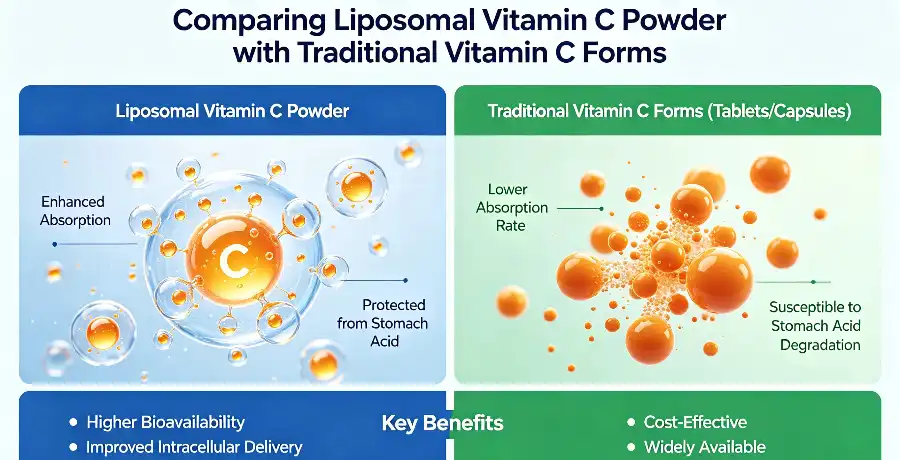
Comparing Liposomal Vitamin C Powder with Traditional Vitamin C Forms
Bioavailability Metrics That Matter
Comparative pharmacokinetic studies show that the ways of delivering drugs are very different. Standard ascorbic acid supplements usually raise plasma levels to 80 to 120 μmol/L, and around half of high amounts are flushed out of the body unaffected in the urine. Liposomal formulations show peak amounts above 200 μmol/L at similar doses, which means they are better at being absorbed. The area under the curve (AUC), which is a key way to measure overall nutrient exposure, gets 8 times better in liposomal vitamin C powder goods that are well-designed.
Dosage Efficiency and Cost Implications
The better absorption means that the product works better. Liposomal vitamin C powder in 500 mg amounts can have the same effects on cells as 2,000 mg of regular ascorbic acid. Product makers can make lower-dose formulations that keep the label promises and lower the cost of raw materials. This efficiency is especially useful when making high-end goods to boost the immune system, since customers care more about the quality of the ingredients than the amount.
Format Versatility and Market Positioning
Traditional powders can't handle the different dosage types that liposome technology can. The enclosed structure stops the bitter taste and acidity problems that often happen with high doses of ascorbic acid, so it's possible to make drinks that don't taste bad. Manufacturers can make ready-to-mix packs for on-the-go immune support, effervescent pills that taste good and work well, or softgel capsules that offer liquid benefits in a handy form. This flexibility lets brands stand out in a variety of modes of marketing, from high-end health food stores to functional food applications.
Benefits and Applications of Liposomal Vitamin C Powder in B2B Markets
Immune Enhancement Formulations
The ingredient is a key part of immune-boosting product lines that aim to improve seasonal health and daily resistance. When making flu-fighting pills, nutraceutical companies benefit from the gentle-on-stomach feature that reduces the stomach problems that come with taking high doses of regular vitamin C. The better absorption helps keep plasma levels more stable throughout the day, which fixes the problem of fast elimination that makes regular supplements less useful.
More and more, beauty-from-within brands are adding the mineral to collagen-boosting drinks and skin-radiance pills. Hyaluronic acid, ceramides, and peptides work together with the protective qualities to support skin health from the inside out. Vitamin C is a necessary ingredient for nutricosmetic formulations because it is shown to play an important part in collagen production in clinical studies. When delivered through liposomal technology, smaller doses reach the levels of cells needed to make skin effects noticeable.
Functional Beverage Integration
Liposomal formulas that dissolve in water solve long-standing technical problems in the making of drinks. The enclosed structure stops oxidation and breakdown while being stored on a shelf, so nutrients stay active in ready-to-drink forms. Functional drink makers can make drinks that are clear and look good without the cloudiness or sedimentation that usually comes with vitamin C pills. The neutral taste profile lets you come up with creative flavors, from immunity shots that are heavy on citrus to health drinks that are lightly flavored with berries.
Sports Nutrition Applications
Athletic performance brands use liposomal vitamin C powder in products that help with healing. The antioxidants help fight oxidative stress caused by exercise, and the improved uptake makes sure that nutrients are quickly available after a workout. Maintaining high amounts of vitamin C in the blood is especially helpful for endurance athletes because it helps the immune system work better during hard training sessions. The ingredient works well with electrolyte mixes, branch-chain amino acids, and post-workout protein formulas, according to contract makers who work with the sports nutrition industry.
Safety, Side Effects, and Quality Considerations
Clinical Safety Profile
The results of studies show that liposomal delivery is very safe for a wide range of people. Because the protective lipid layer keeps ascorbic acid from coming into direct touch with the gut lining, the encapsulation technology reduces irritation in the digestive tract. People who used to get cramps or diarrhea from taking big doses of regular vitamins usually don't have any problems with liposomal forms. Standard usage suggestions are between 500 mg and 2,000 mg per day, but some situations may need different instructions.
Quality Control Standards
From getting the raw materials to releasing the finished product, strict testing methods make sure that the ingredients are pure. Authentic sellers give full proof, such as Certificates of Analysis that prove the vitamin C content is at least 99%, particle size distributions that show proper liposomal formation, and measurements of how well the capsules are encapsulated. Testing by a third party for heavy metals, microbial pollution, and leftover solvents is in line with worldwide standards like FDA, USP, and Ph.Eur.
Certification Requirements for Global Markets
Procurement teams have to make sure that sellers keep their certifications up to date and match the needs of the target market. Some of the most important qualifications are cGMP approval for nutraceutical uses, ISO 9001 for quality management systems, and HACCP for food safety rules. Suppliers that give Halal and Kosher certifications, Non-GMO Project proof, and organic compliance can help brands get into niche markets. It's not just manufacturing certificates that need to be filled out; stability studies, bioavailability validation reports, and regulatory support for new food applications in the EU or ANVISA standards in Brazil are also needed.
Purchasing Liposomal Vitamin C Powder: A B2B Procurement Guide
Supplier Evaluation Criteria
The first step in strategic sourcing for liposomal vitamin C powder is to look at a supplier's professional skills that go beyond basic making. Leading partners have their own research and development (R&D) teams that can make recipes fit specific product ideas. For example, they can make vitamin C-zinc immunity blends, tropical-stable versions for markets in warm climates, or versions that don't taste bad for kids' supplements. The difference between advanced providers and basic ingredient vendors is their ability to provide stability data, particle size analysis, and bioavailability documents.
Concerns about manufacturing capacity go beyond yearly output measurements. Flexible minimum order numbers let new brands test market ideas, and scalable production infrastructure helps well-known brands start campaigns across the country. The best partnerships include technical help for the whole process of developing a product, from the first tests of the formulation to the business scale-up. This makes sure that the quality stays the same as order numbers rise.
Cost Structure and Value Analysis
The price of liposomal vitamin C powder shows how complicated the manufacturing process is. The price per kilogram is usually between $180 and $420, but it depends on how well the particles are encapsulated, the size standards, and the certification needs. Even though it costs more than regular ascorbic acid, the real value must take dosage effectiveness into account. When you make a 500 mg liposomal product that works as well as a 2,000 mg regular vitamin C, the cost per dose becomes more reasonable, especially when you think about better ways to place the product in the market.
Final prices are affected by long-term supply deals, payment terms, and volume promises. When procurement teams negotiate yearly contracts, they usually get good rates and make sure the supply chain stays running. For accurate budget planning, clear cost breakdowns should show different amounts for raw materials, processing fees for packaging, quality testing, and help with regulatory paperwork.
Logistics and Supply Chain Optimization
When you buy something from another country, you have to carefully coordinate wait times, shipping conditions, and customs paperwork. Premium liposomal ingredients require climate-controlled shipping to keep the structure intact while it's being sent. Suppliers that offer regional storage, like EmerWell's San Diego distribution services, offer big benefits like faster shipping, easier customs processes, and access to technical support teams in the area. Being able to buy smaller amounts for recipe tests before committing to full production runs lowers financial risk and speeds up the development of new products.
Conclusion
Liposomal vitamin C powder is a proven change in the way nutrients are delivered. It makes nutrients more bioavailable, which leads to real formulation benefits. The phospholipid coating guards the ascorbic acid while it is being digested, makes it easier for cells to take it in, and lets lower-dose products work without losing their effectiveness. These benefits meet important market needs in the areas of beauty-from-within, healthy drinks, immune support, and sports nutrition. When purchasing this ingredient, people in charge should give more weight to suppliers that show they are technically advanced by having detailed quality paperwork, flexible production options, and helpful customer service that lasts throughout the entire product development lifecycle.
FAQ
Does liposomal delivery actually improve vitamin C absorption compared to tablets?
Yes, studies that have been studied by experts in the field show that liposomal vitamin C works much better than regular pills or powders at getting the same amount of vitamin C into the bloodstream. The phospholipid coating keeps the nutrient from breaking down in the stomach and makes active cell transfer easier. This improves bioavailability by 6 to 8 times compared to normal formulations.
Can liposomal vitamin C powder integrate with other supplement ingredients?
Liposomal vitamin C powder can be mixed with other ingredients in supplements. It has been shown that the technology works very well with supplemental nutrients. Vitamin C and zinc work together to support the nervous system, vitamin C and glutathione work together to form antioxidant networks, and vitamin C and collagen peptides work together to make beauty products. Suppliers with a lot of experience can provide stability testing results that show how ingredients combine and how long they last in multi-component formulas.
How can buyers verify the quality and encapsulation efficiency of liposomal vitamin C powder?
Reliable sellers give out thorough Certificates of Analysis that show the amount of vitamin C in the product, measures of particle size distribution that show proper liposomal formation, and percentages of encapsulation efficiency. These measures have been proven to be accurate by independent tests from approved labs. Teams in charge of buying things should ask for stable studies that show the drug will stay effective for the expected amount of time on the shelf and in the right storage conditions.
Partner with EmerWell for Superior Liposomal Vitamin C Powder Solutions
EmerWell's EncapsWell™ platform provides liposomal vitamin C powder that has been clinically proven to be 8 times more bioavailable than regular versions. Our cGMP-certified production through Wellgreen guarantees consistency from batch to batch, full quality paperwork, and open customization that supports your unique product vision. Our PhD-led research and development team helps with technical aspects from the idea stage to the market launch of immunity sachets, beauty drinks, or sports recovery mixes.
As a company based in San Diego that makes specialized liposomal vitamin C powder, we can provide regional support such as fast sample delivery, in-house analytical testing, and regulatory knowledge for the FDA, the EU, and other foreign markets. Get in touch with our expert team at info@emerwell-bio.com to talk about your formulation needs and get unique samples that show off our better encapsulation technology.
References
Davis, J.L., Paris, H.L., Beals, J.W., et al. (2016). "Liposomal-encapsulated Ascorbic Acid: Influence on Vitamin C Bioavailability and Capacity to Protect Against Ischemia-Reperfusion Injury." Nutrition and Metabolic Insights, 9:25-30.
Łukawski, M., Dałek, P., Borowik, T., et al. (2020). "New oral liposomal vitamin C formulation: properties and bioavailability." Journal of Liposome Research, 30(3):227-234.
Gopi, S., Balakrishnan, P. (2021). "Evaluation and clinical comparison studies on liposomal and non-liposomal ascorbic acid (vitamin C) and their enhanced bioavailability." Journal of Liposome Research, 31(4):356-364.
Carr, A.C., Maggini, S. (2017). "Vitamin C and Immune Function." Nutrients, 9(11):1211.
Padayatty, S.J., Levine, M. (2016). "Vitamin C: the known and the unknown and Goldilocks." Oral Diseases, 22(6):463-493.
Pullar, J.M., Carr, A.C., Vissers, M.C.M. (2017). "The Roles of Vitamin C in Skin Health." Nutrients, 9(8):866.
Online Message
YOU MAY LIKE
High quality furniture manufacturer