

Sep 24, 2026
How to Compare Liposomal Glutathione Powder Suppliers for Bulk Purchasing
One of the most important decisions a product development or procurement team can make is to purchase liposomal glutathione powder in bulk. The supplier you select directly affects the quality of your formulation, your pricing structure, your regulatory standing, and your ability to scale. This guide covers all the important evaluation layers, from technical requirements and certifications, to service models and negotiating methods, to help you proceed confidently from shortlist to signed contract. If you are in the nutraceutical, functional beverage, nutricosmetic or OEM manufacturing industry, the standards outlined below are directly relevant to your procurement process.
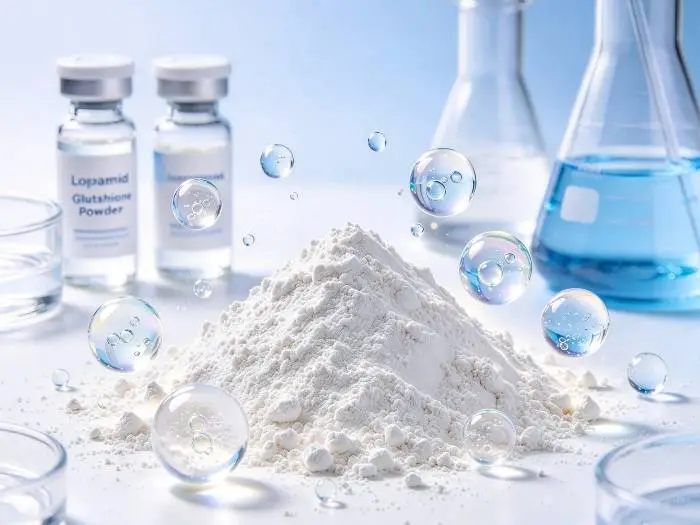
Understanding Bulk Purchasing Needs for Liposomal Glutathione Powder
Before you contact a single supplier, it's a good idea to make a detailed map of your internal needs. What "qualified" really means to you depends on the volume, type of application, and compliance requirements.
Define Your Volume and Dosage Form Requirements
There is a wide range of bulk sales, from small 10 kg batches for testing to large business runs of over 2,000 kg per month. Which sources are even worth getting in touch with depends on how much you think you will need. Also, think about the form of the dose. Liposomal glutathione powder can be used in capsules, sachets, tablets, and ready-to-mix drinks, but not all providers offer all of these options. Early on, make sure that the supplier can support the delivery format you need at the volume you want.
Identify Application-Specific Quality Standards
When reduced glutathione is put into a clinical nutrition product, it is treated differently than when it is put into a beauty-from-within sachet. Nutraceutical brands usually need to follow cGMPs and have the strength of their products checked by HPLC. Functional beverage makers need their drinks to mix with water and keep their flavors. OEM manufacturers put a high value on reliable supplies and quick turnaround times. When you know your product, you can set high standards that suppliers must meet.
Map Regulatory Requirements Before You Source
There are rules about how to run the U.S. market called FDA DSHEA. There are more rules to follow if you want to export because of EU Novel Food and regional standards like ASEAN regulations. If your suppliers already have paperwork like COA, TDS, and SDS, as well as certifications like HALAL, KOSHER, Non-GMO, and Vegan, it will be a lot easier for you to follow the rules. Make sure you understand these needs before you start comparing.
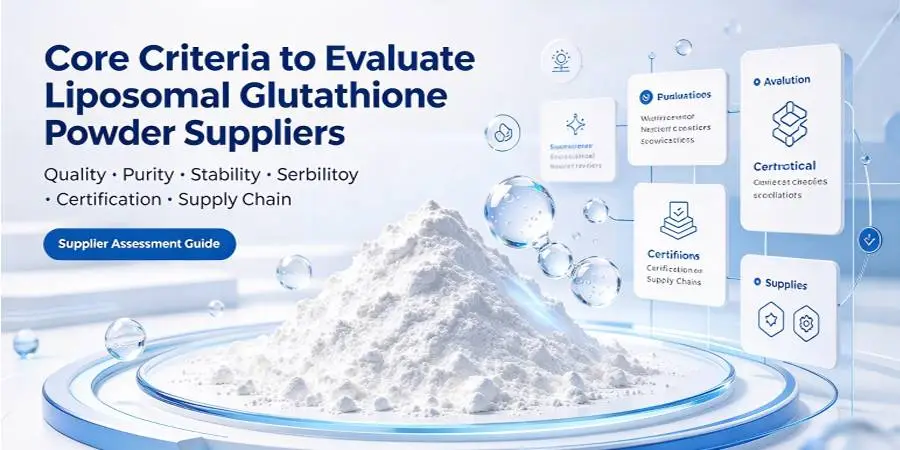
Core Criteria to Evaluate Liposomal Glutathione Powder Suppliers
Once you know what your own needs are, review can be done in an organized way. Product quality, clear price, and reliable availability are the three areas that matter the most.
Product Quality and Certification Depth
A good encapsulated glutathione ingredient should have a minimum of 95% glutathione purity and be more bioavailable than standard powder forms. If the encapsulation is tested and proved to work , then liposome transport through phospholipid bilayers can improve absorption by up to 13 times compared to regular glutathione powder . Look for information on particle size (typically D50 between 100 and 250 nm), encapsulation efficiency greater than 90 percent and third party test results including criteria for strength, heavy metals and microorganisms. Some certifications to check out are ISO9001, ISO22000, FSSC22000, HACCP, cGMP.
Pricing Transparency and Total Landed Cost
The price given per kilogram of liposomal glutathione powder doesn't always tell the whole story. Shipping, import fees, security, and any minimum order fees need to be taken into account. Ask suppliers to break down the total cost of multiple orders and be clear about the payment terms—net-30, letters of credit, or wire transfer expectations can all change how you plan your cash flow. When suppliers give clear prices, it shows that the relationship is more professional.
Supply Chain Reliability and Lead Times
Brands with busy manufacturing schedules must have consistent lead times, production capacity, and inventory depth. Ask the seller for accurate wait time estimates based on the amount you want to order, and find out if they keep safety stock. Suppliers with established transportation infrastructure and local warehousing, like U.S.-based partners with goods in the U.S., lower travel risk and allow for faster reorder cycles.
Comparing Supplier Service and Support for B2B Clients
Long-term results are affected by both technical skills and how well you work with a supplier on a daily basis. Service quality is what sets great providers apart from good ones.
Dedicated Account Management and Technical Support
Strong providers give you a personal point of contact for your account. This person knows your formulation goals and can work with R&D, QA, and operations to make sure everything runs smoothly. For finding liposomal ingredients in particular, being able to get scientific help from scientists with PhDs is a real plus. Complex questions about how the supplement rehydrates, whether it can be co-encapsulated with vitamin C or NAC, and how stable it is under different processing conditions need well-informed answers, not general sales pitches.
Customization and OEM/ODM Flexibility
A lot of brands need more than just a stock ingredient. Customization options, such as changing the particle size, hiding flavors, co-encapsulating with complementary actives, or using white-label packaging, make it possible to do more with a single supplier. You can cut down on the number of suppliers you need and get your supplements to market faster with OEM and ODM programs that support private-label supplement production. Before moving forward, make sure that the seller can meet these needs.
Reputation, Reviews, and Industry Presence
A supplier's trustworthiness can be seen in a number of places, including comments from verified customers, client references, and attendance at industry events like CPHI or Vitafoods. Ask for a list of references from names in the same area as yours. Suppliers who are regulars at B2B ingredient trade shows are more likely to be skilled, which makes relationships with them more reliable.
Analyzing Market Options: Liposomal Glutathione Powder Supplier Types
Direct makers, ingredient distributors, and online trade sites are all types of suppliers. You should carefully think about the trade-offs that come with each.
Direct Manufacturers vs. Distributors
When you buy from the maker, you usually get better access to technical data, lower unit prices, and a better idea of how well the product is made. Distributors can make things easier by letting you buy more than one SKU, but they may charge extra and not carry full formulation documentation. When buying large amounts of special ingredients like liposomal reduced glutathione, it's usually better to work directly with the manufacturer to make sure the quality.
Domestic vs. International Sourcing
This means less waiting, fewer regulatory alignment issues, and better communication. U.S.-based suppliers or companies that have domestic warehouse and delivery infrastructure have all of these advantages. International manufacturers could have lower rates but you have to be very careful with the paperwork, shipping times and import rules. The perfect scenario is a provider with worldwide production capabilities and a local U.S. presence including an in-house lab and a regional support team.
Liposomal vs. Standard Glutathione: Formulation Compatibility
Regular liposomal glutathione powder breaks down in stomach acid, and gives drinks a sulphurous odour. The liposomal coating protects the active tripeptide during digestion and assists in stabilising the pH in different types of liquids, as well as enhancing the flavour and scent. In terms of anti-aging supplements, skin-brightening drinks and liver support solutions, where promises of effectiveness drive sales, the liposomal form consistently scores higher on absorption assessments than other forms.
Making the Final Decision: Step-by-Step Bulk Supplier Comparison
A structured comparison process takes the guesswork out of the decision-making process and makes the person making the choice more responsible.
Build a Weighted Scorecard
Give the following factors more or less equal weight in your evaluation: product quality (30%), price and terms (25%), supply stability (20%), service and support (15%), and regulatory readiness (10%). Use available documents and direct talks to give each shortlisted provider a score based on these factors. A scoring method shows the trade-offs and gives your team a good reason for making the final choice.
Use a Comparison Matrix for Objectivity
You can easily compare sources based on certain factors, such as encapsulation efficiency, licenses held, MOQ, lead time, and ability to customize, with side-by-side matrices. Don't just use sales materials to make the matrix; use verified data as well. To make sure it's filled out correctly, ask for Certificates of Analysis, stability reports, and testing summaries.
Negotiate Trial Orders and Long-Term Terms
Talk about a trial batch before committing to a full commercial run. You can see how responsive and accurate the seller is in real time with a pilot order of 10–50 kg. This gives your R&D team real goods to test. Once the order has been confirmed, you can talk about volume discounts, rolling purchase agreements, and preferred price tiers. When suppliers allow trial sales, it shows that they are confident in their goods.
Conclusion
Getting ready for the process of choosing the right source for buying liposomal glutathione powder encapsulates in bulk pays off. Make it clear what kind of applications you need, what the quality standards are, and make sure that all candidates follow the same rules for documentation. You should give more weight to providers who offer full certification coverage, clear pricing, and expert depth from a local team you can actually reach. With the right partnership, your product will be supported from the pilot phase to the commercial phase without any problems.
FAQ
1.What certifications should a liposomal glutathione powder supplier hold?
Check for cGMP, ISO22000, FSSC22000, and HACCP certificates at the very least. The words "HALAL," "KOSHER," "Non-GMO," and "Vegan" are important for certain markets. Documentation from HPLC tests and third-party COAs independently confirm potency.
2.How do I verify that a powder is genuinely liposomal?
Ask for TEM (transmission electron microscopy) images and dynamic light scattering (DLS) reports on particle size distribution. These show that there are whole phospholipid bilayer vesicles with a D50 value between 100 and 250 nm.
3.What is the typical shelf life for liposomal glutathione in powder form?
If you keep good liposomal glutathione powder in a cool, dry place, it will last for 24 months. Powder liposome suspensions don't need to be kept cold until they are reconstituted, but liquid liposome suspensions do.
4.Does encapsulation use soy-derived phospholipids?
High-quality formulas use lecithin that comes from sunflowers, which means that the ingredient is free of soy and doesn't contain any GMOs. Before you order, you should always check the phospholipid source.
5.What MOQ should I expect for bulk sourcing?
MOQs are different for each seller. Well-known companies offer small batches starting at 10 kg and going up to 2,000 kg per month for full-scale production.
Partner With EmerWell for Your Next Bulk Liposomal Glutathione Powder Order
Based in San Diego, California, EmerWell has an in-house R&D team led by a PhD, as well as an in-house U.S. laboratory for testing and local storage for your purchases. Our EncapsWellTM platform provides liposomal glutathione powder that is at least 95% pure and 13 times more effective at absorption than regular powders. We are a reliable provider of liposomal glutathione powder, and we offer OEM/ODM programs, flexible dosage forms, and full approval paperwork. To get a sample or bulk price quote, email us at info@emerwell-bio.com.
References
1. Sinha, R., et al. "Oral Supplementation with Liposomal Glutathione Elevates Body Stores of Glutathione and Markers of Immune Function." European Journal of Clinical Nutrition, 2018.
2. Richie, J.P., et al. "Randomized Controlled Trial of Oral Glutathione Supplementation on Body Stores of Glutathione." European Journal of Nutrition, 2015.
3. Weschawalit, S., et al. "Glutathione and Its Antiaging and Antimelanogenic Effects." Clinical, Cosmetic and Investigational Dermatology, 2017.
4. Allen, J., & Bradley, R.D. "Effects of Oral Glutathione Supplementation on Systemic Oxidative Stress Biomarkers in Human Volunteers." Journal of Alternative and Complementary Medicine, 2011.
5. Bansal, S., et al. "Liposomes as Drug Delivery Systems: Advances, Challenges, and Clinical Perspectives." Journal of Drug Delivery Science and Technology, 2022.
6. U.S. Pharmacopeia. "Dietary Supplements Quality Verification Program: Standards and Compliance Framework." USP–NF Reference Guide, 2023.
Online Message