May 18, 2026
How Does Liposomal Resveratrol Compare To Resveratrol From Red Wine?
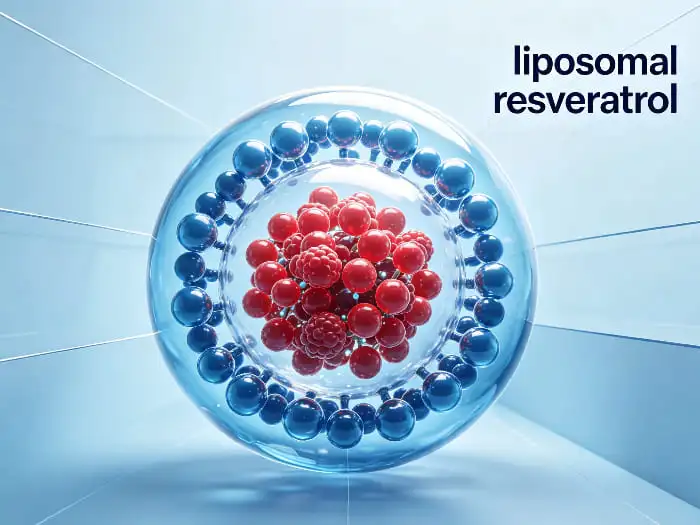
Liposomal resveratrol powder is much better at absorption, stability, and dose accuracy than resveratrol from red wine. Resveratrol is found naturally in red wine, but only about 1% of it is absorbed because the liver breaks it down quickly and it doesn't mix well with other substances. Trans-resveratrol molecules are wrapped in phospholipid bilayers using advanced liposomal encapsulation technology. This allows for up to 14 times higher uptake by skipping the first step of breakdown. Liposomal resveratrol powder is a good choice for nutraceutical brands and contract makers because it is consistent from batch to batch, has a longer shelf life, and can be used in a variety of ways. It also gets rid of the problems that come with red wine extracts, like alcohol content and standardization.
Understanding Resveratrol: Traditional Sources vs. Liposomal Formulations
What Makes Resveratrol Valuable Yet Challenging?
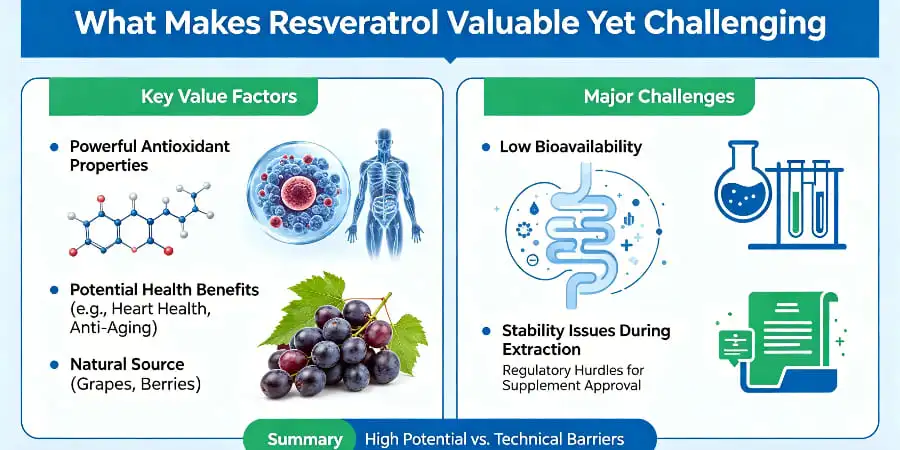
You can find resveratrol naturally in grape skins, Japanese knotweed, and berries. It is a stilbenoid chemical. Red wine is one of the most well-known food options for iron because it has about 0.2 to 5.8 mg per liter, based on the type of grape and how it was fermented. The compound's health benefits are badly restricted, though, by the way its molecules are structured. Resveratrol is very water-repellent and quickly changes into glucuronidation and sulfation in the liver and gut wall. This means that when taken by mouth, less than 1% of it is available to the body's cells.
These barriers to absorption make it very hard for supplement makers to give amounts that are clinically useful. Natural sources aren't always consistent, and the amount of resveratrol in red wine changes depending on the region, the batch, and how it was processed. This makes standardization very hard for quality-controlled production.
How Liposomal Technology Solves Core Absorption Problems?
Liposomal resveratrol powder represents a major improvement in nutrient delivery. Trans-resveratrol is encapsulated in nanoscale phospholipid vesicles, typically made from non-GMO sunflower or soy lecithin. The lipid bilayer mimics the structure of cell membranes, allowing the nutrient to be absorbed directly via the lymphatic pathways in the intestines instead of passing through the liver's portal circulation. This system protects the active ingredient from stomach acid and digestive enzymes while enhancing cellular uptake.
Using freeze-drying or spray-drying technology to turn it into a stable powder has added benefits for business-to-business uses. Powder forms are better than liquid liposomal suspensions because they can last longer on the shelf, are easier to ship, and work with capsules, tablets, and water-dispersible drinking systems. This adaptability meets the needs of contract makers looking for solutions that can be scaled up or down, as well as brands that need exact dosing across a wide range of products.
Core Benefits and Efficacy: Liposomal Resveratrol Powder vs. Red Wine Resveratrol
Bioavailability: The Performance Gap That Defines It
Studies in humans and lab animals regularly show that liposomal packaging increases the rate at which resveratrol is absorbed. Standard resveratrol powders only have a 1% bioavailability. Newer versions, like EncapsWell™, have up to 14 times higher uptake because they improve membrane permeability and lymphatic movement. This means that 100 mg of liposomal resveratrol powder can give the body the same amount of exposure as 1,400 mg of regular powder. This is a very important efficiency win for formulation scientists who have to work within the limits of label claims.
Red wine has a cultural draw, but it's hard to tell how much resveratrol you'll get from it. A typical 150 ml dose might have between 0.3 mg and 0.9 mg of resveratrol, so you would have to drink a lot of it to get close to beneficial levels. The alcohol mix makes things even more complicated. Safety worries and government restrictions mean that red wine can't be used as a controlled ingredient source for supplements.
Antioxidant Capacity and Stability
Resveratrol works as an antioxidant by getting rid of reactive oxygen species and changing the processes that cause cellular stress. But the molecule breaks down quickly when it comes in contact with UV light, air, and high pH—problems that are made worse by the complex chemical environment of red wine. Liposomal encapsulation protects the active molecule within a lipid shell, so it stays active during production, storage, and digestion.
According to ICH standards, stability testing shows that high-quality liposomal resveratrol powders keep more than 95% of their strength after 36 months at controlled temperatures. This is in contrast to unencapsulated forms, which lose their effectiveness within months. This guarantee of a long shelf life is important for global supply chains and regulatory filings in the EU, FDA, and ASEAN markets.
Dosage Precision and Safety Profiles
Liposomal powder forms allow precise dosing down to the milligram level, which meets label accuracy standards and provides scientific proof for health claims. With certified analytical certificates, procurement teams can specify resveratrol content of at least 98%. This makes sure that batch-to-batch uniformity is achieved, which is not possible with plant extracts or wine derivatives.
Advanced transport methods are also better for safety reasons. Red wine contains alcohol, sulfites, and histamines that are not in line with clean label trends and allergen-free positioning. Vegan, non-GMO liposomal powders get rid of these worries and meet certifications like KOSHER, HALAL, and organic standards that people who care about their health want.
Practical Procurement Considerations for B2B Clients
Quality Standards and Certification Requirements
When purchasing companies look at potential sellers, they should focus on those with full third-party certifications that show they are good at making things and are ready for regulations. Check to see if they use HACCP, ISO22000, and FSSC22000 food safety protocols, as well as ISO9001 quality control methods. For brands that sell in the US, cGMP-certified certification proves that they follow FDA rules. HALAL and KOSHER approvals, on the other hand, let more types of customers buy their products.
The analytical paperwork needs to include HPLC confirmation of the trans-resveratrol content, tests for microbes and heavy metals, and analysis of any leftover solvents. Traceability systems that use blockchain or batch-coding to keep track of where raw materials come from give brands even more peace of mind, especially those that want to position themselves as expensive or use their products in medical settings.
Cost-Effectiveness and Scalability Analysis
Even though liposomal resveratrol powder costs more per unit than regular resveratrol extracts, the overall cost-benefit analysis of formulations favors improved delivery methods. Better absorption lets you use less of the drug, which lowers the cost of the material per dose. Shelf-stability cuts down on waste from old stock, and flexible formulation compatibility gets rid of the need for different versions of ingredients for different product lines.
Bulk purchasing deals usually have tiered pricing that starts at monthly commitments of 500 kg, with bigger savings for producers that buy a lot. By combining formulation development, stability testing, and regulatory paperwork into turnkey solutions, OEM/ODM partnerships further improve economics. These solutions cut time-to-market by 40% compared to in-house development processes.
Supply Chain Reliability and Logistics
Getting ingredients from around the world is important for buying managers who have to deal with a volatile supply chain. Reliable sellers get trans-resveratrol from both European and North American botanical sources. This way, they can keep doing business even when there are problems in one area. Localized storage in San Diego is provided by US-based partners like EmerWell. This allows for quick sample delivery and just-in-time inventory management, which lowers the need for working capital.
Another benefit of powder forms over liquid liposomal solutions is that they are more stable when shipped. Dry formulations can handle changes in temperature while in transit and don't require cold-chain logistics, which makes foreign shipping easier for contract makers in Latin America, Asia-Pacific, and developing markets.
Private Label and OEM Customization Options
In competitive sourcing talks, top sellers stand out because they can make things in a variety of ways. Look for partners that can offer variable particle sizes, custom excipient mixing, and co-formulation with actives that work well together, like NMN, quercetin, or collagen peptides. This flexibility helps brands stand out and places products correctly in functional food groups, beauty vitamins, and performance nutrition groups.
White-label services should include help with artwork design, checking label claims, and having regulatory dossiers ready for big markets. These value-added services make it easier for marketing-driven brands and smaller businesses that don't have their own legal experts to do their work. This makes access to new quality ingredients more open to everyone.
Comparison of Formats: Liposomal Resveratrol Powder vs. Capsules, Liquids, and Trans-Resveratrol
Evaluating Delivery Format Advantages
Liposomal resveratrol powder can be found in a number of different end forms, each of which is best for a different purpose. Powder formats are very flexible; they work well in pill compression, hard and soft capsules, stick packs, and drinking matrices that dissolve in water. Contract makers that work with a wide range of brands and functional food companies that make ready-to-drink wellness shots like this freedom.
Consumers like pre-encapsulated pills because they are easy to use, but they limit recipe creativity and raise the cost per unit by adding more processing steps. Liquid liposomal solutions are bioavailable right away, but they need to be kept cold, have protective systems, and be packaged in a way that makes it more difficult to move. Powder is still the best base for custom recipe development for B2B buyers who care most about scalability and shelf-stability.
Trans-Resveratrol Molecular Specificity
It is important to tell the difference between "resveratrol" in general and trans-resveratrol, which is the medically active isomer. Standard plant products have both trans- and cis-resveratrol, but cis-resveratrol doesn't do much biologically. Good liposomal powders say that they have trans-resveratrol contents of 98% or more. This makes sure that the dose claims are based on the active chemical concentration and not the total resveratrol mass. This level of molecular detail helps prove effectiveness and sets expensive formulas apart from generic ingredients.
Decision Criteria for Format Selection
Format choices should be made by procurement teams in line with how they want to reach customers and how they want to get their products. Powder-based pills work well for online and offline stores that want to make money by saving money and keeping products fresh for longer. Liquid-ready powder mixes are made for direct-to-consumer beverage brands that put a lot of emphasis on experience and quick start. Compare the minimum order numbers to the expected demand, keeping in mind that powder formats can usually handle smaller initial amounts than pre-finished capsule runs that need special tools.
Making an Informed Purchase: How to Choose the Right Liposomal Resveratrol Supplier?
Verifying Technical Capabilities and R&D Support
The first step in evaluating a supplier is to review their technical capabilities and equipment. Partners that maintain in-house analytical laboratories and PhD-led research teams demonstrate a commitment to innovation and quality control beyond basic contract manufacturing. Request data on encapsulation efficiency, pH-dependent release behavior, and absorption modeling studies that support bioavailability and solubility claims. Companies that publish peer-reviewed research or maintain collaborations on clinical studies further demonstrate their commitment to scientific rigor and evidence-based product development.
Manufacturing facility credentials warrant equal scrutiny. cGMP-certified production settings that include ISO22000 food safety make sure that all North American, European, and Asian regulations are met. Blockchain-based batch traceability systems let you see the integrity of the supply chain in real time, which is something that brands need to do more and more because of ESG reporting requirements and customer expectations for openness.
Regulatory Documentation and Market Entry Acceleration
Time-to-market for new products is cut down by a huge amount when governmental dossiers are already put together. Leading sellers keep paperwork packages that cover more than 30 different countries. These packages include Novel Food submissions for EU markets, FDA GRAS notices, and ASEAN GMP certifications. These materials should have stable studies, toxicology reports, and label claim support that is in line with the rules for health claims in your area.
Regulatory affairs teams are useful for more than just providing documents. Partners who can help with claim wording, clinical target selection, and comparative positioning help brands stand out in the market while still following the rules. With this method, sellers are turned into strategic partners instead of just transactional vendors.
Negotiating Sustainable Partnerships
Structured discussion models that cover price increase terms, force majeure protections, and intellectual property rights for custom formulations are good for long-term supply agreements. Set clear quality standards and acceptance criteria for scientific testing, along with methods and procedures for fixing problems that arise when standards aren't met. When sellers work together on planning and share information about demand, they can make the best decisions about when to start production and buy raw materials. This leads to higher fill rates and stable costs.
The EncapsWell™ platform from EmerWell is an example of this partnership method. It blends their own multi-vesicular liposomal technology with Wellgreen's cGMP-certified manufacturing capacity. Our R&D center in San Diego offers regional technical help for customers in the US. Our dual-sourcing strategies and flexible MOQ structures can also be used by both new brands and market leaders. Our liposomal resveratrol powder formulations meet the performance standards that procurement workers need, with resveratrol content confirmed to be at least 98% and absorption improvement recorded at 14 times average levels.
Conclusion
The solubility, quality control, and economic viability of liposomal resveratrol powder and resveratrol from red wine are vastly different. Red wine is still important to culture, but it can't meet the accuracy, stability, and legal standards needed to make professional supplements. Advanced liposomal capsule technology changes resveratrol into a high-performance ingredient that can back up health claims and give reliable results for consumers. When purchasing in the nutraceutical, functional food, and beauty supplement industries, it's important for procurement professionals to choose providers with confirmed absorption data, full licenses, and scalable production capacity. This will help their products stand out and help them succeed in the long run.
FAQ
Is long-term liposomal resveratrol use safer than consuming red wine for resveratrol benefits?
Liposomal resveratrol powder products get rid of the alcohol, sulfites, and histamines that are in red wine. This means that they can be taken on a regular basis without putting the liver under stress or exposing people to allergens. Clinical safety ratings show that people can handle doses of up to 500 mg per day, which is a lot more than the amount of resveratrol that can be obtained from drinking wine. This means that liposomal tablets are good for people who care about their health and people whose diets don't allow them to drink alcohol.
What dosage of liposomal resveratrol powder is recommended for effective health outcomes?
For general antioxidant support, doses of 100 to 250 mg per day work well. Higher amounts (250 to 500 mg) are used for specific circulatory and metabolic uses. Quality liposomal formulations increase bioavailability by 14 times, which means that 100 mg provides systemic exposure equal to about 1,400 mg of standard resveratrol. This lets brands offer powerful benefits in small dose sizes that can be used in capsules or shot glasses.
Can liposomal resveratrol powder be incorporated into private label supplement manufacturing?
Of course. Leading providers offer full OEM/ODM services that support processes from powder to finished product. This includes mixing custom formulations, choosing the right excipients for different delivery forms (like tablets, capsules, and liquids), testing for stability, and coordinating white-label packing. Flexible MOQ structures allow for both small-batch trial runs and large-scale commercial production. This means that liposomal resveratrol powder can be used by brands at all stages of growth that want to stand out in the supplement market.
Partner with EmerWell for Premium Liposomal Resveratrol Powder Supply
EmerWell is ready to help you with your resveratrol preparation projects with EncapsWell™ liposomal resveratrol powder, an ingredient that is backed by science and designed to be more bioavailable and flexible in how it is made. Our cGMP-certified production, third-party-verified purity standards, and technical help based in the US give your business the trust it needs. Whether you're making functional drinks, beauty supplements, or performance nutrition goods, our team can help you with everything from improving the recipe to writing up the paperwork for the government. Email us at info@emerwell-bio.com to get samples, detailed datasheets, or to talk about price for large orders for your next product launch. Learn why some of the biggest names in nutraceuticals choose EmerWell as their liposomal resveratrol powder maker for market success based on innovation.
References
Walle T. Bioavailability of resveratrol. Annals of the New York Academy of Sciences. 2011;1215(1):9-15.
Amri A, Chaumeil JC, Sfar S, Charrueau C. Administration of resveratrol: What formulation solutions to bioavailability limitations? Journal of Controlled Release. 2012;158(2):182-193.
Salehi B, Mishra AP, Nigam M, et al. Resveratrol: A double-edged sword in health benefits. Biomedicines. 2018;6(3):91.
Kristl J, Volk B, Gasperlin M, Sentjurc M, Jurkovic P. Effect of colloidal carriers on ascorbyl palmitate stability. European Journal of Pharmaceutical Sciences. 2003;19(4):181-189.
Figueira I, Garcia G, Pimpão RC, et al. Polyphenols journey through blood-brain barrier towards neuronal protection. Scientific Reports. 2017;7:11456.
Zupančič Š, Lavrič Z, Kristl J. Stability and solubility of trans-resveratrol are strongly influenced by pH and temperature. European Journal of Pharmaceutics and Biopharmaceutics. 2015;93:196-204.
Online Message
YOU MAY LIKE
High quality furniture manufacturer