Jun 18, 2026
How does Liposomal Encapsulation Improve NMN Absorption?
Liposomal encapsulation changes how NMN is delivered by enclosing active molecules in phospholipid bilayers that protect them from being broken down in the stomach and make it easier for cells to take them up directly. This improved liposomal NMN powder technology makes the product 4–8 times more bioavailable than regular versions. It does this by solving the major absorption problems that plague regular NMN products. The protective lipid structure is like the membranes of natural cells, which makes it easy for NAD+ precursors to get across intestinal hurdles and into the bloodstream, where they can better support pathways for cellular energy production and aging.
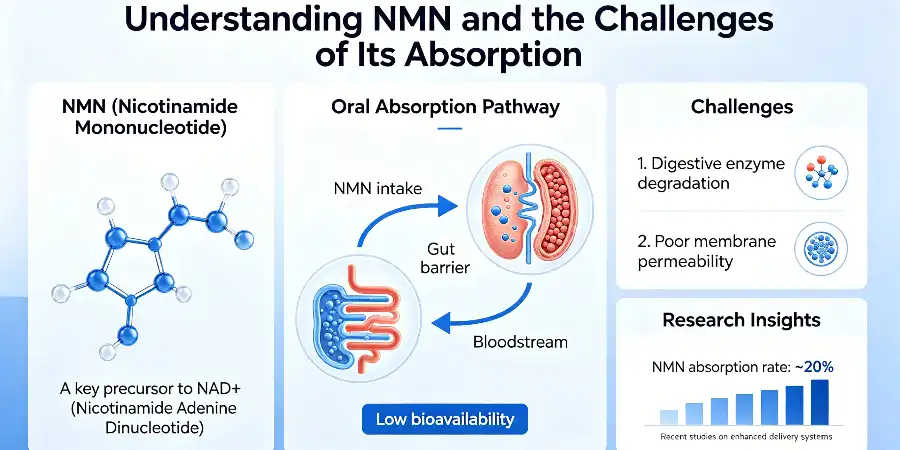
Understanding NMN and the Challenges of Its Absorption
Nicotinamide Mononucleotide is a direct precursor to NAD+, a coenzyme that is needed for mitochondrial activity, DNA repair, and the triggering of sirtuins, proteins that are linked to cell longevity. Since NAD+ levels naturally drop with age, taking NMN supplements has gotten a lot of attention in the health and anti-aging markets. The molecule is very important for turning foods into energy for cells and for keeping the metabolism healthy, the brain working well, and the heart strong.
Even though it has biological potential, standard NMN has a hard time being absorbed. When the molecule is taken in the form of a regular powder or tablet, it quickly breaks down into nicotinamide in the stomach acid before it gets to the small intestine. This early change cuts down on the amount of whole NMN that cells can take in by a large amount. Traditional ways of giving medicine by mouth depend on certain transporters, like SLC12A8, to help the body absorb the medicine in the intestines. However, these transporters can create bottlenecks that limit effectiveness to about 15 to 30 percent of the amount given.
Impact on Product Development and Market Positioning
These limits on absorption have a direct effect on the effectiveness of products and customer happiness for nutraceutical brands, functional beverage makers, and contract manufacturers. Low bioavailability means that more of the drug needs to be used, the cost of the raw materials goes up, and the results for different users may not be the same. This is precisely where liposomal NMN comes into play, as its enhanced encapsulation and targeted delivery are designed to overcome these very hurdles. When B2B procurement teams look at NMN providers, they need to put delivery methods that get around these problems at the top of their list. This will help them stay competitive in a market that is becoming more complex. Brands that have clinically proven absorption benefits can command higher prices and build stronger customer loyalty by showing results.
The Science Behind Liposomal Encapsulation Technology
Liposomal packaging is a big step forward in the science of getting nutrients to cells. In this technology, tiny bubble-like structures are made up of phospholipid bilayers, which are usually derived from non-GMO sunflower or soy lecithin. These phospholipid bilayers physically surround NMN molecules inside their watery core. The finished structure has a width of 100 to 300 nanometers and is best for absorption in the intestines and stable circulation.
High-pressure homogenization or thin-film hydration are used in the production process. Liquid liposomal solutions are then freeze-dried to make a powder that can be stored for a long time. The lipid encapsulation stays intact during this change, which also makes it possible to make different types of pills, tablets, liquid mixes, and sublingual strips. The two-layer structure is very similar to the phospholipid makeup of human cell membranes. This makes it biocompatible, which makes it easier for cells to recognize and take it up.
Enhanced Protection and Targeted Delivery
When NMN is eaten, liposomal structures protect it from the acidic environment of the stomach and digestive enzymes that would break down molecules if they were exposed. The liposomes connect with enterocytes through membrane fusion or receptor-mediated endocytosis when they get to the small intestine. This lets the complete NMN get delivered directly to the cells. This method gets around the problems that regular formulas have with transporter-dependent uptake, which leads to much higher levels of NAD+ precursors in the plasma.
Comparing encapsulated NMN to normal NMN in research shows bioavailability improvements of 400% to 800%, based on the formulation details and measurement methods used. Liposomal delivery's sustained-release properties also make NMN stay active in the bloodstream for longer, keeping NAD+ levels more stable over time instead of experiencing sharp peaks and fast clearance like with unencapsulated forms.
Advantages of Liposomal NMN Powder for B2B Procurement
Finding liposomal NMN powder has strategic benefits that go beyond absorption measures. These include stability, recipe flexibility, and regulatory compliance, all of which are important for launching successful products and keeping a presence in the market.
Superior Bioavailability and Cellular Uptake
NMN content purity levels of ≥99% can be reached through liposome delivery, and packaging efficiency stays above 85%. This means that most of the NMN molecules are physically stuck inside safe lipid rings instead of just mixing with other molecules. This directly leads to higher effective doses per serving, which lets brands make lower-dose products that work just as well or better than traditional high-dose products. This efficiency means better cost-per-result rates for end users and better value offers for business-to-business partners.
Extended Shelf-Life and Storage Stability
Unencapsulated NMN is easily damaged by moisture, changes in temperature, and reactive conditions, which can happen during storage and shipping. The lipid barrier in liposomal products protects well against these harmful substances in the surroundings. When liposomal NMN powder is made correctly, it stays stable for a long time at room temperature as long as it is kept away from light. This cuts down on the need for cold-chain operations and lowers the risks in the supply chain. This benefit of stability is especially useful for brands that sell through a variety of retail outlets or that sell in foreign markets where storage conditions vary.
Formulation Flexibility and Clean-Label Appeal
More and more, modern customers and buying professionals want ingredient lists to be clear and easy to understand. High-quality liposomal NMN powder dissolves easily in water and has a neutral taste, so it can be used in a variety of dose forms without the need for a lot of covering agents or complicated excipients. Vegan choices that are free of allergens like soy, corn, and dairy products fit with clean-label trends and make more products available to more people. Certifications like ISO9001, HALAL, KOSHER, cGMP, ISO22000, FSSC22000, HACCP, and Non-GMO give businesses the proof they need to meet different rules in North America, Europe, and the Asia-Pacific area.
These qualities make it possible to develop products more quickly and lower the risks of reformulating goods for different markets or groups of customers. White-label options and pre-formulated blends can help brands get their products to market faster while still giving them full control over positioning and message.
Liposomal NMN Powder vs Other NMN Delivery Forms: A Rational Choice Analysis
To choose the best NMN delivery method, you need to carefully look at factors like absorption rates, stability profiles, industrial scalability, and end-user experience that are very different between the different formats that are available.
Comparison with Standard Capsules and Tablets
Traditional NMN capsules and tablets give powder that is not covered and can be affected by stomach problems right away. Even though it's cheaper to make these forms, they have problems with bioavailability that mean higher milligram amounts are needed to reach safe levels. Different people absorb things differently, which is affected by their stomach pH, digestive enzyme activity, and transporter expression levels. This makes results uncertain, which can make people lose faith in the product.
By getting around these physiological changes, liposomal powder-based formulations provide uniform absorption profiles across a wide range of user groups. Using packaging technology makes production more difficult and slightly raises the cost per unit, but these investments pay off with stronger claims of effectiveness, smaller serving sizes, and chances to place the product in a more premium way that helps make more money.
Alternative NAD+ Precursors and Complementary Compounds
Nicotinamide Riboside (NR) is another NAD+ precursor that has been studied and found to be useful. While NR is fairly bioavailable when taken by mouth without being encapsulated, head-to-head studies show that liposomal NMN may raise NAD+ levels more effectively, especially in liver and muscle tissues that are important for metabolic health. When deciding which option to go with, procurement teams that are thinking about both should look at how the target tissue is distributed, how much each option costs, and how intellectual property is handled.
NMN is often mixed with ingredients that work well together, like resveratrol, quercetin, and pterostilbene, in products that are meant to help people live longer. Putting these chemicals together in liposomes has multiple benefits. It protects many sensitive active ingredients at once and makes sure they are delivered to cells in an organized way. This method makes formulation easier while increasing the useful benefits that people want in high-end anti-aging goods.
Evaluating Supplier Quality and Manufacturing Standards
Different liposomal NMN products don't work the same way. Some important quality indicators are the particle size distribution (checked with dynamic light scattering), the encapsulation efficiency rates (checked with separation and quantification methods), and the zeta potential values that show how stable the solution will be. Suppliers you can trust give you batch-specific Certificates of Analysis that list these factors along with heavy metal testing, microbial safety screening, and stability data that follows ICH standards.
Certifications for manufacturing facilities, especially those that show they follow cGMP, ISO22000, and HACCP rules, make sure that quality is managed and tracked from the time the raw materials are sourced until the final product is released. Business-to-business buyers should ask for facility audit reports, proof that raw materials can be tracked, and proof that a third party checked the information to make sure suppliers are telling the truth and lowering supply chain risks.
Procurement Insights: Where and How to Source High-Quality Liposomal NMN Powder
To get steady access to premium liposomal NMN powder, you need to work with key suppliers who are skilled in technology, ready for regulations, and able to adapt to changing business needs.
Identifying Reputable Manufacturers and Suppliers
The best liposomal NMN powder provider has a lot of experience in bioengineering, can make a lot of products, and has a history of working with regulators. Companies with specialized research and development teams run by PhDs in lipid chemistry and food delivery systems can help with formulation, test for stability, and offer customization services that speed up the development of new products. Look for OEM/ODM providers that offer a wide range of services, such as masking flavors, enteric coating options, and help with package design, which will shorten the time it takes to go from idea to market.
Geography is another important factor. Technical help based in the US and local storage choices make it easier to talk to each other and speed up the process of evaluating and testing samples. Suppliers who already have regulatory dossiers for FDA compliance, EU Novel Food authorization, and foreign market standards make it easier to get into new markets and lower the legal risks that come with registering new ingredients.
Strategic Purchasing Considerations and Contract Terms
Volume-based pricing systems usually offer big savings for buying in bulk, but the minimum order numbers need to match up with how fast the inventory turns over and your cash flow. Talk about clear prices that take into account the fluctuating costs of raw materials—especially for high-value inputs like liposomal NMN powder, where price volatility can significantly impact your margins—and make long-term supply deals that protect against sudden price hikes. The terms of the contract should include requirements for quality, rules for testing, wait times, and backup plans in case of supply problems.
Before placing a big order, ask for samples to be sent for internal review. If you have the means, you can do comparative bioavailability testing or look over clinical data given by the provider that shows absorption benefits. This research makes sure that performance claims are true and that what the supplier says about the product matches up with what the product actually looks like.
Logistics and Operational Efficiency
Knowing when to ship, how to keep the goods at the right temperature during transport, and what paperwork is needed for customs avoids expensive delays and product damage. Reliable sellers keep the right paperwork for foreign shipping, like MSDS sheets, Certificates of Origin, and compliance statements that import officials need. Make sure that guarantees of shelf-life and storing instructions are clear so that you can better handle your goods and waste less food that has gone bad.
Working with providers who have warehouses and sample shipping services in the US speeds up the evaluation process and lets you respond quickly to market opportunities or the need to change the formula. Local technical support teams can help with formulation, troubleshooting, and gathering market information that can help with product planning and placing against competitors.
Conclusion
Liposomal encapsulation technology finally solves the bioavailability problems that have hindered traditional NMN supplementation. It provides measured improvements in stability, absorption efficiency, and formulation flexibility. When B2B procurement professionals buy high-quality liposomal NMN powder from certified makers who can offer technical help, legal paperwork, and scalable production capacity, they gain a lot of competitive edge. Investing in improved delivery technology directly leads to better product performance, a higher place in the market, and more loyal customers. Strategic relationships with suppliers based on openness, quality assurance, and working together to come up with new ideas help brands take advantage of the growing demand from customers for scientifically proven solutions that last longer.
FAQ
1. Is liposomal NMN powder safe for long-term use?
Liposomal NMN has been shown to be very safe in clinical tests. The technology used to encapsulate it is based on food-grade phospholipids that have been used safely for decades in medical and nutritional settings. There are already enough toxicological worries about NMN without adding to them with the safe lipid structure. Long-term safety tests of NAD+ precursors have not found any major side effects at the doses that are suggested. Reliable providers give full toxicology information and follow Good Manufacturing Practice rules that make sure stability and purity from batch to batch.
2. How does dosing compare between liposomal and conventional NMN?
Because liposomal transport makes the drug more bioavailable, it usually only takes a few milligrams to raise NAD+ levels to the same level as with normal formulations. Products that contain 150–250 mg of liposomal NMN powder may cause plasma NAD+ increases that are similar to those caused by 500–1000 mg of regular powder. Accurate equivalency rates rely on the formulation and metabolic factors of each person. This improves dose accuracy, which lowers the cost of raw materials per serving and makes pill sizes smaller and dosing schedules easier to follow, which makes customers happier and more likely to follow through.
Partner with EmerWell for Premium Liposomal NMN Powder Supply
EmerWell is an expert in providing science-backed liposomal supplement formulations through our own EncapsWell™ platform. We do this by mixing over 12 years of biotechnology knowledge with cGMP-certified production skills. Our liposomal NMN powder provider services offer ≥99% purity that has been checked, better absorption by 4 to 8 times, and full certifications such as ISO22000, HACCP, KOSHER, HALAL, and Non-GMO validation. We offer OEM/ODM agreements that are flexible, with project turnaround times of 8 to 12 weeks, pre-formulated blends, and white-label packaging choices that are made to fit your market placement. Email our San Diego team at info@emerwell-bio.com to get samples, talk about your unique formulation needs, or get access to our regulatory support tools that will help you get your product to market faster and with more of an effect.
References
1. Mills, K.F., et al. (2016). "Long-Term Administration of Nicotinamide Mononucleotide Mitigates Age-Associated Physiological Decline in Mice." Cell Metabolism, 24(6), 795-806.
2. Yoshino, J., et al. (2021). "Nicotinamide Mononucleotide Increases Muscle Insulin Sensitivity in Prediabetic Women." Science, 372(6547), 1224-1229.
3. Akbarzadeh, A., et al. (2013). "Liposome: Classification, Preparation, and Applications." Nanoscale Research Letters, 8(1), 102-110.
4. Patil, Y.P., and Jadhav, S. (2014). "Novel Methods for Liposome Preparation." Chemistry and Physics of Lipids, 177, 8-18.
5. Shade, C.W. (2016). "Liposomes as Advanced Delivery Systems for Nutraceuticals." Integrative Medicine: A Clinician's Journal, 15(1), 33-36.
6. Hong, W., et al. (2020). "Nicotinamide Mononucleotide: A Promising Molecule for Therapy of Diverse Diseases by Targeting NAD+ Metabolism." Frontiers in Cell and Developmental Biology, 8, 246-258.
Online Message
YOU MAY LIKE
High quality furniture manufacturer