Jun 30, 2026
Formulating with Liposomal Resveratrol Powder for Better ROI
Using liposomal resveratrol powder in supplement formulation turns normal supplement creation into a strategic benefit. By putting trans-resveratrol inside phospholipid spheres, producers can make the ingredient up to 14 times more bioavailable than other resveratrol ingredients. This covering keeps the active ingredient from breaking down in the stomach and makes it easier for the body to absorb it directly through capillary routes, skipping the first step of metabolism. This leads to better product performance, cleaner labels, and better results for customers. All of these things help vitamin brands, functional beverage makers, and contract manufacturers get a better return on their investment.
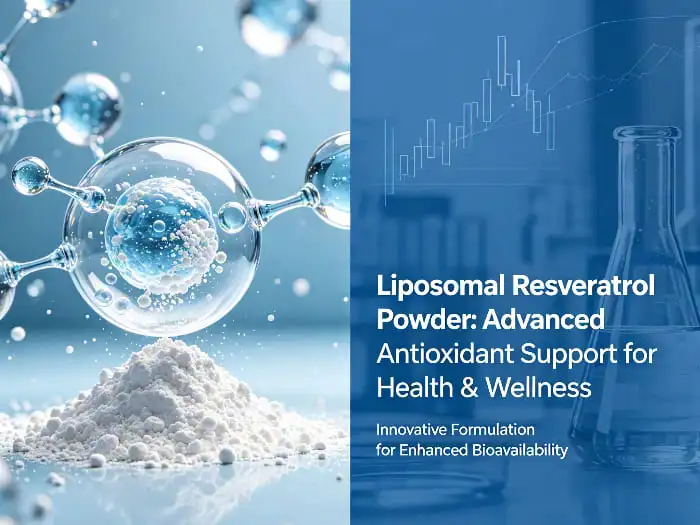
Understanding Liposomal Resveratrol Powder and Its Unique Advantages
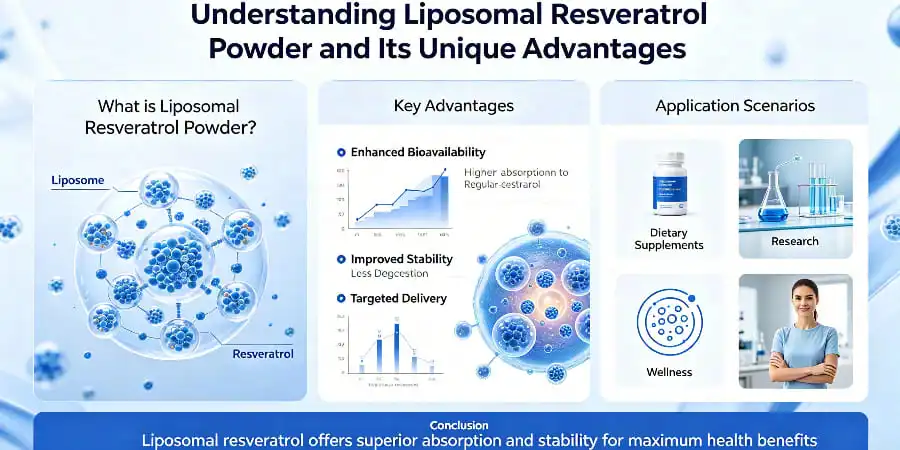
Liposomal transport methods are a big step forward from the way resveratrol has been used in the past. At EmerWell, we work with this advanced ingredient format every day, and the change in performance measures is huge. The "brick dust problem" for standard resveratrol is that it doesn't dissolve well in water and is broken down quickly in the liver, leaving less than 1% available in the body. The nature of liposomal resveratrol powder completely changes this equation.
What Makes Liposomal Encapsulation Different?
The method puts resveratrol molecules inside lipid bilayer particles that are usually between 100nm and 300nm across. These nanoparticle carriers are made to look like cell membranes, which lets them attach to intestine epithelial cells and send payloads straight into the bloodstream. The phospholipid shield, which is generally made from non-GMO soy or sunflower lecithin, shields the antioxidant from damage caused by oxidative stress, UV light, and changes in pH in the digestive system. This defense keeps the chemically active trans-resveratrol isomer and doesn't let it change to the less useful cis-form.
Quantifiable Performance Improvements
When making vitamins for the healthy aging and life markets, absorption rates have a direct effect on how customers feel about them and how often they buy them. In vitro tests show that properly manufactured liposomal resveratrol powder achieves encapsulation efficiency of over 85–90%, which means that most of the active molecules stay safe inside the vesicles. When mixed with liquid, these powders make stable milky mixtures that don't separate, which is important for using them in drinks and getting people to like them. The zeta potential is usually between -20mV and -40mV, which means there is enough electric friction to keep particles from sticking together while they are being stored on a shelf.
Application Versatility Across Product Categories
Because liposomal resveratrol powder is amphiphilic, it can be combined with other ingredients in ways that aren't possible with regular ingredients. Nutraceutical companies put it in pills and packs for NMN synergy products that aim to boost cellular energy and activate the sirtuin pathway. Functional beverage makers like the water-dispersible form because it hides the naturally bitter and chalky taste of resveratrol without adding too many sweets. Beauty-from-within makers use the increased permeability to make nutricosmetic formulas that fight photoaging and keep the skin matrix healthy. The main benefit that all of them share is that active chemicals are reliably delivered to target organs.
Challenges in Formulating with Resveratrol: Why Liposomal Formulation Matters
Traditional resveratrol ingredients are hard to formulate because they cause problems with both the ease of production and the performance of the final product. When mixed with water, raw resveratrol powder sits on top or forms gritty precipitates that sink to the bottom of drinks. Because the substance is sensitive to light, air, and temperature, it is not always stable when it is being processed or stored. Because of these technical issues, formulators have to use higher doses to make up for bad absorption. This raises the cost of the raw materials and puts end users at risk of stomach problems. Liposomal resveratrol powder provides the structural innovation to overcome these technical limitations.
Overcoming Solubility and Stability Barriers
Through structure creativity, liposome encapsulation gets around these problems. The lipid sheath breaks down the hydrophobic resveratrol molecule, making a system that spreads out evenly in both water and fat. It's easier to make pills, hard capsules, soft creams, and ready-to-drink drinks when they can work with both types of materials. The barrier makes the shelf life much longer; according to ICH stability rules, properly made liposomal powders stay active for 36 months, while normal resveratrol ingredients stored under controlled conditions only last 12 to 18 months.
Key Formulation Principles for Success
To get the best results, you need to pay attention to a number of technical factors. The quality of the raw material is very important—the resveratrol level should be at least 98% to make sure that the vesicles form consistently. Particle size distribution needs to be tightly managed, and polydispersity index values below 0.3 mean that liposome populations are all the same. The lipid-to-active ratio needs to find a balance between how well the powder encapsulates and how quickly it can be reconstituted. Formulation teams have had a hard time when they don't do pilot-scale stable testing under hurried conditions. Changing the temperature, exposing the product to humidity, and doing pH stress tests can find problems before they happen in full production.
Real-World Performance Data
One nutraceutical company came to us after getting mixed comments from customers about their regular resveratrol pills. Each dose of their recipe had 500 mg of a normal ingredient, but biomarker testing showed that end users had very low plasma levels. We changed the recipe and used liposomal delivery to give 150 mg per serving, which is less than a third of the original amount. This led to better blood concentration curves with better Cmax and area-under-curve measures. The brand cut the cost of raw materials by 40% while also making the products work better, which increased both earnings and customer engagement.
Comparative Analysis: Choosing the Best Liposomal Resveratrol Powder
When making a procurement choice, you have to look at more than just the unit price. Different types of delivery, like pills, normal powders, and liposomal resveratrol powder, each have their own pros and cons that affect the total cost of ownership and the chance of making money.
Performance Metrics That Matter
Liposomal powders are clearly better at absorption rates and recipe flexibility. Standard resveratrol products need 250–500 mg to have a small effect on the body's systems. Liposomal forms, on the other hand, have bioavailability that is the same as or better at 50–150 mg doses. Because the amount has been lowered, the capsules are smaller, they weigh less, and it costs less to make each one. The water-dispersible nature of liposomal powders makes them great for use in drinks because they don't cause the sediment and bad mouthfeel problems that come with regular resveratrol solutions.
Cost Considerations and Value Analysis
Getting liposomal ingredients for the first time usually costs two to three times as much as getting regular resveratrol pills. However, a full cost study shows that the economics are good when dose reduction, better stability, and better user results are taken into account. Products made with effective ingredients are positioned as special, can support higher market prices, and have a higher customer lifetime value because customers buy them again and again. In the crowded supplement market, where customers want more openness and results, brands that can back up their claims of effectiveness with absorption data stand out.
Vendor Evaluation Criteria
There are a lot of things that need to be thought through when choosing a trusted source. Manufacturing qualifications prove that quality systems work; look for factories that have cGMP, ISO 22000, and HACCP certifications from well-known inspection groups. Analytical testing skills show technical know-how, and in-house methods for particle size analysis, figuring out packaging efficiency, and keeping an eye on stability show a dedication to product consistency. Resilience in the supply chain is very important. Suppliers who get their raw materials from both Europe and North America reduce the chances of problems. Help with documentation speeds up regulatory approvals; pre-made dossiers that cover FDA, EU Novel Food, and ASEAN GMP standards can cut market entry times by months.
Strategic Synergies with Complementary Ingredients
Some brands that are on the cutting edge use liposomal resveratrol powder along with other advanced delivery ingredients to make new product ideas. When combined with liposomal quercetin, they work together to create stronger antioxidant pathways and better support for blood vessels. Co-formulation with NMN or nicotinamide riboside targets NAD+ metabolism and cellular energy production, which will appeal to people who want to live longer. It is mixed with marine collagen peptides and vitamin C by people who make beauty supplements to improve skin health all around. These methods work together to make more market possibilities while taking advantage of the bioavailability benefits that liposomal delivery offers for a number of active drugs.
Procurement Strategies for Liposomal Resveratrol Powder: Maximizing ROI
Decisions about strategic sources affect both the short-term costs of a project and the long-term success of a business. Having good ties with suppliers gives you a competitive edge that lasts beyond the start of a single product using liposomal resveratrol powder.
Supplier Selection and Relationship Development
Reliable partners show their technical know-how through their research and development (R&D) and production facilities. At our plant in San Diego, we built the EncapsWell™ platform to help new supplement makers with the problems they have with formulation. Our main business, Wellgreen, runs production facilities that are cGMP-certified and have blockchain-enabled batch traceability. These facilities give high-end brands the quality assurance and paperwork support they need. When looking at possible providers, find out if they are willing to work with you on unique formulations, change particle sizes for specific uses, and help you build analytical methods.
Negotiating Favorable Commercial Terms
When you buy in bulk, you can get volume-based prices, which makes unit economics a lot better. Many sellers use tiered pricing to reward customers who buy from them on a regular basis. Customers who commit to buying at least 500 kg per month usually get better rates. Talk to your supplier about payment terms that will help you control your cash flow and build relationships at the same time. Creditworthy customers can often get net-30 or net-60 terms from established suppliers. Managing lead times keeps you from running out of stock and causing production delays. Make sure you keep up-to-date predictions and think about what safety stock amounts are best for your production schedule and how demand changes.
Regulatory Compliance and Documentation
To deal with foreign rules, you need providers who are very good at following them. Products that are going to be sold in the U.S. need to be GRAS-certified and follow FDA dietary supplement current good manufacturing practices. Novel Food compliance and, if necessary, EU organic licenses are needed for European marketing. Different Asian markets have different rules. For example, ASEAN GMP, Health Canada NHP regulations, and Australian TGA standards all have different paperwork needs. Suppliers with specific regulatory teams and pre-compiled technical dossiers speed up the approval process and make it easier for your quality assurance staff to do their jobs.
Logistics and Supply Chain Considerations
Shipping goods across international borders makes making purchases more difficult. When sending containers from Asian factories, the journey usually takes between 4 and 6 weeks. Air freight cuts the time to 7 to 10 days, but it costs a lot more. Restocking times are cut down by keeping goods in warehouses in target markets that are close by. EmerWell keeps warehouses in the U.S. for quick sample shipping and just-in-time inventory support. Temperature-controlled operations keep products stable while they're being shipped. Liposomal powders can usually handle normal shipping conditions, but long-term stability can be affected by summer heat in buildings that aren't climate-controlled. Talk about different types of packaging that can keep out moisture and light during all stages of distribution.
Optimizing Formulation Performance and ROI with Liposomal Resveratrol Powder
Market stars are different from followers because they are always making their formulations and production methods better. When technical excellence is paired with operational efficiency, long-term competitive benefits are created through the use of liposomal resveratrol powder.
Addressing Common Formulation Bottlenecks
When going from lab production to industrial production, stability problems often come up. When mixing equipment doesn't produce enough shear forces for proper particle formation, encapsulation efficiency can go down. The way something is stored has a big effect on how long it will last; temperatures above 25°C speed up the breakdown of phospholipids and active compounds. Adding moisture to powder makes it harder for it to flow and can start hydrolysis processes. These risks can be reduced by using humidity-controlled packing, nitrogen washing, and the right kind of desiccant. Monitoring the stability of a formulation on a regular basis under fast conditions finds flaws in the formulation before they affect the finished product.
Quality Control and Analytics
Consumers and regulatory bodies expect stability from batch to batch, which is why strict testing methods are used. Using dynamic light scattering to measure particle size shows that the liposome diameter is within the acceptable levels. High-performance liquid chromatography measures the amount of resveratrol present and checks that the percentage of trans-isomers stays above the acceptable range. Zeta potential tests check the security of colloidal particles and predict their tendency to stick together. Dissolution testing checks how well the substance reconstitutes and how quickly it is released, which is important for absorption. A third-party proof of analysis from an approved laboratory gives customers peace of mind because it is an independent confirmation.
Manufacturing Efficiency and Cost Optimization
The ideas behind lean production cut down on waste and boost output without lowering quality. Standardized work directions and training for operators cut down on variation and extra work. Maintenance plans for equipment keep it from breaking down without warning, which can throw off output schedules. Inventory management systems find the best mix between the supply of raw materials, the need for working capital, and the shelf life of ingredients. Energy-efficient encapsulation methods, like the ones we use, produce 30% less solvent trash than the norm, which is better for the earth and saves money on dumping costs.
Emerging Trends and Innovation Opportunities
Staying ahead of how the market changes sets brands up for long-term growth. The next wave of packaging technologies promises even more stable profiles and higher loading capacities. Clean-label formulas with few fillers and easy-to-recognize ingredient names are becoming more and more popular among consumers. Concerns about the environment lead to a need for green phospholipid sources and less waste from packing. Personalized nutrition trends open the door to making formulas that are special to genetic traits or health measurements. As the market changes, brands that can predict these changes and make changes to their product strategies will stay relevant.
Conclusion
Supplement development goes from being a market competition to creating value through strategic formulation and improved transportation systems. Liposomal resveratrol powder has measured benefits in terms of bioavailability, stability, and recipe flexibility that have a direct effect on how well a product sells. The improved absorption, which has been shown to be 14 times better than regular ingredients, lets doses be lowered, costs be optimized, and user results get better. When brands value supplier capability, legal compliance, and technical help in their procurement strategies, they can quickly enter new markets and stay ahead of the competition. Using lipid capsule technology to solve common resveratrol problems helps companies make unique goods that can command higher prices and give better returns on investment in the nutraceutical, functional food, and beauty supplement markets.
FAQ
What safety data supports long-term use of liposomal resveratrol in supplements?
There is a lot of information about how safe resveratrol is because it has been studied for decades and is sold in supplements. The phospholipid parts used in liposomal products, mostly phosphatidylcholine from sunflower or soy lecithin, are FDA-approved as generally safe (GRAS) and are found in many foods and vitamins. Toxicology tests on liposomal delivery methods show that the suggested doses are very safe. To support regulatory submissions and answer possible customer questions, brands should make sure that providers provide full safety paperwork. This should include genotoxicity studies and repeated-dose toxicity data.
How do manufacturers determine appropriate dosages for different product applications?
How much to give relies on the effects on the goal biomarker, where the customer is in the market, and a study of the competition. The clinical research on resveratrol bioavailability gives us a starting point. However, liposomal formulations need lower amounts than usual because they are absorbed more quickly. Products that aim to help the body's antioxidant defenses usually have 50 to 100 mg of liposomal resveratrol per dose. On the other hand, products that focus on heart health or long life may have 100 to 200 mg. Working with providers that offer absorption modeling and in-house tests can help you choose the best dose for your needs and your budget.
Why does sourcing from certified suppliers matter for commercial supplement brands?
Certification proves that suppliers have quality control methods that meet global standards. cGMP compliance makes sure that production methods are always the same, that equipment is well taken care of, and that employees are properly trained. ISO 22000 and HACCP licenses show that you can handle food safety, which is very important for keeping consumers safe. Third-party reporting by well-known groups offers independent confirmation that builds trust with customers and meets the needs of retailers. By using documented quality assurance methods, brands that only buy from certified sellers lower the risk of poor quality, make it easier to meet legal requirements, and protect their image.
Partner with EmerWell for Premium Liposomal Resveratrol Powder Solutions
Through our own EncapsWell™ liposomal platform, EmerWell turns formulation problems into ideas that are ready for the market. As a reliable provider of liposomal resveratrol powder, we use Wellgreen's cGMP-certified production and research led by PhDs to make sure that the ingredients we send to global supplement brands meet their strict standards. Our team in San Diego offers regional technical support, quick sample delivery, and full formulation support from the initial idea to the product's sale. We offer a range of dosage forms, customized particle specs, and bulk price structures starting at 500 kg per month, whether you're making longevity capsules, functional drinks, or nutricosmetic goods. Get in touch with our team at info@emerwell-bio.com to talk about your unique project needs and get access to analysis data that shows how well our encapsulation works and how stable it is. We give ambitious brands the technical quality and supply chain stability they need to win in the wellness business, which is very competitive.
References
Walle T, Hsieh F, DeLegge MH, Oatis JE, Walle UK. High absorption but very low bioavailability of oral resveratrol in humans. Drug Metabolism and Disposition. 2004;32(12):1377-1382.
Fangueiro JF, Andreani T, Fernandes L, Garcia ML, Egea MA, Silva AM, Souto EB. Physicochemical characterization of epigallocatechin gallate lipid nanoparticles for ocular instillation. Colloids and Surfaces B: Biointerfaces. 2014;123:452-460.
Shao J, Li X, Lu X, Jiang C, Hu Y, Li Q, You Y, Fu Z. Enhanced growth inhibition effect of resveratrol incorporated into biodegradable nanoparticles against glioma cells is mediated by the induction of intracellular reactive oxygen species levels. Colloids and Surfaces B: Biointerfaces. 2009;72(1):40-47.
Zu Y, Overby H, Ren G, Fan Z, Zhao L, Wang S. Resveratrol liposomes and lipid nanocarriers: comparison of characteristics and inducing browning of white adipocytes. Colloids and Surfaces B: Biointerfaces. 2018;164:414-423.
Amri A, Chaumeil JC, Sfar S, Charrueau C. Administration of resveratrol: What formulation solutions to bioavailability limitations? Journal of Controlled Release. 2012;158(2):182-193.
Pujara N, Jambhrunkar S, Wong KY, McGuckin M, Popat A. Enhanced colloidal stability, solubility and rapid dissolution of resveratrol by nanocomplexation with soy protein isolate. Journal of Colloid and Interface Science. 2017;488:303-308.
Online Message
YOU MAY LIKE
High quality furniture manufacturer
_1776234266736.webp)