Aug 14, 2026
All about glutathione: definition, benefits, dosage, and more
Glutathione stands as one of the body's most powerful antioxidants, yet many formulations struggle with poor absorption—a challenge that advanced delivery technologies now address. Liposomal glutathione powder leverages microscopic phospholipid vesicles to encapsulate and protect glutathione molecules, dramatically improving cellular uptake compared to conventional forms. This comprehensive guide explores what glutathione is, how liposomal technology transforms its effectiveness, optimal dosing strategies, and critical considerations for B2B buyers seeking high-performance ingredients for nutraceutical, functional beverage, and cosmetic supplement formulations.
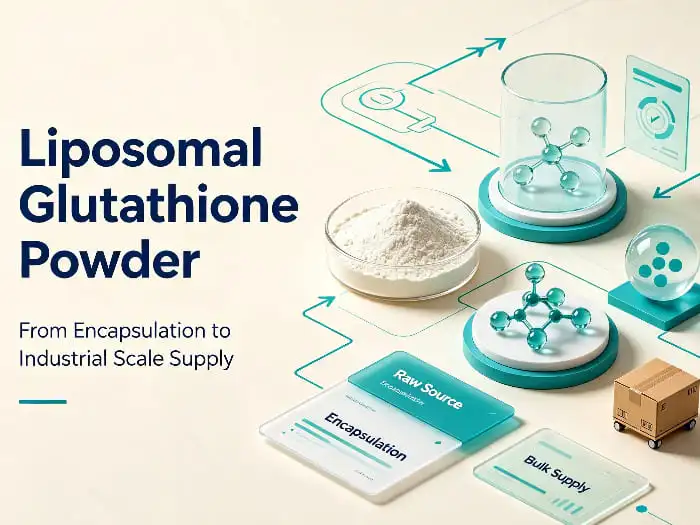
Understanding Glutathione and Liposomal Delivery Technology
What is Glutathione?
Glutathione is made up of three amino acids: glycine, cysteine, and glutamine. It is found in almost all of the body's cells and is the main antioxidant inside cells. It protects cell structures from free radical damage. In the body, the reduced form (GSH) gets rid of reactive oxygen species by giving them electrons. It also gets other antioxidants, like vitamins C and E, to work again. We naturally make less glutathione as we get older or when we are stressed out by outside factors. People who care about their health should take more supplements because of this.
This is because it's hard to measure bioavailability when taken by mouth. Traditional glutathione pills are broken down in the gut by acid and enzymes before they reach the rest of the body. Because of this obstacle to absorption, new ways of transporting drugs have been made, mainly liposomal encapsulation.
How Liposomal Encapsulation Works
Bilayers of phospholipids surround active ingredients in liposome technology in a way that looks like the structure of human cell membranes. Some of these spheres are 50 to 200 nanometers across. They protect glutathione from the harsh conditions in the digestive tract. It joins with cells right away when it gets to the wall of the gut and sends its meal into the bloodstream whole.
It has been shown in studies that liposomal systems can improve absorption rates up to 13 times higher than normal reduced glutathione powder. During the encapsulation process, it is very important to keep an eye on the particle size, the zeta potential (surface charge), and the efficiency of encapsulation. These are the things that make pharmaceutical-grade formulas different from other formulas of lower quality.
Reduced vs. Oxidized Forms
Product makers must distinguish between reduced (GSH) and oxidized (GSSG) glutathione. Antioxidants only operate when weak. Sulfhydryl groups, which allow electrons to donate, cause a pungent sulfur smell. Some items lack this scent because their ingredients have broken down or oxidized, rendering them less usable. Fermented using Saccharomyces cerevisiae enzymes, some excellent mixes retain over 95% of reduced glutathione. This preserves the chemically active L-configuration.
Health Benefits and Applications Across Industries
Cellular Protection and Detoxification
Glutathione sticks to heavy metals and toxins and makes it easier for the liver to get rid of them. This method works really well for businesses that make useful drinks and foods, like detox drinks and health shots. Antioxidants do more than just protect the liver. They also help cells make energy and protect mitochondria from oxidative damage. These are all benefits that people who want to stay healthy and live longer will like.
Medical food and drug companies that make specialized medicines might be able to use glutathione's ability to keep cellular redox balance in clinical nutrition practices. It can turn back into other antioxidants, and it works better when mixed with coenzyme Q10, vitamins C and E, or both.
Immune System Support
Glutathione makes the immune system work better by helping T cells and natural killer cells grow. The people who are making vitamins that boost the immune system know that having more glutathione is linked to better protection against germs. Because of this, supplement companies can use it to help with seasonal health problems or immune system issues brought on by worry. Bioavailability is always high with liposome delivery, which meets the needs of customers who want goods that work.
Skin Health and Nutricosmetics
The "beauty-from-within" crowd loves glutathione because it makes skin look better. Stopping tyrosinase, the enzyme that makes melanin, changes the color and shine of skin. There are collagen drinks, skin tablets, and anti-aging shots that contain it because clinical studies show that it makes skin lighter and more flexible. Liposomal glutathione powder is increasingly included in these formulations because its liposomal delivery enhances absorption, ensuring that more active glutathione reaches the bloodstream. Oxidative stress, which is linked to getting old quickly, is also fought by the antioxidants. Because the goods work in two ways, the marketing claims are more true.
Comparison with Alternative Antioxidants
Glutathione is not the same as N-acetylcysteine (NAC) or vitamin C in a number of ways. When you take liposomal forms of NAC, it skips the step of being turned into glutathione and starts working right away as an antioxidant. Vitamin C helps the body clean more than glutathione, but not as much on its own. For R&D managers who are making full antioxidant solutions, glutathione is the most important antioxidant because it helps all the other ingredients work better.
Dosage Guidelines and Formulation Strategies
Industry-Specific Dosing Recommendations
The right amount to take relies on the product and the outcome you want. Most nutraceutical pills have between 250 mg and 500 mg per dose. As an antioxidant, daily amounts in this range are good for your health. It depends on how well the drink works, how good it tastes, and how much it costs to make the formula. Functional drinks can have anywhere from 100 mg to 250 mg. Sometimes, 500 to 1000 mg per day is used as a therapeutic amount in medical diet items. QA/QC teams that know the rules, though, need to keep an eye on these uses.
Because they are absorbed better, liposomal formulations work better than other types even when used in smaller amounts. This lets the company that makes the product lower the cost-per-serving while still saying that it is competitively effective. This is very helpful in markets where price is important.
Formulation Considerations for Stability
To keep glutathione steady over the course of its shelf life, a number of things must be taken into account. The reduced form turns into an oxide when it comes in touch with water, heat, or UV light. Because of this, it needs to be kept below 25°C in dry, clear containers. Turning yellow is a sign of oxidation and loss of strength. Good providers offer more steady data that shows that the drug's effectiveness lasts for 24 months in controlled circumstances. This is useful knowledge for buying managers who plan how long to keep items in stock.
Standard glutathione can stick together, but liposomal powders that dissolve in water don't do that and are easy to mix into drinks that are already made. The sulfurous taste is also hidden by the phospholipid coating. This helps the development teams find the best flavors. When you co-encapsulate things with ingredients that work well together, like vitamin C, you can make them more stable and valuable, which makes people want them more.
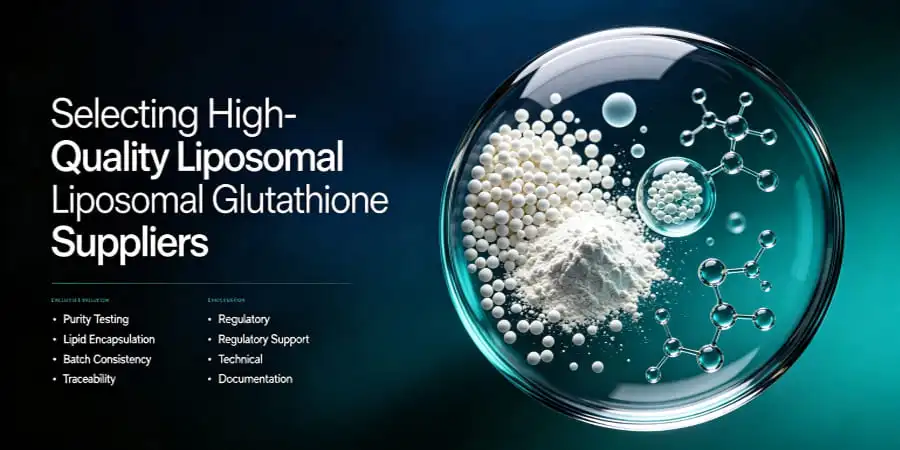
Selecting High-Quality Liposomal Glutathione Suppliers
Critical Quality Indicators
People who buy from other businesses should choose sellers who offer detailed analytical paperwork. It was tested using High-Performance Liquid Chromatography (HPLC) to make sure the product has the right amount of glutathione (≥95% for elite grades), and it was tested to make sure the active ingredients are inside liposomes and not just moving around as powder. By measuring particle size with Dynamic Light Scattering (DLS), you can be sure that the nanostructure is uniform in the 50–200nm range. This makes absorption better. A reading of the zeta potential shows that the support will stay in place for a long time.
If an approved lab tests something, it backs up what the maker says and lowers the risk in the supply chain. There should be a Certificate of Analysis (COA) for each batch that shows heavy metal screening (lead, cadmium, mercury, and arsenic) that is within FDA and EPA standards. The COA should also list checks for microbial contamination and allergy statements. Government officials like it when sellers make it easy to follow their goods from the time they get the raw materials to the time they are packed.
Certification and Compliance Standards
A business that has manufacturing certifications shows that it cares about quality. Check for cGMP (current Good Manufacturing Practices) approval. This makes sure that the methods used to make the drugs are up to code. This shows that ISO 22000 and FSSC 22000 are good at managing food safety. This is especially important when it comes to food. If you have HACCP certification, it means you know how to use key control points and hazard analysis to keep food clean.
Certifications that are specific to a market make it easy to get goods to more people. You can sell your goods in some Middle Eastern and Western markets if they are certified as HALAL or Kosher. People who buy clean labels want the Non-GMO Project and food groups to say that the products are safe. Liposomal glutathione powder is one such ingredient that benefits from these certifications, as its enhanced bioavailability and stability appeal to both clean-label shoppers and regulatory bodies. The EU Novel Food Regulation and the FDA DSHEA (Dietary Supplement Health and Education Act) alignment make it easy for countries to deal with each other. This speeds up the process for big brands to get their goods on store shelves.
Evaluating Fermentation vs. Synthetic Sources
Premium glutathione is made by fermenting sugar cane with Saccharomyces cerevisiae enzymes. This makes an L-configuration, which is the same shape found in human cells. This natural way of making things fits with the trend toward clean labels, and customers usually like it better than choices that are made in a factory. Suppliers should show proof that the ingredients were fermented and explain how they cleaned them to get rid of yeast residue while keeping the antioxidant-active sulfhydryl groups.
The Science Behind Enhanced Bioavailability
Clinical Evidence for Liposomal Superiority
Pharmacokinetics reveals that liposomal packing alters glutathione absorption. Glutathione breaks down in the stomach when taken orally; therefore, blood levels don't increase substantially. However, liposomal variants elevate blood levels within 30–60 minutes and maintain them for 8–12 hours. Due to this continuous flow, therapeutic doses are dosed less frequently, making treatment programs simpler to follow.
The phospholipid barrier protects glutathione from oxidative and chemical damage while being stored and broken down. Liposomes hit gut enterocytes and form membranes that deliver GSH straight to cells without metabolism. In controlled experiments, bioavailability increased 13-fold due to this method.
Quality Control Through Advanced Analytics
People who make goods can tell the difference between companies that just sell basic goods and those that have very good quality control. Centrifugation-ultrafiltration is used to test how well encapsulation works and tell the difference between free and encapsulated glutathione. It's important to measure this because material that isn't enclosed doesn't help absorption. Packaging efficiency goals of 85% or more are usually set for pharmaceutical-grade goods.
Polydispersity Index (PDI) tests find out if the particle sizes are all the same. When the value is less than 0.3, the nanostructure is regular. When the value is greater than 0.3, the mixes are mixed and have different absorption properties. The product works the same way across production runs if the particle size and zeta potential are the same from batch to batch. This is important for contract manufacturers who need to make more private-label goods.
Future Innovations in Delivery Systems
A new study looks into ways to put glutathione inside a liposome along with substances that work well together, like curcumin, resveratrol, or omega-3 fatty acids. Multi-active formulations affect more than one biological process at the same time. This makes products from brands that focus on new ideas stand out. It's possible that personalized diet apps will one day be able to dose glutathione based on signs of oxidative stress, but these ideas are still in their early stages.
It keeps getting cheaper and better to encapsulate things as production technology gets better. With microfluidics and high-pressure homogenization, particle size can be precisely controlled when the process is scaled up while keeping the nanolevel accuracy that was reached in the lab. With these changes, liposomal formulations can be made more commercially at levels of up to 2,000 kg per month, which is what big nutritional brands and contract manufacturers who work with many clients need.
Procurement Strategies for B2B Buyers
Identifying Reputable Manufacturing Partners
That's not all you need to do to find good suppliers. You also need to do more than just compare prices. Technical data sheets (TDS) and safety data sheets (SDS) will tell you how to handle the material and how the government classifies it. Customers who have bought from well-known brands before can tell you a lot about how reliable, consistent, and technical-savvy a product is.
People who buy from suppliers who have already been checked out and shown they care about the professional nutritional field can meet at events like CPHI and Vitafoods, and they can also directly evaluate the manufacturer's credentials—for instance, by asking whether the liposomal glutathione manufacturer follows strict GMP standards and provides batch-specific stability data.
Minimum order quantities (MOQ) make it hard to plan how to buy things. You can come up with new recipes without spending a lot of money if you can find suppliers who are flexible and offer test runs starting at 10 kg. At the same time, being able to increase production to 2,000 kg per month helps growth paths for product launches that go well. Take a close look at the wait times. For unique specs, the production process can take up to six weeks, so you need to plan your supplies ahead of time.
Private Label and OEM Opportunities
When a company doesn't make its own goods, white-label and OEM services help them get their products on the market faster. Partners that cover a lot of areas help with labeling that is legal. They make sure that the nutrition facts and ingredient lists are legal in every area. Brands can stand out while still using the same production infrastructure by using powder sachets, capsules, tablets, and liquid shots as different types of packaging.
The best thing that modern service providers can offer is custom preparation. Different particle sizes can be used for different dissolution profiles. Flavors can be hidden with technologies, and active ingredients that work well together can be co-encapsulated to make goods that can't be directly compared with. Innovation teams work better when they work on R&D projects with suppliers whose knowledge is different from their own. This is very important for new brands that are making their first lines of products.
Cost Management and Bulk Purchasing
Special liposomal glutathione for drugs costs three to five times as much as regular reduced glutathione powder since it is made with more advanced technology. If you buy more than 100 kg every three months, you can save money, and bigger contracts are rewarded with different price levels. The higher absorption, on the other hand, is justified by marketing claims and the product's usefulness, which are what keep customers buying and make the brand money.
Sending products across the globe requires meticulous logistics, particularly for international customers. Because they don't need to be kept refrigerated, room-temperature actives offer substantially reduced freight costs. In large markets like the EU and US, shipments with COAs, certificates of origin, and declarations indicating they respect the regulations cross customs quickly. Buyers of pricey items should know the Incoterms (typically FOB or CIF) and make sure their insurance covers them.
Conclusion
This is because glutathione is the body's major antioxidant. It is also a key ingredient in nutraceuticals, useful foods, and beauty vitamins. The issue of normal bioavailability is fixed by liposome capsule technology, which raises blood levels and shields cells from free radicals in a way that other types can't. When B2B buyers choose suppliers, they should make sure that the suppliers have valid certifications, clear analytical testing, and proven manufacturing skills.
Glutathione powder bulk supplier selection is a critical part of this process, as it directly impacts raw material quality and traceability. This protects the products they sell and makes sure that the suppliers follow all the rules. Pharmaceutical-grade liposomal mixtures are worth the money because they work better, make marketing claims that are more likely to be true, and most importantly, make customers happy so they will stick with the brand.
FAQ
Why does quality glutathione powder have a sulfur smell?
Active sulfhydryl (-SH) groups that contain sulfur are what give things their smell. This is the part of the molecule that allows it to be an antioxidant. When a product doesn't have this smell, it means that the material has broken down or corroded, which makes it less useful. Reliable sources don't try to hide this natural feature by treating it in a way that could damage its bioactivity. Instead, they use it as proof that the glutathione is real and lower.
What certifications matter most for nutraceutical applications?
When it comes to pharmaceuticals, cGMP certification makes sure that the controls used during production are up to par. For food safety, ISO 22000 and HACCP certification show that management systems are in place. People want clean labels, and the Non-GMO Project and veggie guidelines give them what they want. There are more ways for things to get to customers when there are rules that are specific to the market, like EU Novel Food compliance, HALAL, or Kosher standards. When buying something, the people who are in charge should make sure that the certifications are specific to the glutathione line and not just general building credentials.
How does liposomal glutathione compare to NAC supplements?
NAC is a building block that cells use to make glutathione, which is a molecular process that takes more steps. Liposomal glutathione gives you the active reduced form right away, so you don't have to go through the change step. This means you get antioxidant power right away. NAC is still useful for lung health preparations, but straight glutathione supplementation is more useful and more likely to be bioavailable to help the body's antioxidants work better.
What storage conditions prevent glutathione degradation?
Things should be kept below 25°C in boxes that are airtight, don't let water in, and block UV light. To show oxidation and lack of strength, something turns yellow. Sellers who are good at what they do offer quick, stable tests that show how well the product works at different levels of humidity and temperature. This information is useful for making plans about how to store and ship goods between climate zones.
Partner with EmerWell for Advanced Glutathione Solutions
We understand that sourcing a reliable Liposomal glutathione powder supplier demands more than competitive pricing—it requires a partner who delivers consistent quality, scientific rigor, and responsive support. At EmerWell, our San Diego-based R&D center houses a PhD-led technical team providing localized expertise throughout your formulation journey. Our proprietary EncapsWell™ platform achieves ≥95% glutathione content with 13× enhanced absorption, backed by third-party validated encapsulation efficiency and 24-month stability data.
With cGMP-certified production through our strategic manufacturing partner Wellgreen, comprehensive certifications including ISO22000, HACCP, Non-GMO, and Vegan, plus flexible OEM/ODM services spanning powder, capsules, and ready-to-drink formats, we transform your product concepts into market-ready formulations. Our local US warehousing ensures rapid sample delivery, while our technical support team assists with formulation optimization and regulatory documentation. Contact us at info@emerwell-bio.com to discuss how our pharmaceutical-grade liposomal glutathione can elevate your next product launch.
References
1. Jones, D.P. "Redefining Oxidative Stress." Antioxidants & Redox Signaling, 2006, 8(9-10): 1865-1879.
2. Schmitt, B., Vicenzi, M., Garrel, C., Denis, F.M. "Effects of N-acetylcysteine, oral glutathione (GSH), and a novel sublingual form of GSH on oxidative stress markers: A comparative crossover study. "Redox Biology," 2015, 6: 198-205.
3. Sinha, R., Sinha, I., Calcagnotto, A., Trushin, N., Haley, J.S., Schell, T.D., Richie, J.P. "Oral supplementation with liposomal glutathione elevates body stores of glutathione and markers of immune function." European Journal of Clinical Nutrition, 2018, 72(1): 105-111.
4. Witschi, A., Reddy, S., Stofer, B., Lauterburg, B.H. "The systemic availability of oral glutathione." European Journal of Clinical Pharmacology, 1992, 43(6): 667-669.
5. Richman, P.G., Meister, A. "Regulation of gamma-glutamyl-cysteine synthetase by nonallosteric feedback inhibition by glutathione. "Journal of Biological Chemistry, 1975, 250(4): 1422-1426.
6. Allen, J., Bradley, R.D. "Effects of oral glutathione supplementation on systemic oxidative stress biomarkers in human volunteers." Journal of Alternative and Complementary Medicine, 2011, 17(9): 827-833.
Online Message
YOU MAY LIKE
High quality furniture manufacturer